Lithium Battery Knowledge Center
Expert guides and technical references on lithium battery design, safety, certification and applications.
Engineering Case Studies
Real-world engineering analyses from THOR Power battery protection projects. Each case study documents technical challenges, methodologies, and findings.
View Case Studies →Battery Knowledge 8
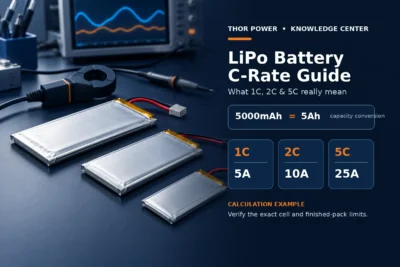
- 1LiPo Battery C-Rate Guide: What 1C, 2C and 5C Really Mean for OEM Devices
Convert LiPo C-rate to amps, diagnose voltage sag and heat, and learn how cell, PCM, wires and connectors determine real OEM current capability.
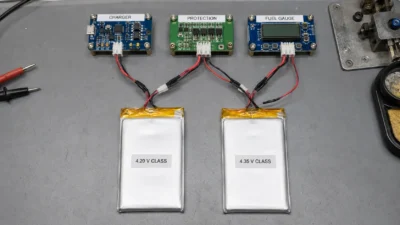
- 24.2V vs 4.35V Lithium Battery: Why the Same 1S Charger May Be Wrong
Compare 4.20V and 4.35V 1S lithium batteries by charger target, protection, fuel gauge, device voltage limits and OEM replacement evidence.
- 3LiFePO4 Battery Safety Engineering Guide: BMS, Cell Balancing, Compression and Energy Storage Risk Control
Learn how BMS protection, cell balancing, low-temperature charging control, compression, precharge and thermal design reduce LiFePO4 battery risks.
- 4Lithium-Ion Battery Safety Engineering Guide: Charging, BMS Protection, Thermal Runaway and OEM Risk Control
Learn how chemistry, charging, BMS protection, thermal design, aging control and production validation reduce lithium-ion battery safety risks.
- 518650 Battery Safety Engineering Guide: Cell Selection, Pack Design, BMS Protection and OEM Risk Control
Learn what causes 18650 battery thermal runaway and how cell matching, BMS protection, welding and insulation reduce pack fire risk.
- 6LiPo Battery Safety Engineering Guide: Thermal Runaway Causes, OEM Design Risks and Fire-Risk Reduction
Learn how OEM teams reduce LiPo battery fire risk: cell selection, charging control, PCM/BMS design, enclosure fit, testing and mass-production consistency.
- 7Home Energy Storage Battery Safety: What Causes Thermal Runaway and How Modern Battery Systems Reduce Fire Risks
How home energy storage battery safety depends on LiFePO4 chemistry, BMS protection, thermal management, pack design and standards like UL 9540A and NFPA 855.
- 8LiPo Battery vs. Li-ion Battery: Understanding the Real Differences
Compare LiPo and Li-ion batteries by geometry, current path, swelling, thermal design and safety to choose the right format for an OEM device.





Manufacturing & Quality 1
- 1How Thor Power Uses Material Optimization to Improve Energy Density and Safety in Custom LiPo Pouch Batteries
Learn how THOR Power uses cathode, anode, electrolyte and separator optimization to improve custom LiPo pouch battery energy density, safety and cycle life.

Buying & Customization Guides 4
- 1How Much LiPo Battery Capacity Does Your Device Need?
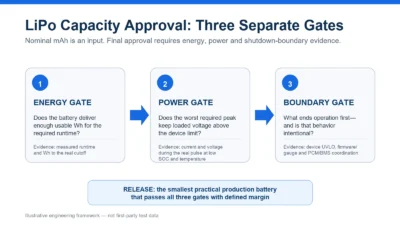
Calculate LiPo battery capacity from duty cycle, usable energy, peak current, cutoff voltage, temperature and end-of-life requirements for OEM devices.
- 2What Size LiPo Battery Fits My Device?
Learn why LiPo cell dimensions are not the finished battery size and how PCM, tabs, wires, connectors, tolerance and clearance affect device fit.
- 3How to Choose a PCM or BMS for a Custom Battery Pack: Chemistry, Current, Protection, Balancing and Validation
Learn how to choose a PCM or BMS by chemistry, series count, current, cutoff settings, balancing, temperature, charger, communication and validation.
- 4Custom Battery Pack Design Guide: Voltage, Capacity, Current, BMS and OEM Integration
Learn how to design a custom battery pack by defining voltage, runtime, peak current, BMS, charging, thermal control, validation and production requirements.


Battery Engineering 22
- 1LiPo Batteries for Wearable and Portable Medical Devices: OEM Design and Validation Guide
Choose a LiPo battery for wearable and medical devices by finished size, pulse current, NTC, charging, safety, transport and production validation.
- 2Custom LiPo Battery Prototyping: From Device Requirements to Mass Production
Learn how to move a custom LiPo battery from device requirements and engineering samples to production-intent validation, compliance and mass production.
- 3High-Discharge LiPo Battery: How to Validate Continuous, Peak and Pulse Current
Learn how to validate high-discharge LiPo batteries using real load waveforms, voltage sag, PCM limits, pulse testing and production-intent samples.
- 4How to Maximize Usable Energy in a Small Custom LiPo Battery
Maximize usable energy in a small custom LiPo battery by optimizing cavity, PCM layout, cell geometry, pulse stability and production validation.
- 5How to Choose a Custom LiPo Battery for Smart and IoT Devices
Choose a custom LiPo battery for smart and IoT devices by duty cycle, pulse current, cutoff voltage, size, PCM/NTC, connector and production validation.
- 6LiPo Battery Connector Types: How to Choose Pitch, Wire and Polarity
Choose LiPo battery connector types by exact series, mating part, pinout, wire, current path, live-contact safety and production controls.
- 7LiPo Battery Dimensions: How to Choose the Right Size for Your Device
Choose LiPo battery dimensions using finished-pack size, tolerance stack-ups, PCM, connector clearance, load checks and production validation.
- 8Wearable LiPo Battery Design: Why 1 mm Thinner Can Be a Worse Product
Making a wearable 1 mm thinner can cut battery space by 20%. Learn how thickness affects runtime, voltage sag, heat, finished size and battery life.
- 9How to Fit a 5000mAh LiPo Battery in Limited Space
Compare 5000mAh LiPo battery sizes and finished pack envelopes. Use a cavity-first method to evaluate 6060100 fit, energy density and OEM validation.
- 10LiPo Battery Dimensions: Why a Cell That Fits in CAD May Not Fit Your Product
A LiPo cell that fits in CAD may fail after PCM, wires and tolerances are added. Learn how to calculate and validate finished battery dimensions.
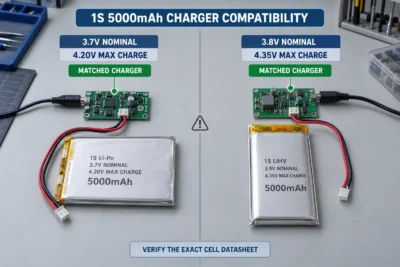
- 114.2V vs 4.35V 5000mAh LiPo Battery: Can the Same 1S Charger Be Used?
Need a 5000mAh LiPo battery replacement? Compare 4.2V vs 4.35V charging, PCM, fuel gauge, connector and OEM validation before choosing a replacement.
- 12LiPo Battery Standby Drain: Why Smart Devices Lose Charge While Off
Identify LiPo battery standby drain in smart devices. Separate self-discharge, quiescent current and device sleep current, then set a storage-life budget.
- 13Custom LiPo Battery Size Guide: How to Specify Pouch Cell Dimensions for OEM Products
Choose a custom LiPo battery size by thickness, width, length and finished-pack clearance. Check PCM, wires, connector and NTC before requesting an OEM sample.
- 14LiPo Battery Voltage Sag: Why Devices Shut Down Under Peak Load
Identify LiPo voltage sag under peak load. Separate cell, PCM, harness and device-side losses, then release the pack from measured voltage margin.
- 15Semi-Solid LiPo Battery: What OEM Engineers Should Validate
Compare a semi-solid LiPo battery by usable Wh, power, charge voltage, safety, swelling and lot consistency before approving an OEM pouch cell.
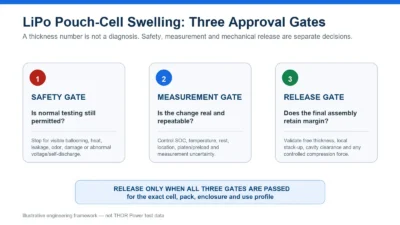
- 16How to Diagnose LiPo Pouch Cell Swelling in OEM Products
Learn how OEM teams separate reversible pouch-cell breathing from residual swelling, control thickness and force measurements, and validate enclosure margins.
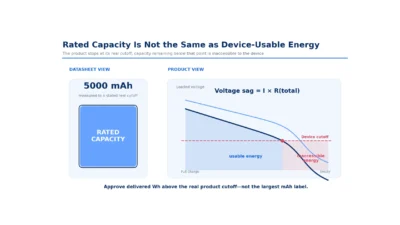
- 17How to Read a Lithium Battery Datasheet: Why Higher mAh Can Deliver Less Runtime
Learn why a higher-mAh lithium cell may shut down earlier under load by comparing capacity, resistance, voltage sag, cutoff and usable energy.
- 18Battery Pack Prototype Testing: From First Sample to Final-Device Validation
Learn how to test a custom battery pack from first sample through final-device and pilot-production validation, with clear acceptance and change control.
- 19Battery Pack Thermal Management Guide: Heat Sources, Hotspots, Sensor Placement and Validation
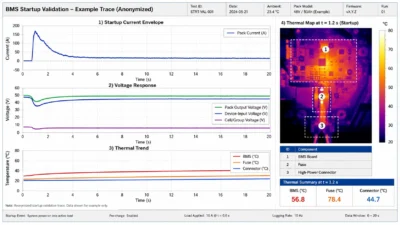
Diagnose battery-pack heat, locate hotspots, place temperature sensors, design cooling paths and validate thermal performance in the final OEM product.
- 20Battery Connector, Wire Gauge and NTC Selection Guide: Current Path, Voltage Drop, Crimping and Validation
Choose battery connectors, wire gauge and NTC sensors by current, voltage drop, crimp quality, polarity, temperature placement and validation.
- 21Series vs Parallel Battery Configuration: Voltage, Capacity, Current Sharing, BMS and OEM Pack Design
Compare batteries in series and parallel, calculate voltage and capacity, and understand current sharing, BMS, fusing, charging and validation risks.
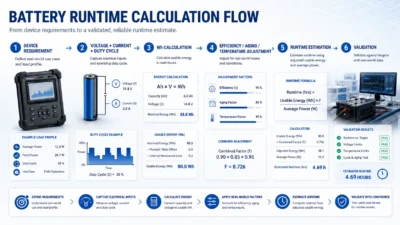
- 22Battery Runtime Calculation Guide: Ah, Wh, Load Profiles and Pack Sizing
Calculate battery runtime from Ah, Wh, load profiles, efficiency, cutoff voltage and aging margin, then size an OEM pack for real device conditions.