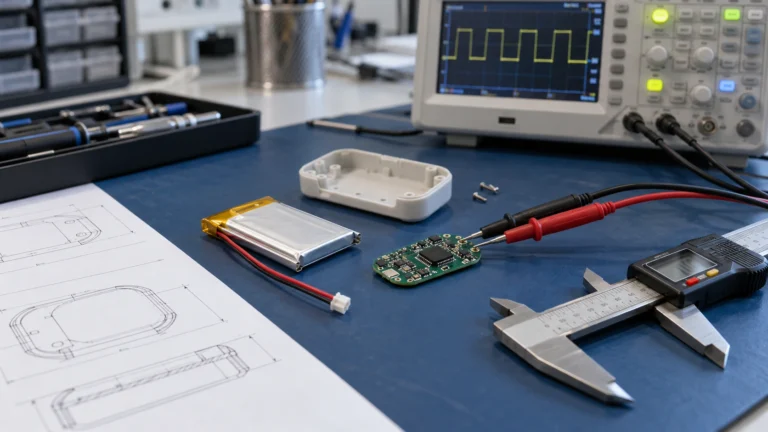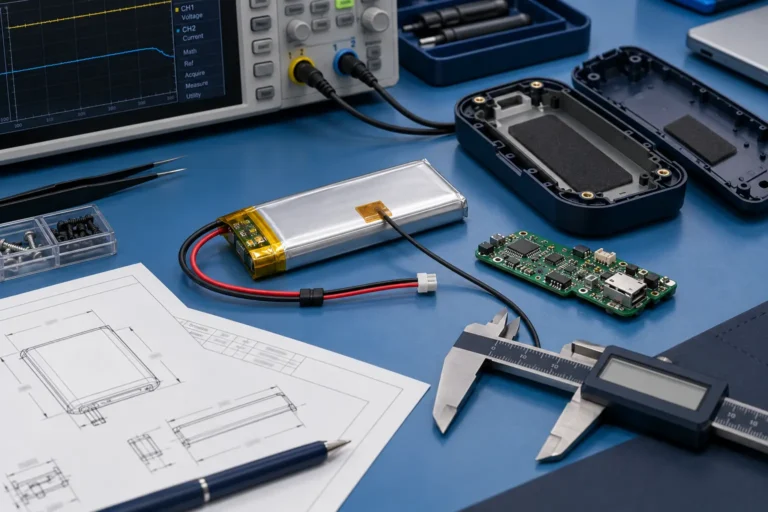
How to Fit a 5000mAh LiPo Battery in Limited Space
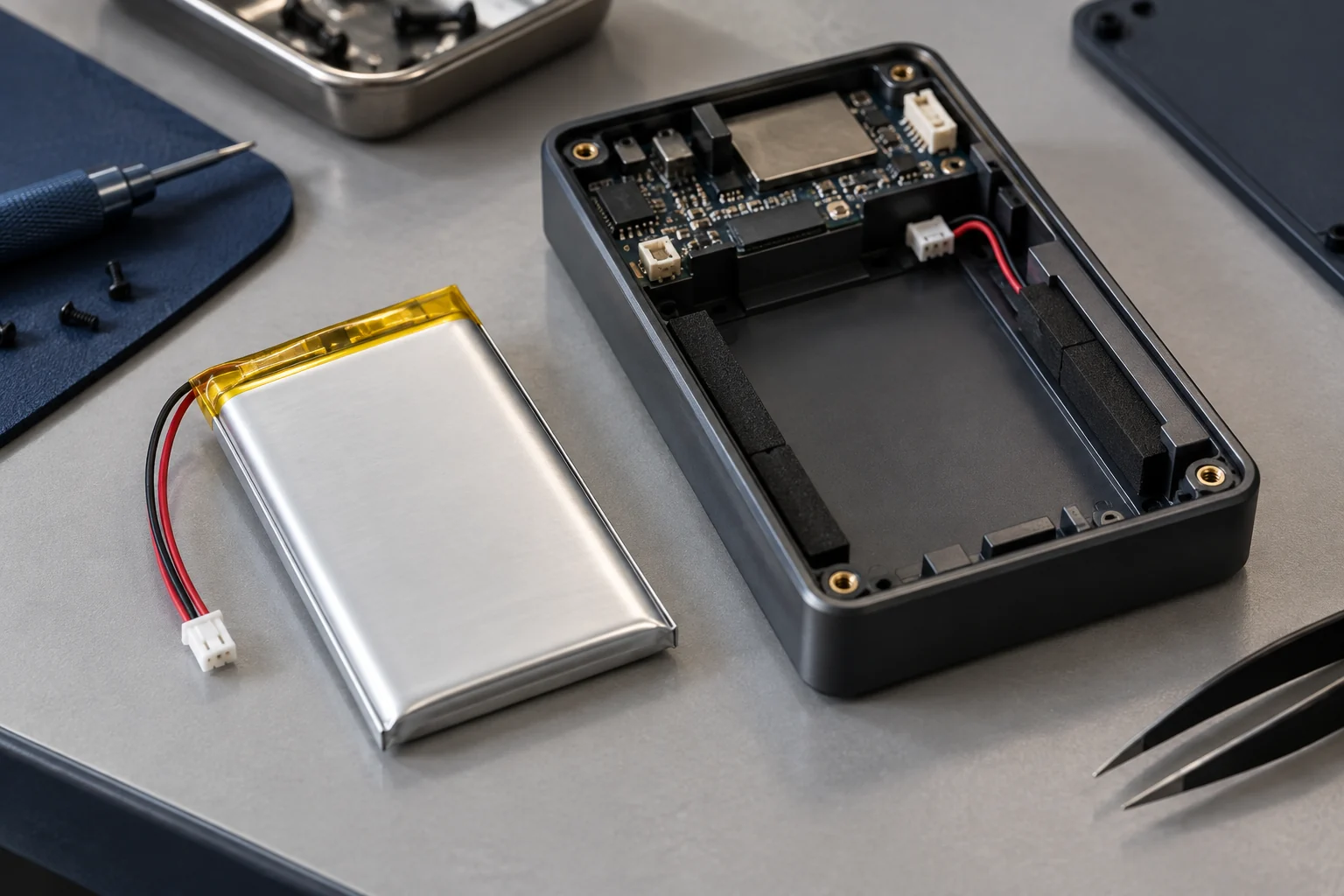

Technical reviewer: Dr. Maximilian Weber
Chief Scientist at THOR Power. Reviews battery engineering content for technical accuracy, test boundaries and production relevance.

Author: Victor Xiong
OEM Division President at THOR Power, focused on custom lithium battery development and manufacturing for device programs.
A cavity-first engineering guide to 5000mAh battery size, energy density, 6060100 selection and OEM validation
Quick Answer
A 3.7V, 5000mAh LiPo battery represents approximately 18.5Wh of nominal energy. When a device has a fixed battery cavity, the useful question is not simply “Which 5000mAh model is smallest?” It is whether that energy can be delivered in a finished battery assembly that fits the available thickness, width and length while still meeting the device’s current, charging, temperature, cycle-life and safety requirements.
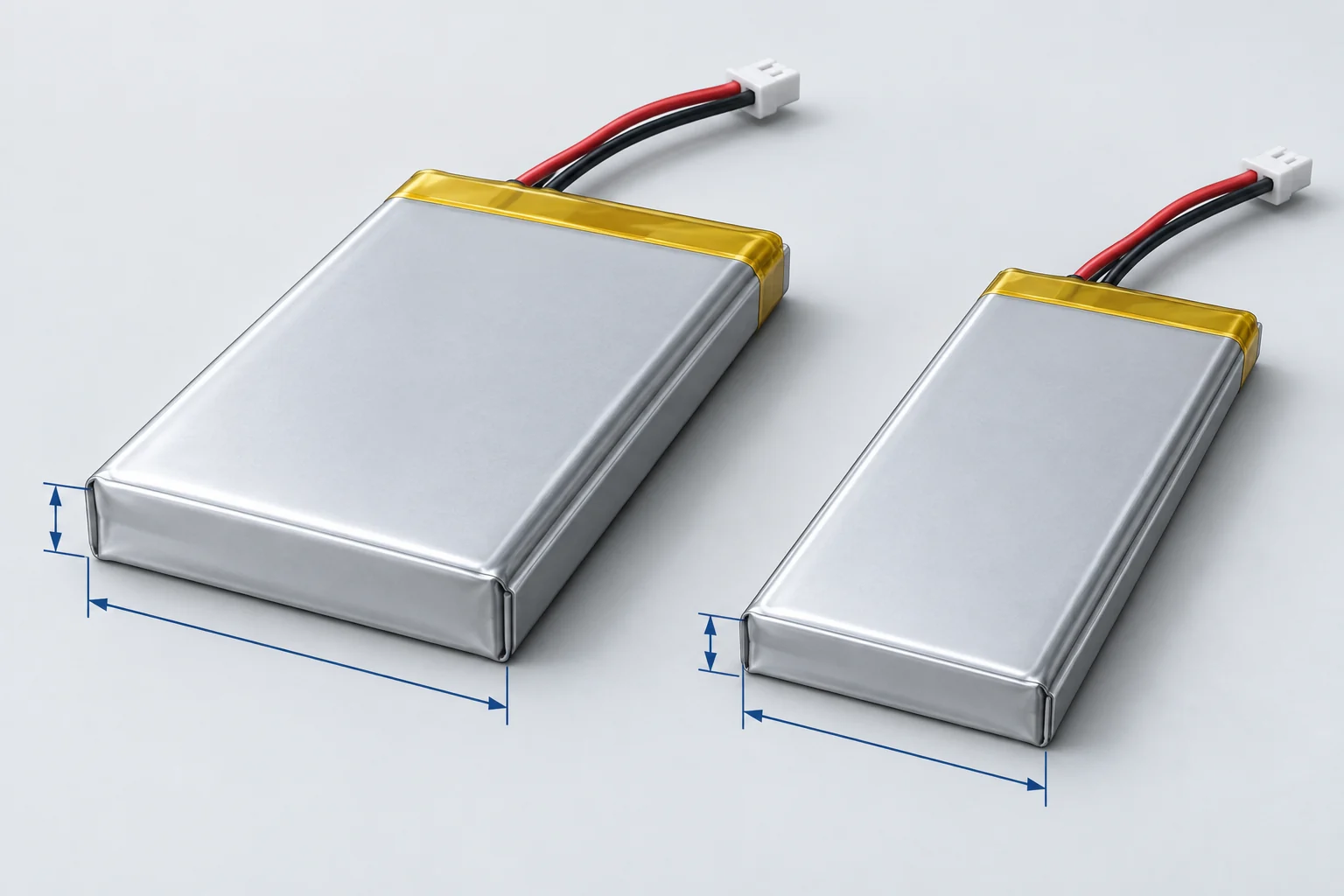
THOR Power lists multiple 5000mAh pouch geometries. Two current examples are THOR-7062100 at about 7 × 62 × 102mm and THOR-6060100 at about 6 × 60 × 102mm. On those listed envelopes, the 6060100 occupies about 17% less rectangular volume for the same nominal 18.5Wh target. That makes it a useful compact-space example, but the comparison is a geometric screening tool, not proof of higher measured cell-level Wh/L. Final approval requires the controlled drawing and production-intent sample.
BUYER TAKEAWAY / Start from the finished battery space and required runtime. Use mAh and Wh/L to screen candidates, then approve the exact cell only after checking current capability, charger compatibility, finished dimensions, life target and real-device performance.
Table of Contents
- Start With the Finished Battery Space
- A Worked Comparison: 7062100 vs 6060100
- What “Higher Energy Density” Actually Means in This Decision
- What to Verify Beyond the Dimensions
- A Cavity-First Selection Workflow
- If 6060100 or Another Listed 5000mAh Model Still Does Not Fit
- THOR Power Engineering Note
- What to Send for an Engineering Review
Start With the Finished Battery Space
Define the maximum finished-battery envelope before choosing a model. Measure the usable cavity after enclosure tolerances, ribs, adhesive, foam, PCB keep-out areas and the space needed for the PCM, wires and connector. Record thickness, width and length separately. A battery with a smaller total volume can still fail to fit if one axis, the local PCM high point or the wire-exit location exceeds its limit.
Capacity, energy and usable runtime are related but different. The nominal 5000mAh rating is measured under a specified test method. At 3.7V it corresponds to about 18.5Wh, while the energy the device actually uses before cutoff depends on load current, temperature, voltage sag, system losses and the device’s minimum operating voltage. Begin with the runtime and load profile, then decide whether 5000mAh is the correct target.
For an early feasibility screen, divide the nominal energy target by the maximum permitted finished-battery envelope in liters. This produces a required pack-envelope energy index. It is intentionally different from a laboratory cell-level energy-density result because the envelope can include protection and packaging space, and the actual cell volume and test conditions may not yet be controlled.
Required pack-envelope energy index = required nominal energy (Wh) ÷ maximum finished envelope (L)
This boundary discipline matters. Son and colleagues showed why specific-energy and energy-density comparisons can become misleading when material-, electrode-, cell- and pack-level calculation boundaries are mixed. Read the calculation-boundary study.
A Worked Comparison: 7062100 vs 6060100
The current THOR Power catalogue lists both models at 3.7V and 5000mAh. The values below use the listed overall envelopes for screening. They should not be interpreted as verified bare-cell dimensions or released project tolerances.
| Catalogue metric | THOR-7062100 | THOR-6060100 |
|---|---|---|
| Listed T × W × L | 7 × 62 × 102 mm | 6 × 60 × 102 mm |
| Nominal capacity | 5000mAh | 5000mAh |
| Nominal energy at 3.7V | ≈18.5Wh | ≈18.5Wh |
| Rectangular envelope volume | 44.27cm³ | 36.72cm³ |
| Nominal energy / listed envelope | ≈418Wh/L | ≈504Wh/L |
On this screening basis, 6060100 uses approximately 17% less rectangular envelope volume, while its nominal-energy-per-envelope index is approximately 21% higher. The practical advantage is not the percentage by itself: the model reduces listed thickness by 1mm and width by 2mm while keeping the same listed length. Those two millimeters can decide whether the pack clears a cover, rib or PCB edge.
For example, in a hypothetical usable cavity of 6.5 × 61 × 105mm, 6060100 passes an initial axis-by-axis screen, while 7062100 exceeds both the thickness and width limits. The 6060100 still is not automatically approved. A finished drawing must confirm tolerance, PCM high points, wire exit and connector routing, and the real sample must fit without forced compression.
Equally important, the geometry does not establish that 6060100 uses a different chemistry, has higher measured cell-level Wh/L, delivers the same current, or provides the same cycle life. A valid energy-density claim needs measured energy and a consistent volume boundary for both released configurations.
What “Higher Energy Density” Actually Means in This Decision
Higher energy density is useful only when it solves the customer’s package problem. In a limited-space 5000mAh project, it means placing the required usable energy into less controlled cell or pack volume without making the electrical and life performance unacceptable. When an emerging chemistry is being considered, the same comparison should include semi-solid LiPo battery validation under production-intent electrical, mechanical and life conditions.
| Metric | What it answers | Common mistake |
|---|---|---|
| mAh | How much charge is delivered under a defined test method? | Treating 5000mAh as a physical size or a power rating. |
| Wh | How much nominal energy is associated with the voltage and capacity? | Comparing different voltage classes by mAh alone. |
| Cell Wh/L | How much measured energy is stored per controlled cell volume? | Using a model-code box or finished-pack envelope as if it were measured cell volume. |
| Pack-envelope Wh/L | How much nominal or measured energy fits inside the product-level battery envelope? | Presenting a screening index as intrinsic chemistry performance. |
| Usable device energy | How much energy reaches the product before its cutoff under the real load? | Assuming rated Wh equals runtime in the final device. |
At cell level, higher Wh/L can come from several design levers: more active material per unit area, higher electrode density, lower inactive-material fraction, optimized separator/current-collector use, improved electrolyte utilization, or a different validated voltage window. These levers can increase stored energy, but they can also change ion transport, resistance, heat generation, manufacturing tolerance and aging behavior. That is why a compact 5000mAh pouch should be treated as a different engineering solution, not as a standard cell that has simply been “compressed.”
For a deeper discussion of electrode and material design, see the THOR Power high energy density LiPo guide. This page stays focused on the OEM decision: whether a specific 5000mAh solution fits and performs in the customer’s device.
What to Verify Beyond the Dimensions
| Engineering question | Evidence required before approval |
|---|---|
| Will it really deliver 5000mAh / 18.5Wh? | Capacity and Wh test method, charge voltage, discharge current, cutoff voltage, temperature, sample count and production tolerance. |
| Will it power the device? | Continuous and peak current ratings, peak duration, voltage sag, PCM limit, wire/connector resistance and temperature rise at the real duty cycle. |
| Will it charge correctly? | Exact maximum charge voltage/current, charger accuracy, protection thresholds, NTC behavior and fuel-gauge profile. |
| Will it fit throughout service? | Controlled finished drawing, tolerance, local high points, assembly method, life-related dimensional allowance and real-enclosure sample fit. |
| Will the “high energy density” claim be comparable? | Measured Wh, clearly defined cell or pack volume boundary, mass if Wh/kg is quoted, and identical calculation basis for the comparison. |
| Will it meet life and supply targets? | Capacity retention, resistance growth and dimensional behavior under the intended cycle/storage profile, plus production controls and change management. |
A higher energy-per-volume result is not a power rating. A compact cell can meet the 5000mAh target and still fail on pulse voltage, temperature or charging. Likewise, a 4.35V-class cell cannot be substituted for a 4.20V charging system without checking the exact cell, charger, PCM, fuel gauge and final device.
See the THOR guide to 4.2V vs 4.35V 5000mAh charging for that separate system decision.

A Cavity-First Selection Workflow
- Measure the usable maximum finished T × W × L, including local keep-out zones and the required mechanical margin. Record exactly where PCM, wires and connector may extend.
- Define required runtime, average load, continuous and peak current, peak duration, temperature range and device cutoff. Translate runtime into a Wh requirement before fixing the mAh target.
- Calculate the required pack-envelope Wh/L screening index. If the requirement is unusually high, verify whether the cavity definition has accidentally consumed space needed by PCM or installation clearance.
- Shortlist several pouch geometries. Compare each axis and the intended pack layout, not just thickness or total volume. A longer/narrower 5000mAh pouch can solve a width limit that 6060100 cannot, and vice versa.
- Check the exact cell specification: capacity test conditions, approved charge profile, continuous/peak current, PCM, connector, wire gauge/length, life target and relevant market requirements.
- Build samples with the intended PCM, insulation, wires and connector. Measure finished dimensions and test runtime, voltage sag and temperature in the actual device before production release.
If 6060100 or Another Listed 5000mAh Model Still Does Not Fit
Identify the failing dimension first. The correct response depends on which axis is actually constrained; asking for “the same 5000mAh but 1mm smaller everywhere” is rarely a useful engineering specification.
| Constraint | Better next step | Avoid |
|---|---|---|
| Thickness limit | Use more available width or length; review PCM placement and local high points. | Forcing the pouch under the cover or ignoring finished thickness. |
| Width limit | Try a longer/narrower 5000mAh geometry or reposition nearby mechanical features. | Choosing only by total volume. |
| Length limit | Use a shorter/wider aspect ratio or move PCM/connector into an allowed side region. | Comparing cell-body length while ignoring protection hardware. |
| All three axes fixed | Evaluate a verified higher-energy cell, a different system voltage, lower capacity, lower device power, or an enclosure change. | Assuming any supplier can remove volume without electrical/life trade-offs. |
| Runtime target can be changed | Test whether a lower capacity still meets real runtime after firmware/power optimization. | Treating “5000mAh” as more important than the actual product requirement. |
When evaluating a proposed high-energy-density option, ask for measured Wh and Wh/L with the volume boundary, capacity test condition, charge voltage, discharge capability and cycle-life result clearly stated. A meaningful proposal should explain what improves and what trade-off, if any, is being accepted.
For why the finished battery can be larger than the nominal pouch code, see Bare Cell Size vs Finished Battery Size.
THOR Power Engineering Note
WHAT WE WANT BEFORE SAMPLE BUILD / For a space-constrained 5000mAh inquiry, the most useful starting package is a cavity drawing plus the maximum finished battery T × W × L, installation direction, continuous/peak current, charger voltage and connector location. The model code comes after those constraints. If two 5000mAh options both appear to fit, we prefer the one with adequate mechanical and electrical margin rather than automatically choosing the smallest envelope.
This is also why installation photos are useful when wire exit or connector orientation is hard to describe. The final sample should be judged against the finished-pack drawing and the device, not against the nominal model code alone.
What to Send for an Engineering Review
| Buyer input | What to provide |
|---|---|
| Mechanical limit | Maximum finished T × W × L, cavity drawing, ribs/keep-out zones and any allowed PCM/connector extension. |
| Runtime / energy | Target runtime, average load, device cutoff and whether 5000mAh is mandatory or only a starting target. |
| Load profile | Continuous current, peak current, peak duration and duty cycle. |
| Charge system | Charger voltage/current, charger IC if known, NTC requirements and fuel-gauge information. |
| Pack details | PCM requirements, connector/mating part, polarity, wire gauge, wire length and exit direction. |
| Life / compliance | Cycle target, storage/temperature range, target markets and required transport or safety documentation. |
| Project route | Prototype quantity, expected annual volume and target schedule. |
Browse current 5000mAh LiPo battery sizes or request an engineering review with your maximum finished space and electrical requirements.
Key Takeaways
- 5000mAh is a capacity target, not a standardized physical size. At 3.7V it corresponds to about 18.5Wh nominal energy.
- Current THOR catalogue examples show that 7062100 and 6060100 can carry the same listed capacity in different envelopes; on the listed dimensions, 6060100 is about 17% smaller by rectangular volume.
- The resulting 418Wh/L vs 504Wh/L values are screening indices based on listed pack envelopes, not proof of intrinsic cell chemistry performance.
- Higher energy density is valuable only if current delivery, charger compatibility, temperature, cycle life, finished size and production consistency still meet the device requirements.
- When no 5000mAh model fits, change the failing axis, aspect ratio, pack layout, system requirement or enclosure – not the physics by assumption.
- For OEM release, the controlled drawing, test method and production-intent sample matter more than the model number.
Planning a 5000mAh LiPo Battery for Limited Space?
Send the available cavity, target runtime, voltage window, load profile, charger setting, connector, wire exit and production quantity. THOR Power can compare feasible 5000mAh geometries before samples are built.
Frequently Asked Questions
What is the smallest 5000mAh LiPo battery?
There is no universal smallest 5000mAh LiPo battery. Different manufacturers and cell designs use different aspect ratios, voltage windows, test methods and pack hardware. The useful question is which released 5000mAh or equivalent-energy solution fits your maximum finished envelope and load requirements.
Does 6060100 have a higher measured energy density than 7062100?
The catalogue dimensions alone do not establish that. They show a smaller listed rectangular envelope for the same nominal capacity and voltage. A measured cell- or pack-level Wh/L comparison requires consistent energy tests and a defined volume boundary for both released configurations.
Will a 6060100 battery fit a cavity measuring 6 × 60 × 102mm?
Do not assume so from matching dimensions. An exact-boundary design leaves no demonstrated allowance for tolerance, PCM high points, installation, wire exit or life-related dimensional change. Confirm the finished drawing and real sample fit.
Does a smaller 5000mAh battery deliver the same current?
Not necessarily. Capacity does not specify continuous or peak discharge capability. Compare the exact cell rating, PCM, wires, connector, voltage sag and temperature under the device load.
Can a 4.35V cell replace a 4.20V cell to save space?
Only after a system-level review. The exact cell, charge voltage, charger, protection and fuel-gauge settings must be compatible. A higher-voltage cell is not an automatic drop-in replacement.
Technical Sources
THOR Power, current LiPo model catalogue. Source for the listed 7062100 and 6060100 dimensions and nominal capacity; project release still requires the controlled drawing.
Y. Son and colleagues, “Reliable protocols for calculating the specific energy and energy density of Li-Ion batteries,” Materials Today Energy 21, 100838 (2021). Supports consistent calculation boundaries for energy-density comparisons.
U.S. Department of Energy, “Volumetric Energy Density of Lithium-ion Batteries” (2022). General definition and context for volumetric energy density; not evidence for either THOR model.
THOR Power, “How Material Optimization Improves Energy Density and Safety in Custom LiPo Pouch Batteries.” Material-level background on energy-density trade-offs.
IEC 62133-2:2017+AMD1:2021. Safety context; it does not establish certification for a specific listed model.
UNECE, UN Manual of Tests and Criteria, Revision 8 and Amendment 1. Transport-testing context including Section 38.3; it does not establish certification for a specific listed model.