Factory-Direct Custom Battery Products
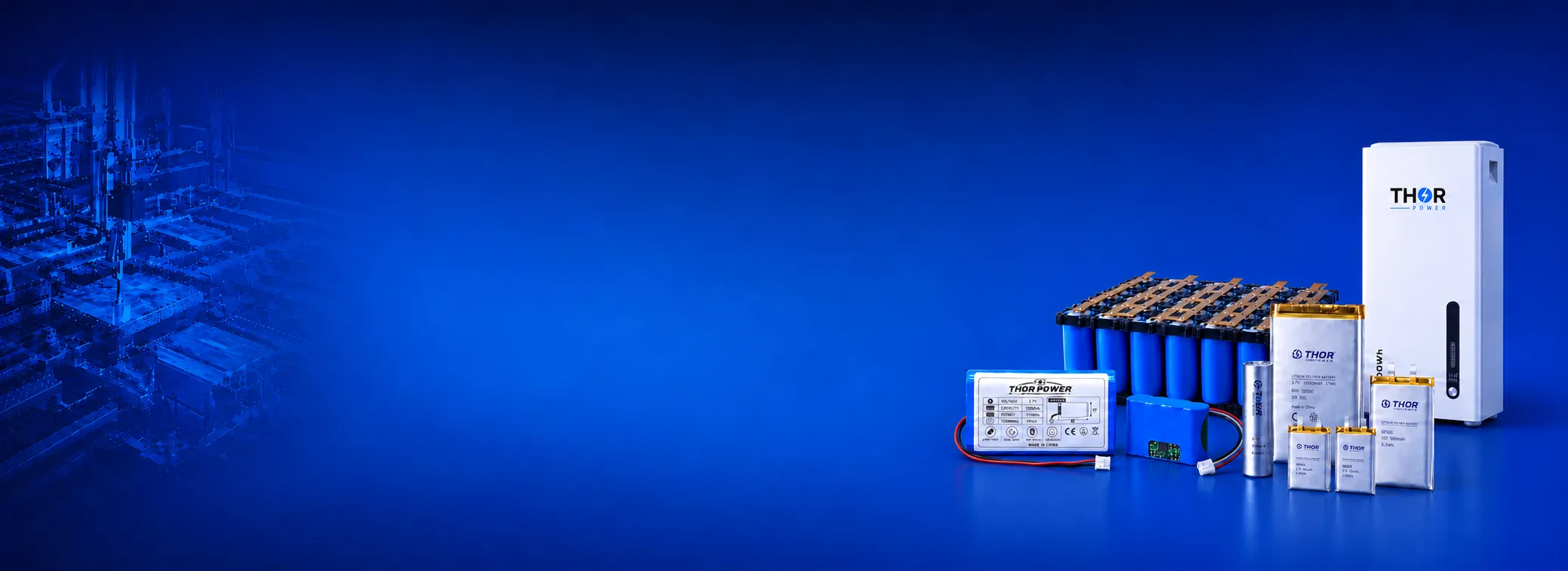
THOR Power provides factory-direct custom lithium battery products for OEM/ODM projects — LiPo pouch batteries, lithium-ion packs, LiFePO4 (LFP) energy storage, 18650 / 21700 packs, and custom special battery packs.
Choose the Right Battery Product Direction
Start with the device space, load profile, required runtime, mechanical structure, service-life target and compliance needs—not chemistry name alone. Use this matrix to identify the most suitable THOR Power product direction before reviewing specific models or beginning sample development.
| Product Direction | Best When | Main Design Priority | Confirm Before Sampling |
|---|---|---|---|
| Custom LiPo Pouch Batteries View LiPo Batteries | The device is thin, compact, shape-constrained or needs a battery geometry that closely follows the available enclosure space. | Thickness × width × length, capacity, runtime, continuous / pulse load and finished-pack fit. | Finished dimensions, PCM, NTC if required, connector, wire routing and device clearance. |
| LiFePO4 / LFP Battery Packs View LiFePO4 Battery Packs | The project prioritizes backup power, energy storage, long cycle life, system stability or configurable multi-cell voltage. | Voltage, energy / Wh, runtime, BMS architecture, housing and system interface. | Load profile, charge method, BMS functions, communication if required, enclosure and certification / transport requirements. |
| 18650 / 21700 Battery Packs View 18650 / 21700 Packs | The project benefits from cylindrical-cell construction, structured series / parallel configurations, higher-current capability or mature cell supply. | Cell model, S/P structure, current capability, welding, BMS, mechanical support and thermal behavior. | Continuous / peak current, pack structure, housing, connector, wire gauge and protection design. |
| Custom Special Battery Packs View Special Battery Packs | No standard battery family adequately fits the electrical, mechanical, interface, environmental or certification requirements. | System-level electrical + mechanical integration. | Electrical architecture, enclosure, interface, protection, thermal requirements, validation plan and compliance needs. |
There is no single best battery for every product. The right solution balances battery type, voltage, capacity, discharge current, BMS protection, safety, certification, cost, sample testing, and long-term supply stability.
Our Battery Product Categories
Each product family below leads to its dedicated models and engineering details. Choose the direction identified in the selection matrix above, then enter the product family to review specific options.
Custom LiPo Batteries
Custom-size lithium polymer pouch batteries with flexible thickness, shape, connector and protection circuit options for compact devices.
- Custom thickness, width and length
- Lightweight pouch cell design
- Connector, wire and PCM integration
LiFePO4 / LFP Battery Packs
Custom LiFePO4 battery packs for energy storage, UPS, backup power, portable power and industrial systems, with configurable voltage, capacity, BMS, housing and interfaces.
- BMS protection and stable output
- Configurable voltage and capacity
- Housing, connector and port options
18650 / 21700 Battery Packs
Cylindrical lithium battery packs using 18650 or 21700 cells with flexible series / parallel assembly, BMS and mechanical support.
- Mature cylindrical cell structure
- Flexible series / parallel configuration
- Higher-current capability
- Welding, BMS and housing options
Custom Special Battery Packs
Project-based custom battery development when standard product families cannot satisfy the complete electrical, mechanical or interface requirements.
- System-level electrical + mechanical integration
- Replacement and private label projects
- Non-standard voltage or interface designs
Find Batteries by What You Already Know
Already know the size, capacity, application or system type? Start from the most useful engineering reference instead of choosing a battery chemistry first.
Know the Available Space?
Browse LiPo models by size and geometry when your enclosure dimensions are already known.
Browse LiPo ModelsKnow the Capacity Range?
Jump directly to the capacity hub that best matches your device and runtime target.
Building Backup or Energy Storage?
Browse LiFePO4 energy-storage and backup-power platforms before starting a project-specific configuration.
Browse Energy Storage ModelsKnow the Device Application?
Start from the device requirements when the battery type has not yet been selected.
Browse ApplicationsFactory-Direct Support for Custom Battery Projects
THOR Power helps OEM/ODM customers review battery direction, sample testing, quality control, shipping documents and long-term supply before production.
For the full path from requirement review and sample development to validation and stable production, see how custom battery projects work.
Battery Direction Review
Review cell type, voltage, capacity, discharge current, and pack structure before sampling.
Custom Sample Development
Support custom size, connector, wire, PCM/BMS, label, and prototype testing.
Full-Process Quality Control
Control key steps from cell production and PACK assembly to electrical testing and shipment review.
Application-Based Testing
Check fit, charging, discharge, protection, and real-use performance.
UN38.3 / MSDS Support
Support shipping documents based on battery model, transport method, and project needs.
Long-Term Supply Support
Support repeat orders, private label projects, batch supply, and production follow-up.
Custom Battery Product Selection FAQ for OEM/ODM Buyers
Answers focused on choosing the right battery product direction, comparing LiPo pouch batteries with cylindrical and LiFePO4 options, and understanding system-level cost before starting a custom battery project.
If I only know my device application, how do I choose the right battery product category?
Start with the device space, operating voltage, required runtime, continuous and peak current, charging method, environment and expected service life. Thin or shape-constrained products often lead toward custom LiPo pouch batteries; backup and energy-storage systems may favor LiFePO4; structured cylindrical packs may suit higher-current or mechanically supported designs; and projects with unusual electrical or mechanical requirements may need a custom special battery pack. Chemistry alone should not determine the category.
When should I choose a custom LiPo pouch battery instead of cylindrical cells?
Custom LiPo pouch batteries are especially useful when thickness, width, length or overall enclosure geometry is tightly constrained. Their pouch format allows many shape combinations and can integrate PCM, NTC, custom wire lengths and device-specific connectors. Cylindrical cells such as 18650 or 21700 may be more appropriate when the project benefits from a rigid cell format, structured series / parallel assembly or different current and mechanical requirements.
When should I choose a LiFePO4 battery pack for energy storage or backup power?
LiFePO4 is commonly considered when a project prioritizes long cycle life, system stability, backup operation or configurable multi-cell energy storage. The final design still depends on required voltage, energy capacity, charge and discharge current, BMS functions, communication needs, housing and installation conditions. The battery chemistry is only one part of the complete system design. Browse available LiFePO4 battery pack options to review configurable platforms.
When are 18650 / 21700 battery packs a better product direction?
18650 and 21700 battery packs are often suitable when the design benefits from a standardized cylindrical cell format, flexible series / parallel architecture, established cell supply or a mechanically supported pack structure. Selection should still consider the exact cell model, continuous and peak current, welding method, BMS, thermal behavior, housing, connector and available installation space rather than choosing the format by capacity alone.
When should a project be treated as a custom special battery pack?
A project may require a custom special battery pack when standard LiPo, LiFePO4 or cylindrical-pack architectures cannot satisfy the complete electrical, mechanical or interface requirements. Examples include unusual voltage structures, constrained enclosures, special protection or communication needs, replacement designs, proprietary interfaces or application-specific validation requirements. In these cases the battery should be engineered as a complete system rather than forced into a standard product category.
Why should OEM buyers avoid choosing a battery category only by chemistry name?
Battery chemistry does not define the complete product. Two projects using the same chemistry can require very different cell formats, series / parallel structures, current capability, protection systems, connectors, housings and certification paths. Product selection should therefore begin with the device requirements and finished battery system, then confirm the chemistry and cell structure that best support those requirements.
How should I compare cost between different custom battery product categories?
Compare the complete battery system rather than cell price alone. Project cost can be affected by cell format, capacity, series / parallel structure, PCM/BMS complexity, housing, connector and wire harness, tooling, testing, certification, sample quantity and production volume. A lower-cost cell does not always produce the lowest-cost finished battery pack if it requires more complex mechanical or electrical integration.
Still Not Sure Which Battery Product Fits Your Project?
Send your device application, available space, voltage, capacity, working current, connector, PCM/BMS or BMS requirements, quantity, and shipping needs. Our engineering team can review your project and recommend a suitable product category.