18650 & 21700 Lithium-ion Cells
and Custom Battery Packs
THOR cylindrical Lithium-ion Cells in four chemistries, in stock and ready to order as bare cells, welded modules or finished packs. As a custom-focused manufacturer, most of our business is tailored cells and packs supplied under long-term, high-volume OEM/ODM agreements.
18650 Cells & Packs Ø18.4 × 65.2 mm
The 18650 is the most widely deployed cylindrical lithium-ion cell in the world — a steel-can cell 18 mm in diameter and 65 mm tall. Its mature supply chain, consistent quality and broad chemistry choice make it the default building block for series/parallel battery packs in power tools, e-mobility, instruments and consumer devices.
THOR 18650 cells cover four chemistries: NMC / ternary (3.6–3.7V, up to 3500mAh, energy and high-drain versions), LiFePO4 (3.2V, 2000+ cycles for storage and backup), LCO (high energy density for consumer electronics) and LMO (thermal stability for tools and medical devices).
Best-Selling 18650 Li-ion Cells & Battery Packs

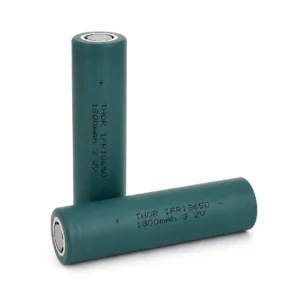
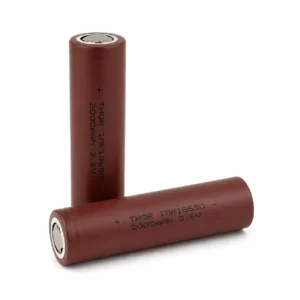

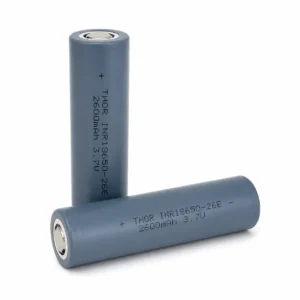
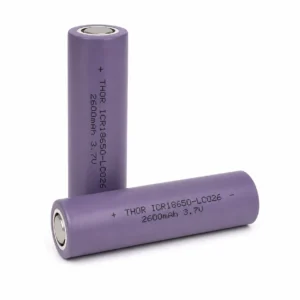

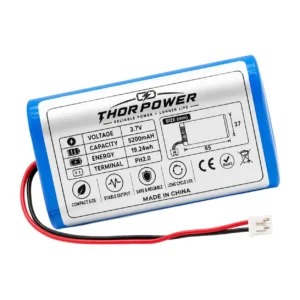
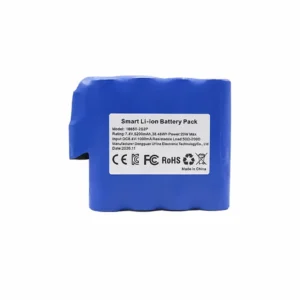
Need a different configuration? We build 18650 packs to your voltage, runtime and discharge spec — see custom packs ↓
18650 Common Chemistry & Capacity Options
The 18650 is available in multiple cathode chemistries — each with different voltage, capacity and cycle-life characteristics:
| Chemistry | Nominal Voltage | 18650 Capacity | Cycle Life | Best For |
|---|---|---|---|---|
| NMC / NCA (Ternary Lithium) | 3.6–3.7 V | 1800–3500 mAh | 500–2000 cycles | Power tools, e-mobility, high-drain packs |
| LiFePO4 (LFP) | 3.2 V | 1100–1800 mAh | 2000–5000+ cycles | Energy storage, backup power, solar, medical |
| LCO (Lithium Cobalt Oxide) | 3.7 V | 2200–2600 mAh | 300–500 cycles | Consumer electronics, moderate-rate devices |
| LMO (Lithium Manganese Oxide) | 3.6 V | 1500–2500 mAh | 300–700 cycles | Tools & medical devices needing thermal stability |
21700 Cells & Packs Ø21.4 × 70.2 mm
The 21700 delivers roughly 35–50% more energy per cell than the 18650 in a slightly larger can. For the same pack capacity that means fewer cells, fewer welds and a simpler BMS — which is why it has become the preferred format for e-mobility, portable power stations and energy storage modules.
THOR 21700 cells are available as NMC energy cells (up to 5300mAh), NMC high-drain power cells (up to 30A continuous), and 3.2V LiFePO4 for long-cycle storage applications.
Best-Selling 21700 Li-ion Cells & Battery Packs
Need a different configuration? We build 21700 packs to your voltage, runtime and discharge spec — see custom packs ↓
21700 Popular Chemistry & Capacity Options
Most common 21700 chemistry options include NMC/NCA and LiFePO4. Other chemistries may be available depending on project requirements.
| Chemistry | Nominal Voltage | 21700 Capacity | Cycle Life | Best For |
|---|---|---|---|---|
| NMC / NCA (Ternary Lithium) | 3.6–3.7 V | 4000–5300 mAh | 500–2000 cycles | E-mobility, power tools, portable power stations |
| LiFePO4 (LFP) | 3.2 V | 3000–4000 mAh | 2000–5000+ cycles | Energy storage, backup power, solar, medical |
Need a chemistry or capacity not listed? All options are available as custom cells and packs — tell us your requirements.
Custom 18650 / 21700 Battery Packs
Cells are only half the story. Most projects need a finished pack — and that is where THOR does its real work. We engineer packs from 1S1P to 20S+ configurations using matched cells from the models above, in any of the four chemistries.
Cell Matching
Capacity and internal-resistance sorted cells for balanced packs and consistent cycle life across the whole battery.
BMS & Protection
Overcharge, over-discharge, overcurrent and short-circuit protection, with cell balancing and NTC temperature monitoring options.
Mechanical Build
Nickel-strip spot or laser welding, PVC heat-shrink, ABS or metal housing, and XT60 / JST / Molex or fully custom connectors and wiring.
Testing & Documentation
Aging, capacity grading and IR testing on every pack, with UN38.3 and MSDS documentation provided for shipping.
Common 18650 / 21700 Series and Parallel Configurations
Series count sets the voltage; parallel count (nP) multiplies the capacity. These are the configurations we build most often — anything from 1S to 20S+ is available:
| Configuration | NMC/NCA Voltage | LiFePO4 Voltage | Capacity Depends On | Typical Applications |
|---|---|---|---|---|
| 1S / 1S2P / 1S3P | 3.6–3.7V | 3.2V | Parallel count × cell capacity | IoT, handheld devices, backup modules |
| 2S / 2S2P / 2S3P | 7.2–7.4V | 6.4V | Parallel count × cell capacity | Medical devices, lighting, routers |
| 3S / 3S2P / 3S3P | 10.8–11.1V | 9.6V | Parallel count × cell capacity | Portable equipment, field devices |
| 4S / 4S2P / 4S3P | 14.4–14.8V | 12.8V | Parallel count × cell capacity | Tools, 12V LFP replacement, portable systems |
| 5S / 5S2P | 18–18.5V | 16V | Parallel count × cell capacity | Power tools, outdoor devices |
| 6S / 6S2P | 21.6–22.2V | 19.2V | Parallel count × cell capacity | Robotics, garden tools, e-mobility |
| 10S / 10S2P | 36–37V | 32V | Parallel count × cell capacity | E-bikes, scooters, industrial packs |
| 13S / 13S2P | 46.8–48.1V | 41.6V | Parallel count × cell capacity | 48V NMC e-mobility packs |
| 16S / 16S2P | 57.6–59.2V | 51.2V | Parallel count × cell capacity | 51.2V LFP storage systems |
Note on “48V class”: 13S NMC (≈48V) and 16S LiFePO4 (51.2V) are different chemistries at different exact voltages — they are not the same spec, but customers often refer to both as “48V class” packs.
Voltages shown are nominal. Need a different series/parallel count, dual-voltage output or smart BMS with communication? All configurations are fully custom.
Get a Battery SolutionFrequently Asked Questions
18650 vs 21700 — which cell format should I choose for my battery pack?
Both are cylindrical lithium-ion cells from the same family. Choose 21700 when total pack energy and runtime matter most — higher capacity per cell means fewer cells, fewer welds and a simpler BMS, which lowers cost per Wh for e-bikes, power stations and energy storage. Choose 18650 when you need the widest chemistry choice (NMC, LiFePO4, LCO, LMO), the most mature supply chain, or a slimmer form factor for compact enclosures. If you are unsure, send us your target voltage, capacity and dimensions and our engineers will recommend the best format.
Can I order custom 18650 / 21700 battery packs built to my own specification?
Yes — THOR is a custom 18650 and 21700 battery pack manufacturer offering full OEM/ODM service. We build from 1S to 20S+ series and parallel configurations with your choice of chemistry, capacity, BMS, connector, wiring and housing. Send a drawing, a sample or just your electrical and mechanical requirements and we will engineer a pack around them.
What is the minimum order quantity (MOQ) and how fast can I get samples?
We are MOQ-friendly and support small pilot runs, so new projects and startups are welcome. Standard-cell samples typically ship within days; custom pack samples depend on BMS and housing tooling. Tell us your specification and target quantity and we will confirm both a sample lead time and a mass-production schedule with your quote.
Can you mix chemistries or different capacities in one battery pack?
No — a safe, long-life pack uses one cell model throughout. We build every pack from capacity- and internal-resistance-matched cells of a single chemistry. Mixing chemistries or capacities causes cell imbalance, accelerated aging and safety risk, so cell matching is a standard part of our production process.
Do your cells and packs include a BMS or PCM for protection?
Yes. Packs ship with a PCM/BMS providing overcharge, over-discharge, over-current and short-circuit protection, with optional NTC temperature sensing. For higher-voltage or communicating systems we can fit a smart BMS with SMBus, UART, RS485 or CAN for state-of-charge reporting. Bare cells are also available if your own PCBA already handles protection.
Can you customize the voltage, connector and BMS communication interface?
Yes — series count sets the nominal voltage (for example 36V, 48V or 51.2V) and we match the connector and interface to your device: XT30/XT60/XT90, Molex, JST, Anderson, aviation plugs and more. Dual-voltage output, custom wiring harnesses and communicating BMS options are all supported.
What certifications do your lithium battery packs have (UN38.3, MSDS)?
All cells and packs are UN38.3 certified for safe air, sea and road transport, and we provide MSDS documentation for shipping. Depending on your target market and application we can also discuss IEC 62133, CE, UL, KC and other certifications during the quotation stage.
How do you ship lithium batteries internationally and safely?
We ship worldwide by air, sea and express couriers using UN-rated packaging and the correct dangerous-goods declarations for Class 9 lithium batteries. Each shipment includes UN38.3 test summaries and MSDS, and we advise on the most cost-effective compliant logistics route for your destination and order size.
How does temperature affect performance, and can you supply low-temperature cells?
Capacity and cycle life drop in cold conditions and high heat accelerates aging. For demanding environments we can supply low-temperature cells that discharge down to around -40°C, self-heating packs, and NMC or LiFePO4 chemistries selected for your operating window. Tell us your temperature range and we will recommend the right cell.
What is the cycle life of your 18650 and 21700 cells?
Standard NMC cells deliver at least 500 charge cycles at 0.5C while retaining 80% or more of rated capacity, and LiFePO4 cells reach 2000–5000+ cycles for energy-storage and backup use. Actual life depends on charge/discharge rate, depth of discharge and operating temperature — we can advise on the best chemistry for your cycle-life target.
Related Articles
LiPo Batteries for Wearable and Portable Medical Devices: OEM Design and Validation Guide
HomeLiPo Battery Wearable Medical DevicesBy Victor Xiong · Reviewed by Dr. Maximilian Weber, Chief Scientist · Last reviewed: October 2026
October 16, 2026
Custom LiPo Battery Prototyping: From Device Requirements to Mass Production
A practical OEM guide to moving a custom LiPo battery from device requirements and engineering samples through production-intent validation, compliance planning and...
September 28, 2026
High-Discharge LiPo Battery: How to Validate Continuous, Peak and Pulse Current
Learn how to validate high-discharge LiPo batteries using real load waveforms, voltage sag, PCM limits, pulse testing and production-intent samples.
September 28, 2026