4.2V vs 4.35V 5000mAh LiPo Battery: Can the Same 1S Charger Be Used?

Technically Reviewed By
Chief Scientist
Dr. Maximilian Weber is THOR Power’s Chief Scientist and a senior expert in lithium battery technology. His technical review focuses on battery safety, performance optimization, energy density and custom battery solution development.
Last technical review: September 2026

Written By
President of OEM Division & Custom Battery Specialist
Victor Xiong holds a Master’s degree from The Chinese University of Hong Kong, Shenzhen. He leads THOR Power’s OEM Division and focuses on custom battery solutions for global device brands, product developers and industrial customers.
Quick Answer
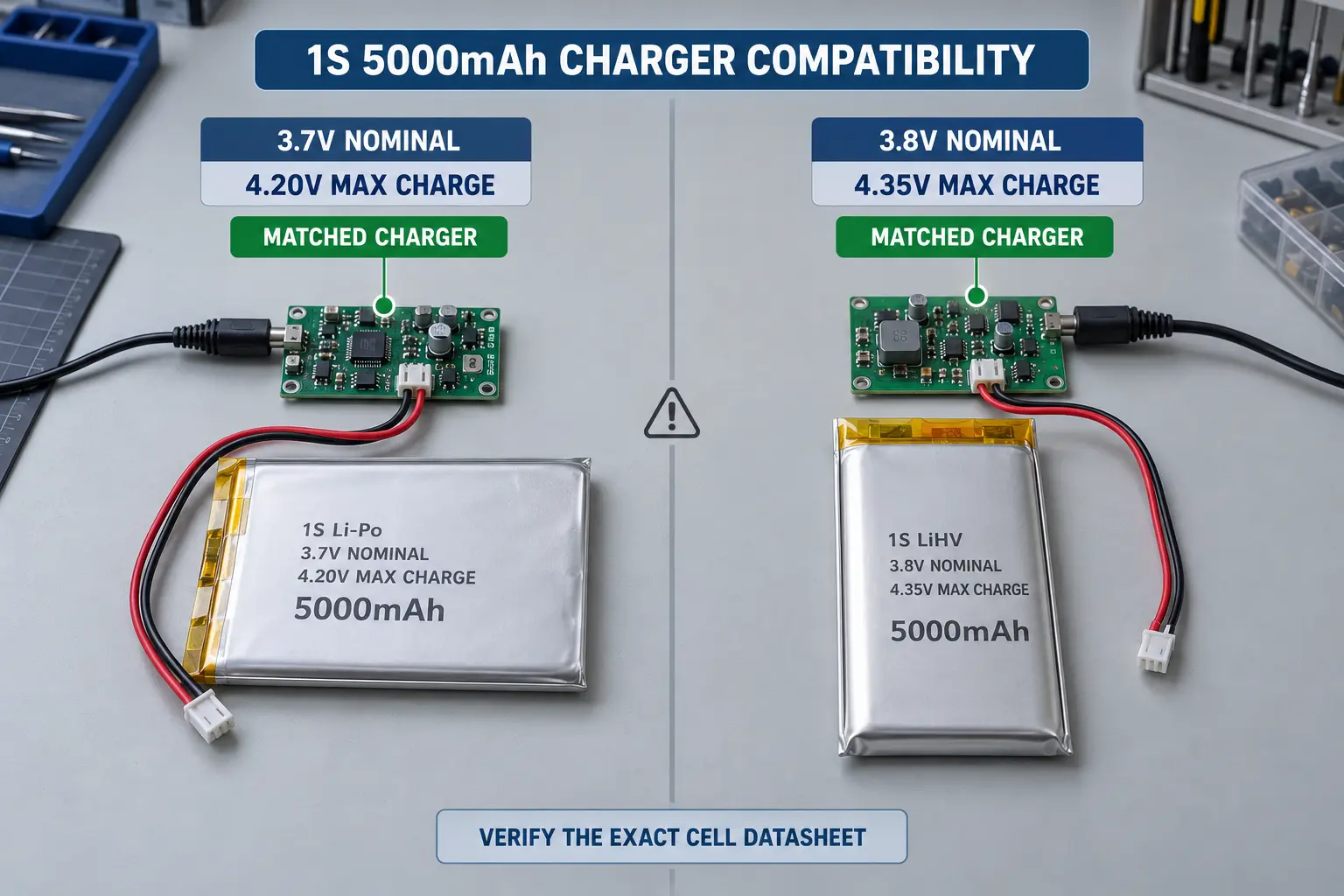
A 5000mAh LiPo battery is not automatically a 4.20V battery, and a 1S label does not tell you the correct charger voltage. The approved maximum charge voltage must come from the exact cell specification. A 4.35V rated LiPo pouch cell charged only to 4.20V will normally deliver less than its rated full-charge capacity, while a 4.20V rated cell charged to 4.35V is being driven above its specified ceiling and should not be treated as compatible.
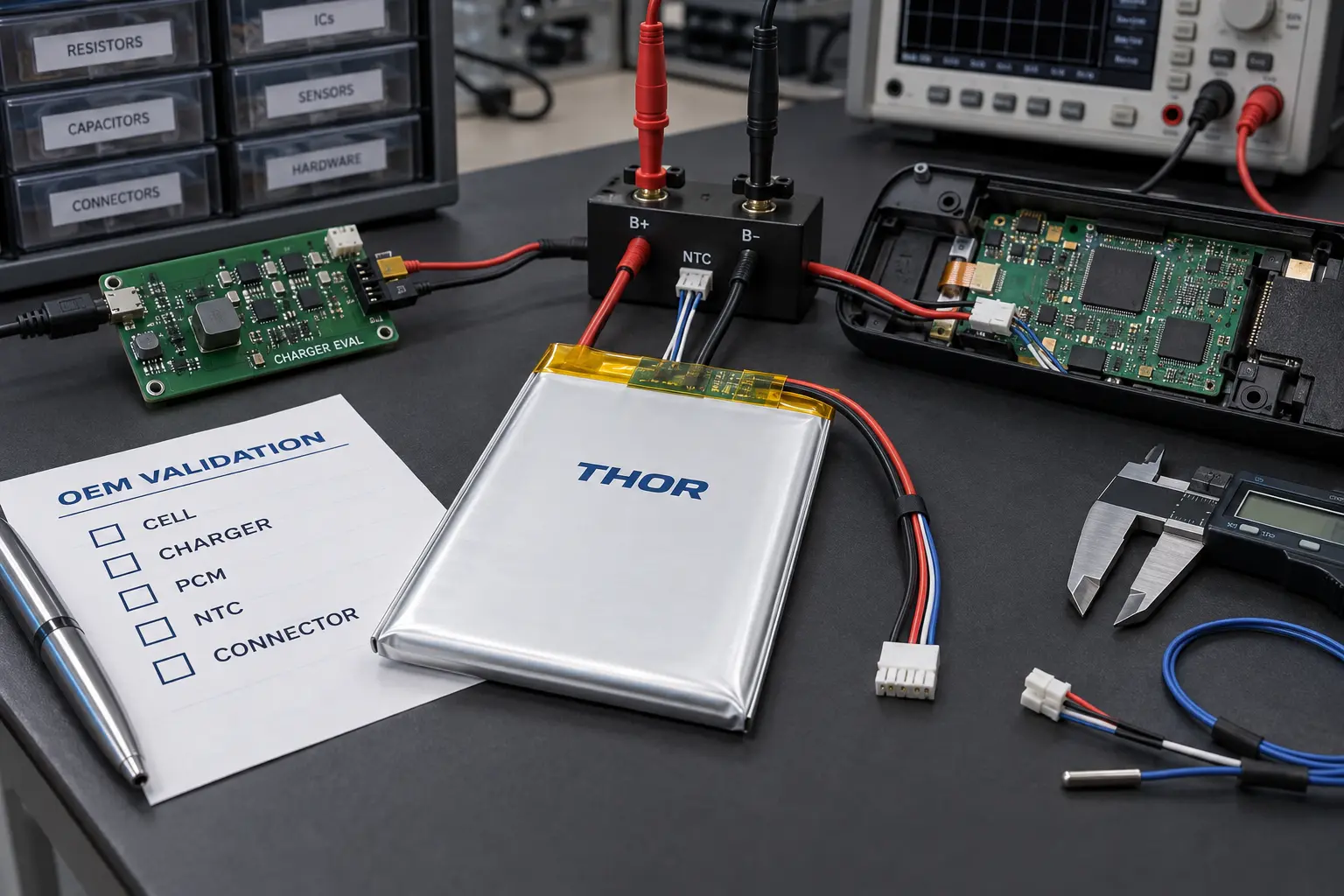
For OEM replacement or custom production, match the cell charge ceiling, charger regulation voltage, charger accuracy, termination current, PCM protection threshold, NTC temperature window, fuel gauge model, connector polarity and final device validation as one system. Capacity, connector shape and pouch dimensions are not enough.
Buyer takeaway: If you are sourcing a 3.7V 5000mAh LiPo battery, a 3.8V 5000mAh LiHV battery or a custom 5000mAh LiPo battery pack, confirm the maximum charge voltage first. Then compare the exact product options by finished size, PCM, connector, load capability and certification requirements.
Four Approval Questions
- What exact maximum charge voltage does the released cell datasheet specify: 4.20V, 4.35V, 4.40V or another value?
- Does the charger IC or firmware configuration regulate to that voltage within tolerance across temperature and production spread?
- Are PCM or BMS thresholds, fuel gauge settings, NTC limits, connector polarity and power-path behavior aligned with the same cell profile?
- Has the final device been validated for charged capacity, charge termination, post-charge voltage, temperature rise and cycle behavior using the production-intent cell and charger together?
At-a-Glance 5000mAh Charger Compatibility
| Cell rating | Charger regulation | Release view |
|---|---|---|
| 4.20V | 4.20V | Matched ceiling; validate current, temperature and termination. |
| 4.35V | 4.20V | Possible supplier-approved partial-charge strategy; rated full capacity may not be available. |
| 4.20V | 4.35V | Out of specification unless the exact cell is explicitly released for 4.35V. |
| 4.35V | 4.35V | Matched ceiling; validate charger accuracy, protection and production-intent assembly. |
The mismatch direction matters: undercharging a 4.35V-rated cell is not equivalent to charging a 4.20V-rated cell above its released maximum voltage.
- Why 1S and 5000mAh do not define the charger voltage
- What 4.20V and 4.35V mean at cell level
- Can a 5000mAh LiPo battery use a 4.2V or 4.35V charger?
- Four charger-to-cell compatibility cases
- CC/CV charging and charger IC accuracy
- PCM, fuel gauge, NTC, connector and power-path checks
- How to choose a custom 5000mAh LiPo battery replacement
- Production validation and RFQ information
- FAQ
- Technical references
1. Why 1S and 5000mAh Do Not Define the Charger Voltage
The term 1S only means one cell in series. It does not define whether the cell should be charged to 4.20V, 4.35V, 4.40V or another manufacturer-approved ceiling. The term 5000mAh only describes rated capacity under a specified test method. It does not define chemistry, voltage class, protection threshold, discharge current, connector, NTC value or charger compatibility.
This distinction matters because many buyer searches combine capacity and replacement intent: 3.7V 5000mAh LiPo battery, 1S 5000mAh LiPo battery, 5000mAh lithium polymer battery replacement or custom 5000mAh LiPo battery pack. Those searches often come from teams that already have a product, a battery cavity and a runtime problem. They need a replacement decision, not only a voltage definition.
For a 5000mAh replacement, treat the battery as a system component rather than a capacity label. The released solution must match maximum charge voltage, finished pack dimensions, PCM settings, connector polarity, load profile and final-device testing. A charger-compatible pack therefore has to be selected from the battery specification and the existing device architecture together, especially when the project is intended as a drop-in OEM replacement.
2. What 4.20V and 4.35V Mean at Cell Level
A 4.35V rated cell is not simply a conventional 4.20V cell that somebody decided to charge 150mV higher. The cell must be designed and qualified for the higher upper-voltage region. Electrode formulation, electrolyte system, coating design, separator behavior, formation process and manufacturer validation all influence whether a LiPo pouch cell is intended for a 4.20V, 4.35V, 4.40V or other charge ceiling.
The market term LiHV can be useful, but it is not a universal standard. Two cells sold as high-voltage LiPo may have different nominal voltages, maximum charge voltages, fast-charge limits, cycle-life targets, storage recommendations and temperature restrictions. The released cell datasheet remains the controlling document.
For a custom LiPo battery program, the correct question is not simply whether the charger can be set to 4.35V. The correct question is whether this exact LiPo pouch battery is designed for 4.35V and whether the complete device charging system is qualified around that profile.
3. Can a 5000mAh LiPo Battery Use a 4.2V or 4.35V Charger?
Sometimes yes, sometimes no. The capacity value 5000mAh does not answer the charger question. A 3.7V 5000mAh LiPo battery is often associated with a 4.20V maximum charge voltage, while a 3.8V 5000mAh LiHV battery may be associated with a 4.35V maximum charge voltage. Those are common market patterns, not release rules. The exact cell specification controls the design.
A 4.35V 5000mAh LiPo battery charged with a 4.20V charger may be a valid partial-charge strategy if the cell supplier allows it, but the buyer should not claim the full 5000mAh rating unless capacity was measured under that 4.20V charge condition. A 4.20V 5000mAh LiPo battery charged with a 4.35V charger should not be approved unless the exact cell manufacturer explicitly releases that higher charge ceiling.
For a replacement project, send the old battery label or datasheet, finished battery dimensions, connector photos, charger IC or schematic, load current and target market before requesting samples. This lets the supplier identify a voltage-profile mismatch before mechanical fit alone drives the decision. If the mechanical envelope is still open, compare the available LiPo battery models before locking the enclosure.
| Requirement | What it may mean | What must be confirmed |
|---|---|---|
| 5000mAh capacity target | Longer runtime request. | Nominal voltage, max charge voltage, cell size, load current and pack finish. |
| 3.7V 5000mAh LiPo | Common 1S nominal class for many 4.20V systems. | Whether the released cell ceiling is 4.20V and whether charger tolerance fits. |
| 3.8V 5000mAh LiHV | High-voltage 1S class that may use 4.35V charging. | Exact upper charge voltage, fuel gauge profile, cycle-life target and charger support. |
| Drop-in replacement | Same product cavity and harness. | Connector, polarity, wire gauge, NTC value, PCM threshold, dimensions and device validation. |
| Pack with PCM | Protected finished battery pack request. | Overcharge, over-discharge, over-current, temperature and physical pack limits. |
4. Four Charger to Cell Compatibility Cases
The direction of the mismatch matters. Charging a 4.35V rated cell only to 4.20V is fundamentally different from charging a 4.20V rated cell to 4.35V. The first is an undercharge relative to the rated full-charge ceiling. The second exceeds the intended ceiling and should be treated as an out-of-spec condition.
| Cell specification | Charger regulation | Primary result | Release decision |
|---|---|---|---|
| 4.20V cell | 4.20V charger | Matched charge ceiling when current, temperature and termination settings also comply. | Accept only after normal system validation. |
| 4.35V cell | 4.20V charger | Cell is charged below its rated maximum. Usable full-charge capacity may be lower than the rated value. | Possible partial-charge strategy only if supplier and product requirements permit it. |
| 4.20V cell | 4.35V charger | Cell is driven above its specified charge ceiling. Protection may trip, but that is not valid charge regulation. | Do not release as compatible. |
| 4.35V cell | 4.35V charger | Matched upper voltage, subject to charger accuracy, termination current, thermal limits and protection settings. | Accept only after production-intent validation. |
5. CC/CV Charging and Charger IC Accuracy
Do not use a percentage shortcut. The capacity difference between charging to 4.20V and 4.35V is not equal to the 3.6 percent voltage difference. Capacity gain or loss depends on the cell voltage curve, electrode design, discharge cutoff, C-rate, temperature and aging state. Use measured cell data.
If a charger datasheet specifies a symmetric percentage regulation tolerance, a first-pass screen is VREG,max = VSET x (1 + tolerance). For production release, use the charger datasheet’s specified minimum and maximum regulation voltage across the applicable temperature, line and load conditions, then compare those limits with the exact cell supplier’s approved charge ceiling and required design margin.
Some charger ICs provide separate 4.20V, 4.35V and other Li-ion regulation settings. That is a charger capability, not proof that every 4.35V pouch cell accepts the same worst-case voltage or that every 5000mAh LiPo battery can use the same charger board. The released cell datasheet still controls the battery-side limit.

6. PCM Fuel Gauge NTC Connector and Power Path Checks
A charger-to-cell match is not only about one voltage number. The finished battery pack and device must agree on protection thresholds, fuel-gauge modeling, temperature sensing, connector polarity and power-path behavior. This is especially important for 5000mAh LiPo battery replacement projects, because the buyer may assume a similar connector and capacity rating are enough.
| System element | What must be checked | Common failure after a battery change |
|---|---|---|
| Charger IC and firmware | Regulation voltage, charge current, termination current, recharge threshold and temperature behavior. | Firmware still programs 4.20V after a 4.35V cell is introduced, or vice versa. |
| PCM or protection IC | Overcharge threshold, release behavior and coordination with charger regulation. | Protection is treated as the normal way to stop an over-voltage charger. |
| Fuel gauge | Battery profile, full-charge reference, SOC learning and full or empty thresholds. | SOC reaches 100 percent too early or too late after the charge ceiling changes. |
| NTC and temperature window | Thermistor value, placement, charge temperature range and cold-charge limits. | A new cell is charged under a temperature condition that was never qualified. |
| Connector and wire | Connector model, polarity, wire gauge, resistance, strain relief and finished pack dimensions. | A physically fitting connector hides reversed polarity, higher resistance or poor mechanical fit. |
| Power path and system load | Whether the product is powered while charging and how load current affects termination. | Device load prevents taper current from reaching the intended termination condition. |
| Production test | Cell-terminal voltage, charge-complete behavior, current taper and temperature. | Only the charger register value is checked; actual battery-terminal voltage is never verified. |
Protection boundary: A PCM or BMS overcharge threshold is a backup protection function, not a substitute for correct charger regulation. A design that repeatedly relies on protection to stop a mismatched charger is not a valid released charging system.
7. How to Choose a Custom 5000mAh LiPo Battery Replacement
- Confirm the nominal voltage class: 3.7V LiPo, 3.8V LiHV or another manufacturer-specified class.
- Confirm the maximum charge voltage from the exact released cell datasheet.
- Measure the maximum finished battery size, including PCM, insulation, label, tape, wire exit and connector.
- Confirm connector model, polarity, wire gauge, NTC value and mechanical retention.
- Compare continuous current, peak current, cutoff voltage, voltage sag and temperature rise under the real device load.
- Check whether the fuel gauge and firmware need a new battery profile.
- Validate cycle life, swelling, storage behavior and end-of-life runtime.
- Confirm transport and product safety documentation for the exact production configuration.
For capacity and runtime calculations, see THOR Power’s LiPo battery capacity and runtime guide. These supporting topics should not replace charger-to-cell compatibility validation.
8. Production Validation and RFQ Information
A battery change is not fully released when one prototype reaches the expected voltage once. The production-intent cell, charger, firmware, PCM, connector and device load should be validated together with repeatable pass and fail limits for pilot build and mass production. For a broader validation workflow, use THOR Power’s battery pack prototype testing guide.
| Validation area | Release evidence to request |
|---|---|
| Cell identity | Exact manufacturer, model, nominal voltage, maximum charge voltage, capacity rating and date code or lot control. |
| Charger behavior | Charger IC part number, firmware setting, VREG tolerance, charge current, termination current and recharge threshold. |
| Battery terminal voltage | Measured cell-terminal voltage at end of charge under released hardware, firmware and temperature condition. |
| Capacity and runtime | Measured usable capacity and Wh under the approved charge ceiling and real device cutoff. |
| Thermal behavior | Battery, PCM, connector and charger-board temperature during normal and worst-case charge use. |
| Cycle and storage | Capacity retention, resistance change, swelling and charge behavior after cycle or storage aging. |
| Production control | Incoming inspection, finished-pack test limits, charger test method, traceability and change-control rules. |
What Buyers Should Send in an RFQ
If the charger already exists, send its details before requesting a replacement or higher-energy 5000mAh LiPo cell. That lets THOR Power identify voltage incompatibility before samples are built.
| Buyer should send | Why it matters |
|---|---|
| Current battery label, datasheet or photos. | Identifies nominal voltage, capacity, charge ceiling, connector and protection style. |
| Required capacity and required runtime. | Separates catalog capacity from actual product runtime requirement. |
| Maximum finished battery dimensions. | Prevents a bare pouch cell from being confused with a finished battery pack. |
| Charger IC part number, schematic or charge voltage setting. | Confirms whether the device is built around 4.20V, 4.35V or another profile. |
| Connector model, polarity, wire length, wire gauge and NTC requirement. | Reduces drop-in replacement failures. |
| Continuous current, peak current, cutoff voltage and operating temperature. | Confirms whether a high-capacity cell can also support the load. |
| Target certifications, sample quantity and annual forecast. | Defines documentation, production path, MOQ and change-control expectations. |
Planning a 4.20V or 4.35V Custom LiPo Battery?
Send the existing charger IC, charge-voltage setting, required pouch dimensions, capacity target, discharge load, connector and temperature range. THOR Power can check where compatibility risk sits before samples are built.
Key Takeaways
- 5000mAh describes capacity, not the correct charger voltage.
- 1S describes series count, not whether the battery charges to 4.20V or 4.35V.
- A 3.7V 5000mAh LiPo battery and a 3.8V 5000mAh LiHV battery may require different charger profiles.
- A 4.35V rated cell charged to 4.20V may be a partial-charge strategy, but the rated capacity benefit may not be available.
- A 4.20V rated cell should not be charged to 4.35V unless the exact manufacturer specification allows it.
- PCM protection is not a substitute for correct charger regulation.
- Custom 5000mAh LiPo battery replacement requires checking charger IC, PCM, fuel gauge, NTC, connector, dimensions and device load together.
Conclusion
The difference between a 4.20V and 4.35V LiPo battery is not a cosmetic label and not a charger setting that can be changed casually. The maximum charge voltage belongs to the exact cell design, and the charger must regulate to that value within controlled tolerance while the rest of the battery system uses matching protection, temperature and fuel-gauge assumptions.
For OEM teams sourcing a 5000mAh LiPo battery replacement or a custom 5000mAh LiPo battery pack, the safest process is direct: identify the exact cell charge ceiling, verify charger and firmware settings, measure real battery-terminal voltage, confirm PCM and connector details, then validate capacity and temperature with the production-intent assembly.
FAQ
Does 1S mean a LiPo battery must charge to 4.20V?
No. 1S only means one cell in series. The maximum charge voltage must come from the exact cell specification. Some 1S LiPo or Li-ion pouch cells are designed for 4.20V, while others are designed for 4.35V, 4.40V or another approved ceiling.
Can a 5000mAh LiPo battery use a 4.35V charger?
Only if the exact 5000mAh cell is specified for that charge voltage and the charger, PCM, fuel gauge, NTC and final device are validated for the same profile. Capacity alone does not prove 4.35V compatibility.
Can a 4.35V 5000mAh LiPo battery be charged with a 4.20V charger?
It may be possible as a partial-charge strategy if the cell supplier allows it, but the battery will normally deliver less than its rated full-charge capacity. The product should state the validated capacity under the 4.20V charging condition.
Can a 4.20V 5000mAh LiPo battery be charged with a 4.35V charger?
No, not as a released condition unless the exact cell manufacturer specifies that higher ceiling. A protection circuit does not make an over-voltage charger compatible.
Is a 3.7V 5000mAh LiPo battery the same as a 3.8V 5000mAh LiHV battery?
No. The nominal voltage, maximum charge voltage, voltage curve, charger requirement, fuel gauge profile and cycle-life behavior may differ. Treat them as different cell specifications.
What should I check before replacing a 5000mAh LiPo battery?
Check maximum charge voltage, physical size, connector model, polarity, wire gauge, NTC value, PCM threshold, discharge current, cutoff voltage, charger IC setting and final-device runtime.
Does a higher charge voltage always give more runtime?
Not always. The useful runtime gain depends on the cell voltage curve, discharge cutoff, load current, temperature, aging state and whether the device can use the extra upper-voltage energy.
What information should I send for a custom 5000mAh LiPo battery quote?
Send the existing battery label or datasheet, maximum finished dimensions, required capacity and runtime, charger IC or charge-voltage setting, connector and NTC details, load current, temperature range, certification requirements and forecast quantity.
Technical References
- Texas Instruments. BQ25170 product page and datasheet. Example of a charger IC with selectable Li-ion regulation voltages including 4.20V and 4.35V.
- Texas Instruments. BQ27441-G1 product page and datasheet. Example of a fuel gauge where cell chemistry and voltage-profile assumptions matter.
- International Electrotechnical Commission. IEC 62133-2:2017+AMD1:2021. Safety requirements for portable sealed secondary lithium cells and batteries.
- UNECE. UN Manual of Tests and Criteria, Revision 8 files. Lithium battery transport-testing context.
- UL Solutions. Battery safety testing and certification overview.
Compliance Context
IEC 62133-2, UN 38.3 and other safety or transport requirements do not create a universal 4.20V or 4.35V charging rule for every LiPo cell. They provide safety and logistics context. The released cell specification, charger design, PCM settings, final device validation and target-market compliance route remain controlling.