
How Thor Power Uses Material Optimization to Improve Energy Density and Safety in Custom LiPo Pouch Batteries

Technically Reviewed By
Chief Scientist
Dr. Maximilian Weber is THOR Power’s Chief Scientist and a senior expert in lithium battery technology. His technical review focuses on battery safety, performance optimization, energy density and custom battery solution development.
Last technical review: September 2026

Written By
President of OEM Division & Custom Battery Specialist
Victor Xiong holds a Master’s degree from The Chinese University of Hong Kong, Shenzhen. He leads THOR Power’s OEM Division and focuses on custom battery solutions for global device brands, product developers and industrial customers.
| Written By | Technically Reviewed By |
|---|---|
| Victor Xiong President of OEM Division & Custom Battery Specialist. Victor Xiong leads THOR Power‘s OEM Division and focuses on custom battery development for global device brands, product developers and industrial customers. | Dr. Maximilian Weber Chief Scientist. Dr. Weber’s technical review for this article focuses on pouch-cell material optimization, energy-density and safety trade-offs, protection and charging design, mechanical protection and production validation. |
For many electronic products, battery selection is no longer just about choosing the right size and capacity.
Customers often need a battery that is thin, lightweight, high-capacity, safe, stable, and suitable for long-term mass production. This is especially important for products such as drones, GPS trackers, wearable devices, medical devices, RC models, smart electronics, and compact industrial equipment.
LiPo (lithium polymer) pouch batteries are widely used in these applications because they offer flexible dimensions, lighter packaging, and better space utilization compared with cylindrical or prismatic batteries.
However, one challenge always exists: How can we increase battery energy density without sacrificing safety?
At Thor Power, we believe the answer is not simply to use a higher-capacity cell. A reliable custom LiPo pouch battery solution requires material-level optimization, electrochemical matching, structural design, and application-based safety evaluation.
This article explains how material optimization helps custom LiPo pouch batteries achieve a better balance between energy density, cycle life, swelling control, and safety performance.
You can compare standard pouch-cell sizes and capacities in our LiPo battery models library before defining a custom specification.
Quick Answer
A custom LiPo pouch battery can raise energy density without sacrificing safety when material selection, cell design, protection circuit, charging control and mechanical protection are engineered together for the specific device. Higher energy density is safe only when the complete pack — cell, BMS/PCM, charger and enclosure — is validated as one system.
1. Why Custom LiPo Pouch Battery Material Selection Directly Affects Your Product
For a product developer or purchasing manager, battery performance may look simple on the surface:
- Capacity
- Voltage
- Size
- Connector
- Discharge current
- Certification documents
But behind these specifications, the real performance of a LiPo pouch battery is determined by its internal material system.
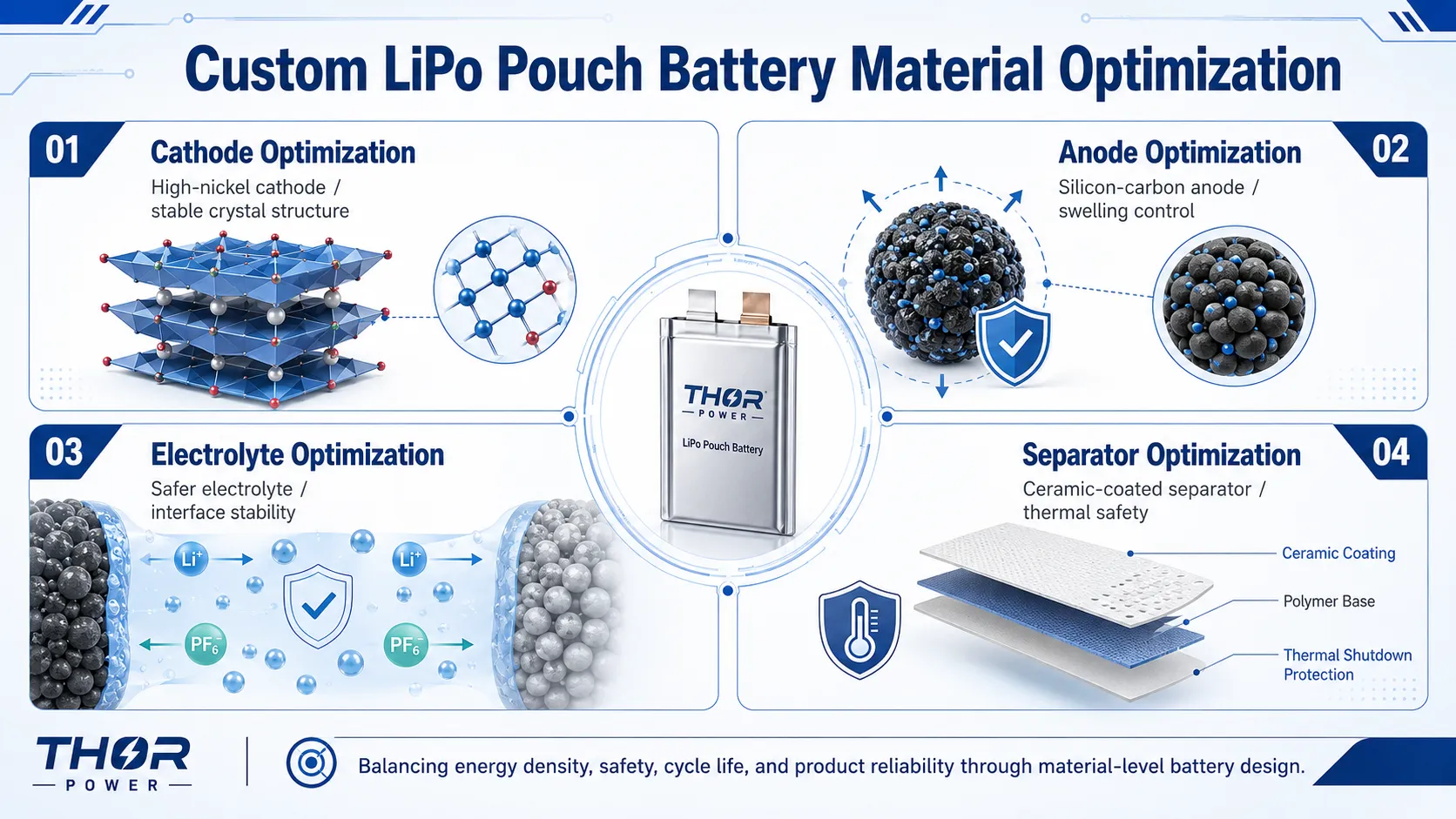
The cathode affects capacity and voltage stability. The anode affects cycle life, swelling, and charging behavior. The electrolyte affects safety, internal resistance, and low-temperature performance. The separator affects short-circuit protection and thermal stability.
If these materials are not properly matched, the battery may still work in early samples, but problems can appear later during mass production or long-term use.
Common problems include:
| Customer Concern | Possible Material-Related Cause |
|---|---|
| Battery runtime is shorter than expected | Cathode capacity or electrode loading is not optimized |
| Battery swells after cycles | Anode expansion or electrolyte side reactions |
| Product gets hot during use | High internal resistance or poor material matching |
| Fast charging is unstable | Anode interface cannot handle high charging current |
| Capacity drops quickly | Cathode cracking, SEI instability, or electrolyte degradation |
| Safety risk under abuse conditions | Separator shrinkage, electrolyte flammability, or internal short circuit |
This is why Thor Power does not treat custom battery development as only a “size + connector” project. We evaluate the material system according to the real application environment.
2. Improving Energy Density Starts with the Cathode
The cathode is one of the most important materials affecting the energy density of a LiPo pouch battery.
For customers, higher energy density means:
- Longer product runtime
- Smaller battery size for the same capacity
- Lighter product weight
- More flexible internal structure design
- Better user experience
In high-energy LiPo pouch batteries, high-nickel cathode materials may be used to increase capacity. However, high-nickel materials also require careful control because they can be more sensitive to high voltage, heat, and surface side reactions.
If the cathode structure is unstable, it may lead to gas generation, capacity fading, increased internal resistance, or lower safety margin.
How Thor Power Approaches Cathode Optimization
For custom LiPo pouch battery projects, Thor Power focuses on selecting and matching cathode systems based on the customer’s product requirements. For example:
| Product Requirement | Cathode Design Focus |
|---|---|
| Longer runtime | Higher-capacity cathode system |
| Compact product space | Higher electrode loading and better compaction density |
| Long cycle life | More stable cathode structure |
| High-voltage operation | Improved surface stability |
| Better storage performance | Reduced side reactions and gas generation |
In advanced high-energy systems, single-crystal or structurally optimized cathode materials can help reduce particle cracking and improve cycling stability.
For customers, this means the battery is not only designed to have a higher capacity number, but also to maintain more stable performance during actual use.
3. Silicon-Carbon Anode Helps Increase Runtime, but It Must Be Controlled
Many customers want a higher-capacity battery without changing the product structure. This is common in GPS trackers, smart wearables, medical electronics, and compact portable devices. We support many of these products with LiPo batteries for compact electronic devices.
One possible way to improve energy density is to use silicon-carbon anode materials.
Silicon can store much more lithium than traditional graphite, which makes it attractive for high-energy battery design. However, silicon also expands during charging. If this expansion is not properly controlled, it may cause swelling, capacity fading, and higher internal resistance.
What This Means for Customers
A silicon-based anode is not automatically better for every product. It may be helpful when the product requires:
- Higher capacity in limited space
- Longer standby time
- Higher energy density
- Better use of internal product volume
But it must be carefully evaluated if the product requires:
- Very long cycle life
- Fast charging
- High-temperature operation
- Very strict swelling control
- Ultra-stable mass production consistency
Thor Power’s Anode Matching Logic
Thor Power evaluates the anode system according to the real use case. For example:
| Application | Anode Selection Priority |
|---|---|
| GPS tracker | Long standby time and stable capacity retention |
| Wearable device | Low swelling and thin pouch structure |
| Medical device | Safety, consistency, and reliability |
| Drone / RC model | Low internal resistance and high discharge capability |
| Smart device | Balance between capacity, size, and cycle life |
For high-energy LiPo pouch batteries, silicon-carbon composite anodes may be combined with optimized binders, electrolyte additives, and formation processes to reduce expansion and stabilize the electrode interface.
The purpose is not to chase extreme capacity, but to achieve a practical balance between runtime, safety, cycle life, and manufacturability.
4. Electrolyte Optimization Improves Safety from the Inside
The electrolyte is often overlooked by customers, but it plays a critical role in battery safety and performance — and is one of the properties evaluated under portable-cell safety standards such as IEC 62133-2. It affects:
- Ion transport
- Internal resistance
- Low-temperature performance
- High-temperature stability
- Gas generation
- Cycle life
- Abuse tolerance
Traditional liquid electrolytes provide good conductivity, but they may become unstable under high temperature, overcharge, mechanical damage, or internal short circuit.
For LiPo pouch batteries, this is especially important because pouch cells use aluminum-plastic film packaging. They are lightweight and flexible, but they require careful internal safety design.
Safer Electrolyte Design Direction
Depending on the application, safer electrolyte strategies may include:
- High-voltage electrolyte systems
- Electrolyte additives for better SEI/CEI formation
- Gas-suppression additives
- Flame-retardant additives
- Quasi-solid or gel electrolyte systems
- Better compatibility with high-nickel cathodes and silicon-carbon anodes
For customers, electrolyte optimization can help improve:
| Customer Concern | Electrolyte Optimization Benefit |
|---|---|
| Battery swelling | Reduces side reactions and gas generation |
| Cycle life | Stabilizes cathode and anode interfaces |
| Safety | Improves thermal and abuse tolerance |
| Fast charging | Helps form a more stable anode interface |
| High-voltage use | Reduces electrolyte oxidation |
| Storage performance | Improves long-term stability |
Thor Power evaluates electrolyte systems not only by laboratory performance, but also by actual product requirements, charging conditions, operating temperature, and mass production stability.
5. Separator Design Is the Last Physical Safety Barrier
The separator is a thin membrane inside the battery. Its function is to prevent the cathode and anode from touching each other while allowing lithium ions to move through.
If a separator shrinks or fails under high temperature, the battery may develop an internal short circuit. This is why separator selection is very important for high-energy LiPo pouch batteries.
Ceramic-Coated Separators
For higher safety requirements, ceramic-coated separators can improve thermal dimensional stability and puncture resistance. They are especially useful for applications where the battery may face:
- Higher discharge current
- High operating temperature
- Compact internal product space
- Mechanical stress
- Higher safety requirements
- Long-term reliability demands
For customers, a better separator can help reduce the risk of internal short circuit and improve the safety margin of the battery pack.
Practical Value for Custom Projects
Thor Power may consider separator upgrades when a customer’s product requires:
| Product Situation | Separator Design Focus |
|---|---|
| Thin battery structure | Better mechanical strength |
| High-energy cell | Higher thermal stability |
| Portable device | Better puncture resistance |
| Medical device | Higher safety consistency |
| Industrial electronics | Stronger reliability margin |
The separator does not increase capacity directly, but it plays an essential role in making high-energy battery designs safer and more reliable.
6. Material Optimization Must Match the Product Application
A common mistake in battery selection is focusing only on capacity.
For example, two LiPo pouch batteries may both be marked as 3.7V 1000mAh, but their real performance can be very different depending on materials, electrode design, electrolyte system, separator, internal resistance, and production control.
That is why Thor Power starts custom battery projects by understanding the product first. We usually evaluate:
- Available battery space
- Target capacity
- Working voltage
- Discharge current
- Peak current
- Charging current
- Operating temperature
- Expected cycle life
- Swelling limit
- Safety requirements
- Certification requirements
- Connector type
- Wire length and polarity
- PCM/BMS requirements
- Mass production quantity and consistency needs
Only after these factors are clear can we recommend the most suitable material system and battery structure, supported by a controlled battery production and quality control process.
7. How Material Optimization Affects Different Products
Different products need different battery priorities.
A high-capacity solution is not always the best solution. A safe and stable battery should be designed around the real working conditions of the final product.
| Application | Customer Concern | Material Optimization Focus |
|---|---|---|
| Drone / UAV | Lightweight, high power, safety | Low-resistance electrode, stable cathode, thermal control |
| GPS tracker | Long standby time | High capacity, low self-discharge, stable electrolyte |
| Wearable device | Thin size and swelling control | Stable anode, flexible pouch design, low gas generation |
| Medical device | Reliability and safety | Stable materials, strict consistency, safer separator |
| RC model | High discharge performance | Low internal resistance, high-rate electrode design |
| Smart electronics | Compact structure | High energy density and connector customization |
| Industrial equipment | Long-term use | Safety margin, cycle stability, production consistency |
For this reason, Thor Power does not recommend one fixed battery design for all customers. We help customers select the right balance based on their product.
8. Energy Density Should Not Be Improved at the Cost of Safety
Short answer: In most cases a custom LiPo pouch cell can be made higher in capacity within the same size, but only if the material system, charging window and safety design are matched to it. Pushing energy density too far without controlling electrode loading, electrolyte stability and separator margin can increase swelling, gassing and thermal risk. A higher-capacity cell should still pass the same safety and transport validation, including UN 38.3 transport testing, before mass production.
For many projects, customers ask: “Can we make the battery capacity higher in the same size?”
In many cases, the answer may be yes. But the more important question is: “Can the higher-capacity battery still remain safe, stable, and suitable for mass production?”
A higher-capacity cell may require higher electrode loading, thinner separator, higher compaction density, or more aggressive material design. These changes must be carefully evaluated. Thor Power usually considers:
- Whether the battery has enough safety margin
- Whether swelling can be controlled
- Whether cycle life meets the product requirement
- Whether the battery can pass transport and safety tests
- Whether the design is suitable for stable mass production
- Whether the product really needs maximum capacity or a more balanced solution
For B2B customers, the best battery is not always the one with the highest capacity. It is the one that works reliably in the final product.
9. Thor Power’s Custom LiPo Battery Development Support
Thor Power provides custom LiPo pouch battery solutions for customers who need more than standard battery models. Our support includes:
- Custom pouch cell size design
- Capacity and voltage matching
- LiPo and Li-ion battery pack solution support
- Connector and cable customization
- PCM/BMS protection solution support
- Battery structure design
- Sample development
- Small-batch project support
- UN38.3 and MSDS document support
- Long-term production and supply support
For customers developing drones, GPS trackers, wearable devices, medical devices, RC products, smart electronics, and industrial equipment, we help evaluate the battery from both performance and safety perspectives.
Our goal is to help customers avoid common battery problems before mass production, such as swelling, short runtime, unstable cycle life, overheating, poor connector matching, and insufficient safety margin.
Conclusion
For custom LiPo pouch batteries, energy density and safety should never be considered separately.
Higher energy density depends on cathode and anode optimization. Better safety depends on electrolyte stability, separator design, and internal structure control. Long-term reliability depends on material matching, production consistency, and application-based design.
At Thor Power, we use material optimization as part of a complete custom battery development process. Instead of simply offering a higher-capacity cell, we help customers select a battery solution that fits the real product environment.
A good custom LiPo battery should not only power the product. It should help the product become safer, lighter, more reliable, and more competitive in the market.
Planning a Custom LiPo Pouch Battery?
Send the target energy, finished battery space, load profile, charging method, connector and annual volume. THOR Power can review material, cell geometry, protection and production requirements before samples are built.
Can I simply choose a higher-capacity LiPo pouch battery to improve my product runtime?
Not always. A higher-capacity LiPo pouch battery may improve runtime, but it can also increase electrode loading, internal stress, swelling risk, and thermal sensitivity if the material system is not properly matched. For custom battery projects, Thor Power does not recommend judging a battery only by its mAh value. We evaluate the available space, discharge current, charging method, operating temperature, cycle life target, and safety requirements before recommending a suitable LiPo pouch cell. In many cases, the best solution is not the highest-capacity cell, but a balanced battery design that provides stable runtime, controlled swelling, safer operation, and reliable mass production performance.
Why do some LiPo pouch batteries swell after several cycles, even when the size and capacity look correct?
Battery swelling is usually related to internal side reactions, gas generation, unstable electrode interfaces, or poor material matching. It may happen when the anode expands during cycling, the electrolyte decomposes, the cathode surface becomes unstable, or the battery is charged and discharged outside a suitable condition. This is why material optimization is important. A stable cathode system, well-controlled silicon-carbon or graphite anode, suitable electrolyte additives, and proper formation process can help reduce gas generation and improve long-term dimensional stability. For products such as wearables, GPS trackers, medical devices, and compact smart electronics, Thor Power reviews swelling risk at the battery design stage instead of only checking it after samples are made.
How does material optimization improve the safety of custom LiPo pouch batteries?
LiPo pouch battery safety is not controlled by one component alone. It depends on the coordinated design of the cathode, anode, electrolyte, separator, protection circuit, and cell structure. For example, a more stable cathode can reduce harmful side reactions under high voltage. A properly designed anode can reduce lithium plating and swelling risk. A safer electrolyte system can improve interface stability and thermal tolerance. A ceramic-coated separator can help reduce internal short-circuit risk under high-temperature or mechanical abuse conditions. Thor Power uses material-level evaluation together with PCM/BMS protection and connector customization, electrical testing, and shipment documentation support to help customers build safer and more reliable custom LiPo battery solutions for real product applications.
