Semi-Solid LiPo Battery: What OEM Engineers Should Validate

Technically Reviewed By
Chief Scientist
Dr. Maximilian Weber is THOR Power’s Chief Scientist and a senior expert in lithium battery technology. His technical review focuses on battery safety, performance optimization, energy density and custom battery solution development.
Last technical review: September 2026

Written By
President of OEM Division & Custom Battery Specialist
Victor Xiong holds a Master’s degree from The Chinese University of Hong Kong, Shenzhen. He leads THOR Power’s OEM Division and focuses on custom battery solutions for global device brands, product developers and industrial customers.
| Written By | Technically Reviewed By |
|---|---|
| Victor Xiong President of OEM Division & Custom Battery Specialist. Victor Xiong leads THOR Power’s OEM Division and focuses on project-specific pouch-cell selection, pack integration, validation and long-term production supply. | Dr. Maximilian Weber Chief Scientist. Dr. Weber’s technical review focuses on electrolyte architecture, electrochemical trade-offs, safety and mechanical boundaries, scale-up evidence and production-intent validation. |
THOR Power supplies project-specific conventional and semi-solid LiPo pouch-cell and battery-pack solutions for OEM and ODM products. The commercially useful question is not whether semi-solid technology is newer; it is whether the exact production configuration gives the device more usable energy without violating current, charge voltage, temperature, lifetime, safety, swelling, certification or supply requirements. If the project is already defining size, capacity and pack integration, review THOR Power custom LiPo battery options before comparing technology labels.
Quick Answer
A ‘semi-solid LiPo battery’ is a commercial term generally used for a lithium-ion pouch cell whose electrolyte retains liquid within a polymer or solid framework. It may support higher-energy designs and reduced free-liquid behavior, but it does not define chemistry, voltage, safety or performance. OEM approval must use the exact production cell and finished pack.
THOR Power Supply Scope
THOR Power supplies project-specific semi-solid LiPo pouch-cell and battery-pack solutions after confirming cell chemistry, dimensions, voltage class, usable Wh, current, temperature, protection, certification markets and forecast. Sample status, MOQ, lead time and production conditions are confirmed for the exact project configuration.
Approval Questions
1. Is the term semi-solid defined by actual electrolyte and cell construction, not marketing language? 2. Does the exact production cell improve usable device-level energy without current, charge, swelling or safety trade-offs? 3. Can the supplier prove pilot-scale consistency, certification path and lot traceability? 4. Can the approved cell, pack, process and forecast be repeated in mass production?
Case Transparency Note
The project situations described in this article are representative composite scenarios from recurring OEM evaluation patterns. They are used to explain validation logic without presenting confidential customer data or naming a specific THOR Power development program.
1. Define Semi-Solid Before Comparing Batteries
Battery terminology is loose in this area. Gel polymer electrolyte (GPE), quasi-solid-state electrolyte (QSE), gel-solid-state and semi-solid-state are used for different hybrid systems in which a polymer or porous framework immobilizes part of a liquid electrolyte. GPEs can retain liquid-like ion transport and favorable interface contact while adding structural stability; all-solid-state systems instead aim to conduct ions through solid electrolyte layers without a conventional liquid phase. [1] [2]
The word ‘LiPo’ creates an additional ambiguity. In the commercial OEM market it commonly refers to a lithium-ion pouch battery, not one fixed cathode, anode or electrolyte recipe. Semi-solid is also not inherently a pouch format, although ‘semi-solid LiPo’ is normally used for pouch products. For dimensional and capacity screening, compare candidates with the THOR Power LiPo battery model database before treating electrolyte architecture as a substitute for product fit. The supplier must therefore define the construction rather than asking the customer to infer it from the name.
| Commercial term | Practical engineering meaning | What the term does not prove |
|---|---|---|
| Conventional LiPo pouch | Commercial lithium-ion pouch architecture, usually with a liquid or gelled electrolyte and flexible laminate package. | One fixed chemistry, voltage class, C-rate, energy density or swelling limit. |
| Gel / quasi-solid / semi-solid | A hybrid electrolyte architecture in which a polymer or solid framework retains part of the liquid phase; composition and process vary by supplier. | All-solid-state construction, zero flammable content, lithium-metal anode or a guaranteed Wh/kg value. |
| All-solid-state | Ion transport is designed around solid electrolyte layers or composites rather than a conventional liquid electrolyte phase. | Immediate mass-production readiness, low interface resistance, no stack-pressure requirement or easy pouch integration. |
Electrolyte state and electrode chemistry must be separated. A graphite or silicon-carbon semi-solid lithium-ion cell is not equivalent to a lithium-metal quasi-solid research cell, even if both use a polymer network. The anode changes lithium-plating risk, swelling, cycle-life mechanisms, pressure requirements, transport classification and commercialization maturity.
Quasi-solid electrolytes have also been demonstrated in room-temperature lithium-ion systems without a lithium-metal anode. That evidence is useful for commercial direction, but it must still be tied to the reported electrode pair, electrolyte formulation, loading, format and test conditions. [6]
| Electrolyte architecture | Graphite / silicon-carbon anode | Lithium-metal anode | Main OEM implication |
|---|---|---|---|
| Liquid / conventional gel | Mature commercial Li-ion/LiPo baseline. | Primarily development-stage lithium-metal batteries. | Do not compare only by packaging name. |
| Gel / quasi-solid / semi-solid | Commercial bridge technology; maturity is supplier- and design-specific. | High-energy research and early industrialization path. | Require the exact cathode, anode, liquid fraction or process description, voltage and production status. |
| All-solid-state | Research or specialized architectures. | Major all-solid-state development direction. | Solid-solid interfaces, pressure and thin-electrolyte manufacturability become central. |
TERMINOLOGY GATE
Do not approve a battery because a supplier calls it ‘semi-solid’, ‘solid-state’ or ‘next-generation LiPo’. Request the exact electrolyte architecture, cathode/anode system, maximum charge voltage, cell-level energy basis, rate and temperature limits, mechanical behavior, safety evidence, sample status and production route.
2. Compare Energy, Power and Evidence on the Same Basis
Semi-solid electrolyte alone does not create a high-energy battery. Cell energy depends on cathode capacity and voltage, anode capacity and excess, electrode loading and porosity, electrolyte amount, current collectors, separator, tabs, pouch film, formation loss and manufacturing margin. Advanced semi-solid designs are often paired with high-nickel cathodes, silicon-rich anodes or lithium metal, so the gain cannot be credited to the electrolyte label alone.
For an existing product, compare delivered watt-hours through the real device voltage window and load profile. The relevant energy is Wh = ∫ V(t) × I(t) dt, not rated mAh alone. Use the same method described in the LiPo battery capacity and runtime guide and keep charge voltage, temperature, rest, discharge cutoff and aging state equal.
| Metric | Correct basis | Common sourcing mistake |
|---|---|---|
| Gravimetric energy (Wh/kg) | Delivered cell Wh divided by the controlled cell mass; state whether tabs and pouch are included. | Using a material-level or packaging-excluded value as a finished-cell claim. |
| Volumetric energy (Wh/L) | Delivered cell Wh divided by controlled maximum cell volume at a defined SOC and condition. | Choosing the highest Wh/kg cell when thickness or cavity volume is the real constraint. |
| Usable device energy | Wh delivered above the device cutoff under the real duty cycle, temperature and aging condition. | Assuming rated capacity remains usable during pulse load or cold operation. |
| Pack-level benefit | Include PCM/BMS, harness, connector, insulation, enclosure and thermal/mechanical materials. | Applying a cell-level mass saving directly to the finished product. |
For a commercially available baseline, review high-capacity LiPo models under identical load, voltage and temperature conditions. The product family is a starting comparison pool; it is not evidence that a semi-solid substitute has passed the same release gates.
ILLUSTRATIVE SCREEN
An 80 Wh cell at 220 Wh/kg weighs about 364 g; at 300 Wh/kg it weighs about 267 g, a theoretical cell-level reduction of about 97 g. If the same cells are 600 and 750 Wh/L, their theoretical volumes are about 133 and 107 cm3. Neither calculation predicts the finished-pack saving until protection, wiring, enclosure, thermal materials and swelling clearance are included.
Published high-energy results must retain their test boundary. As an adjacent solid-state research benchmark, one 2025 study reported 604.2 Wh/kg and 1153 Wh/L in an 11 Ah lithium-metal pouch cell, with 92.83% energy retention at cycle 100. The result used a high-nickel cathode, lithium metal, lean electrolyte and a controlled pressure fixture. It demonstrates a technical path; it is not a universal commercial semi-solid LiPo specification and is not equivalent to a graphite or silicon-carbon production cell. [5]
Power must be screened separately. Higher electrode loading and lower inactive mass can increase Wh/kg while making ion transport and heat rejection harder. Under a pulse load, the first approximation is voltage sag = current x DC resistance, but the real response is SOC-, temperature-, pulse-duration- and aging-dependent. A higher-energy cell that reaches the device cutoff earlier can deliver less mission energy than a lower-resistance conventional LiPo.
| Power evidence | Required comparison |
|---|---|
| Continuous current | Current in amperes, heat rise, terminal voltage and steady-state limit at defined SOC and temperature. |
| Pulse current | Peak current, duration, repetition, voltage sag, recovery and device-cutoff margin. |
| Resistance | DCIR or pulse resistance using the same method, SOC, temperature, rest and age; ACIR alone is not a load-performance substitute. |
| Aging effect | Repeat the current and heat screen after cycle and storage aging, not only at beginning of life. |
3. Validate Charge, Temperature and Mechanical Integration
A semi-solid pouch cell may use a 4.20 V, 4.35 V, 4.40 V or another controlled maximum charge voltage. Nominal voltage and physical size do not establish charger compatibility. Confirm the approved upper voltage, charge-current profile, taper/termination condition, recharge threshold, gauge profile and protection settings for the exact cell. If the candidate changes voltage class, use the 4.2 V vs 4.35 V lithium battery guide before approving the charger or fuel gauge.
For space-constrained 1S electronics, current small-capacity LiPo batteries remain the mechanical and electrical baseline; any semi-solid candidate must outperform that baseline without changing the device safety envelope.
Gel and quasi-solid electrolytes can preserve favorable interface contact, but ion transport still depends on polymer motion, liquid/plasticizer content, salt chemistry and interphase resistance. Reviews identify low-temperature conductivity and interface kinetics as important limitations, while specialized laboratory cells show that carefully designed electrolytes can extend temperature capability. Those results prove possibility, not a default product rating. [1] [4] [7] [8]
Fast charging and cold charging must be qualified separately. A room-temperature 1C or 2C headline does not establish charge acceptance at the coldest allowed cell temperature, high SOC or end of life. The validation must consider anode potential, lithium-plating risk, charger tolerance, rest history, resistance growth and the real product thermal path.
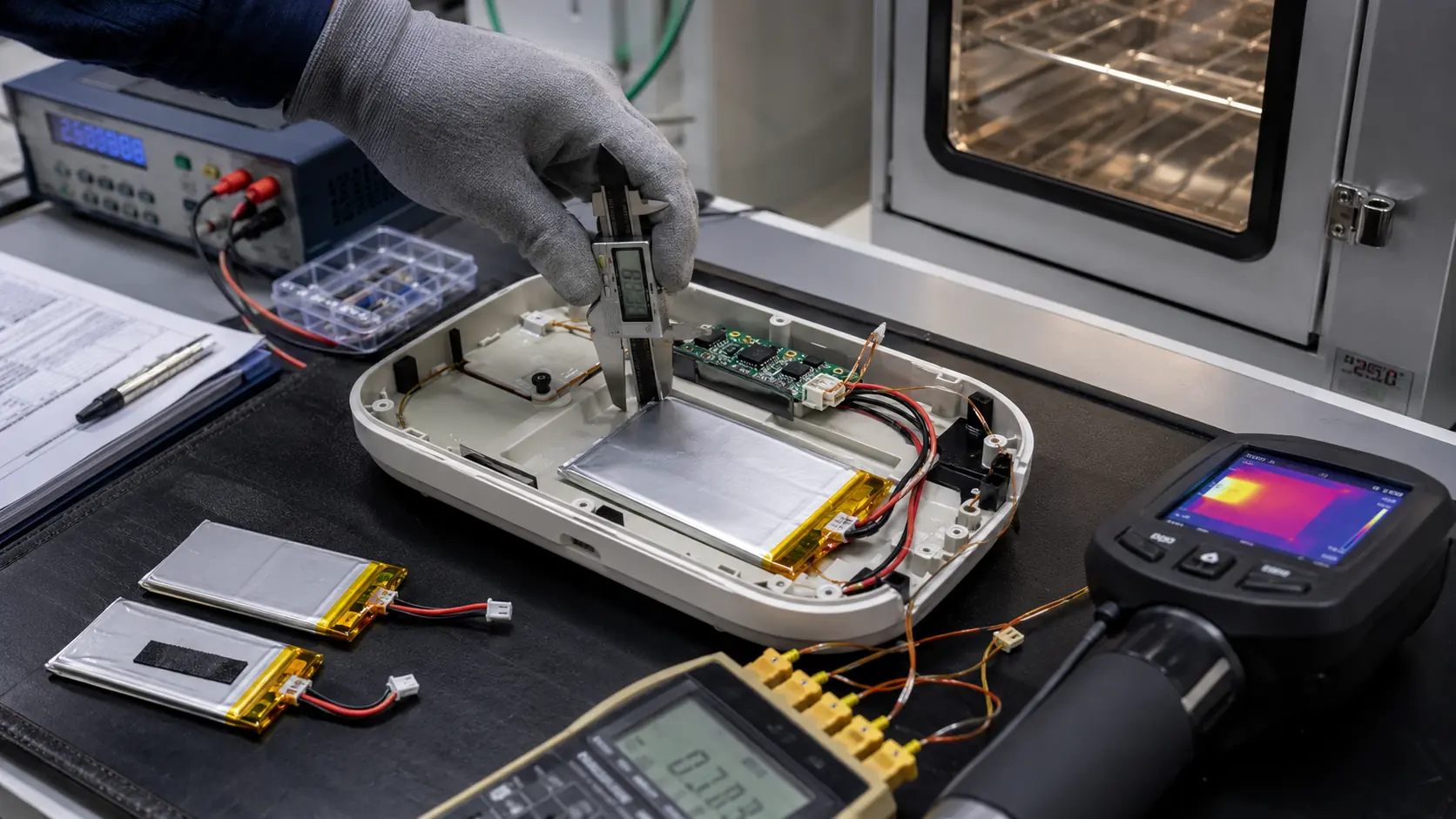
Semi-solid electrolyte also does not remove electrode expansion. Graphite, silicon-containing anodes and lithium-metal interfaces can change thickness with SOC and aging, while side reactions can still produce gas. A rigid enclosure may hide visible swelling while increasing local force. Apply the measurement logic in the LiPo pouch-cell swelling guide: define SOC, temperature, rest, preload and measurement location, and separate reversible breathing from residual life growth.
| Device integration gate | Minimum controlled evidence | Failure if ignored |
|---|---|---|
| Charge compatibility | Maximum voltage, CC/CV profile, termination, recharge, gauge and PCM/BMS limits. | Overcharge margin loss, incomplete charge, gauge error or accelerated aging. |
| Cold operation | Cold discharge voltage sag and cold charge acceptance at relevant SOC and age. | Early cutoff, lithium plating or unacceptable charge time. |
| High temperature | Heat rise under load, high-temperature operation/storage and interface stability. | Gas generation, resistance growth, life loss or safety-margin reduction. |
| Free dimensions | BOL envelope, SOC breathing, residual growth and local PCM/label/tab maxima. | The sample fits initially but the production pack or aged pack interferes. |
| Constrained force | Force/pressure where the enclosure contacts the pouch under defined SOC, temperature and life state. | Hidden load transfers into display, PCB, seal or enclosure. |
PROJECT FIT REVIEW
For first-pass screening, send the current battery datasheet, maximum cavity, charge voltage, device cutoff, current profile, temperature range and swelling clearance.
4. Treat Safety, Transport and Certification Separately
Immobilizing liquid electrolyte can improve leakage resistance, thermal behavior or abuse tolerance in some designs, but semi-solid is not a synonym for nonflammable, non-combustible or incapable of thermal runaway. A pouch-cell study comparing quasi-solid and liquid-electrolyte lithium-metal cells evaluated safety at electrolyte, interface, coin-cell and pouch-cell levels, which illustrates why complete-cell evidence is required. [3]
| Evidence layer | Minimum OEM question |
|---|---|
| Electrolyte/material | What retained liquid, plasticizer or flammable component remains, and what are the thermal and flammability test methods? |
| Cell electrochemistry | What cathode, anode and upper charge voltage are used, and how do they change heat and gas generation? |
| Electrical/thermal abuse | How does the exact production cell behave under overcharge, short circuit, heating and protection faults? |
| Mechanical abuse | What happens after crush, impact, local deformation or other project-applicable mechanical tests? |
| Pack/system | Do protection, spacing, thermal path, enclosure and venting keep the product inside its safety envelope? |
The electrolyte label also does not determine transport classification. The exact chemistry and configuration determine whether lithium-ion or lithium-metal provisions apply. UN 38.3 is a transport testing requirement, not a universal product certification. IATA’s 2026 guidance routes both categories through the applicable UN Manual of Tests and Criteria, Part III, subsection 38.3 requirements and requires a test summary tied to the relevant cell or battery description. Prototype or low-production transport follows separate approval conditions. [9]
| Compliance question | Practical release requirement |
|---|---|
| Transport | UN 38.3 test summary and shipping classification tied to the exact cell/battery design, manufacturer and tested type; confirm prototype rules when production testing is not complete. |
| Portable applications | Evaluate IEC 62133-2 and market/device-specific requirements where applicable; do not present it as universal certification for every product. |
| Industrial applications | Evaluate IEC 62619 or the more specific applicable product standard where within scope. |
| Dimensions/performance | Use controlled drawings and applicable cell performance/dimension standards such as IEC 61960-3 where relevant; this does not replace pack-level approval. |
| Design change | Define which chemistry, construction, connection, mass, production-site or pack changes trigger revalidation or document update. |
The relevant IEC scope must be selected by application: IEC 62133-2 addresses portable sealed secondary lithium cells and batteries, IEC 62619 addresses industrial secondary lithium cells and batteries, and IEC 61960-3 covers specified performance, marking and dimensional topics for portable lithium cells and batteries. A standard named in a supplier brochure is not proof that the quoted production configuration is covered by a valid report. [10] [11] [12]
SAFETY RED LINE
Do not convert ‘improved safety’ into ‘cannot catch fire’. Require direct evidence from the exact production-intent cell and finished pack under the applicable transport, regulatory, customer and final-device conditions.
5. Confirm Manufacturing, Supply-Chain and Commercial Readiness
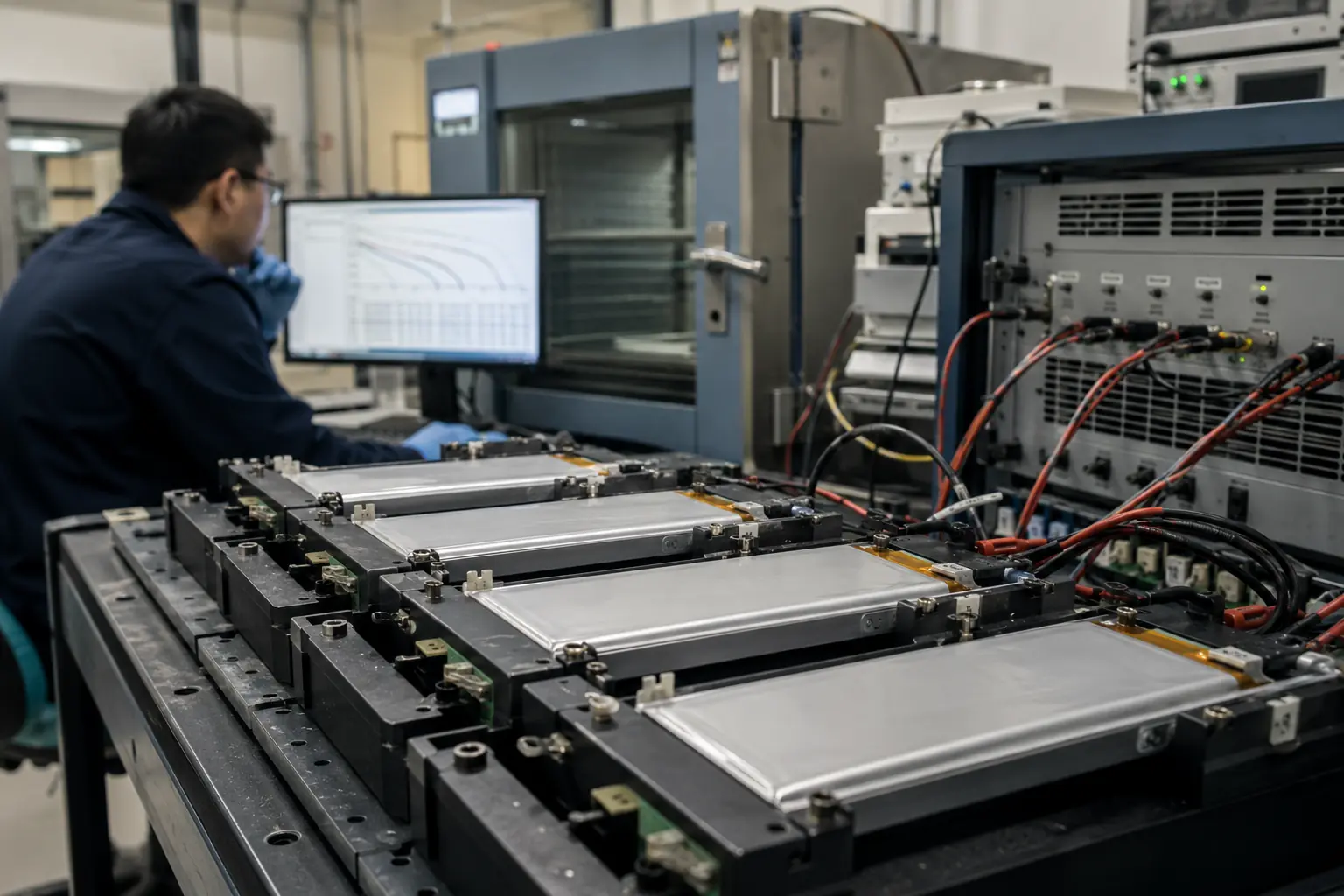
A chemistry can work in a coin cell or carefully built pouch and still fail as a stable product. Semi-solid systems may add process variables such as precursor wetting, in-situ polymerization, initiator/catalyst control, cure temperature, conversion, residual monomer, electrolyte distribution, fixture pressure, formation and interface conditioning. Reviews of practical in-situ-polymerized polymer batteries note that the process can retain favorable electrode/electrolyte contact and fit existing lithium-ion manufacturing concepts, while scale-up from lab cells to practical pouch cells still requires tighter process control and validation. Map those new control points against the visible LiPo battery production process so that each variable has an owner, record and acceptance criterion. [13]
Production readiness is also commercial. A technically acceptable sample may still be unsuitable if the supplier cannot support the target size, forecast, lead time, certification route, change control or long-term material availability. The OEM should therefore release the chemistry, cell design, pack design, process route and supply agreement as one controlled configuration.
| Readiness gate | Supplier evidence to request | Buyer risk addressed |
|---|---|---|
| Materials | Controlled polymer/monomer, salt, solvent/additive, cathode and anode specifications with approved-source and change-control rules. | Unannounced formulation drift or loss of performance consistency. |
| Wetting / polymerization | Fill quantity/distribution, soak, time-temperature window, conversion or validated proxy, fixture condition and equipment traceability. | Local dry area, incomplete cure, inconsistent interfaces or lot spread. |
| Formation / degassing | Formation recipe, aging/quarantine, gas removal, OCV/IR/capacity/thickness criteria and retained samples. | Early swelling, self-discharge or unstable first production lots. |
| Pilot-to-production | Multiple production-intent lots, distribution data, end-of-line controls and pilot-to-mass-production correlation. | Approval based on hand-selected or laboratory-built samples. |
| Commercial supply | Available configuration, MOQ, sample and production lead time, forecast/capacity alignment and product-lifecycle commitment. | A technically suitable cell that cannot support launch or ongoing demand. |
| Change and continuity | PCN process, revalidation triggers, material/plant changes, second-source strategy and end-of-life notice. | Certification invalidation, redesign or unexpected supply interruption. |
COMMERCIALIZATION TEST
Ask whether the quoted performance comes from the same production-intent cell size, electrode loading, pouch construction, manufacturing route and production location that will be shipped. Different-format or laboratory data are development evidence, not production approval.

6. Build a Production-Intent Validation and Release Plan
The fastest defensible comparison is one normalized matrix. Do not compare one supplier at 25 °C and 0.2C with another at a different charge voltage, discharge cutoff, pressure, rest or cycle endpoint. Freeze the project pass criteria before reviewing results, and identify whether each result comes from a literature paper, supplier datasheet, supplier test report, third-party qualification, engineering sample or production lot.
| Validation item | Controlled condition | Project pass criterion | Evidence and release record |
|---|---|---|---|
| Usable energy | Same charge limit, temperature, rest, duty cycle and device cutoff. | Minimum delivered Wh at BOL and defined aged state. | Raw curve, calculation basis, sample IDs and cell mass/volume basis. |
| Power | Multiple SOCs and temperatures; defined pulse/continuous waveform. | Voltage sag, heat rise and cutoff margin remain within device limits. | Current/voltage/temperature traces and resistance method. |
| Charge | Approved charger profile, coldest charge temperature, high SOC and aged resistance. | No prohibited condition; charge time, heat and retention meet project limits. | Charger settings, cell temperature and post-charge checks. |
| Life/storage | Cycle and calendar/storage plan with periodic energy, resistance, self-discharge and dimensional checkpoints. | Project-specific retention, resistance and dimensional limits. | Defined sample quantity, lot coverage, failures and censoring rules. |
| Mechanical | Defined SOC, temperature, rest and preload; free and constrained measurements. | Finished envelope and local force stay within product limits. | Controlled drawing, measurement locations, fixture and aged data. |
| Safety/compliance | Applicable cell/pack tests and project-specific abuse conditions. | Pass the applicable acceptance criteria with reports tied to the exact design. | Test summary/report identifiers, lab, date and tested-type mapping. |
| Production | Production-intent lots and final end-of-line process. | Lot distribution and traceability satisfy the release plan. | Lot IDs, process revision, control plan, retained samples and PCN agreement. |
Sample count and acceptance limits must be risk- and project-based; one universal number would be misleading. Define samples and lots before testing, include expected failures and exclusions, and use capability statistics only when the measurement system, quantity and process stability support them. A single best sample is not a lot distribution.
Link the validation to the final connector, wire harness, PCM/BMS, NTC, insulation and enclosure. The PCM/BMS selection guide and battery-pack thermal-management guide help define system limits; record the final release through the battery-pack prototype testing and validation process.
FINAL APPROVAL RULE
Approve the exact production configuration only when usable energy, power, charge compatibility, temperature, life, safety, transport/certification, swelling/force behavior, lot consistency and commercial supply all remain inside the project-specific validated envelope.
Need to Verify Whether Semi-Solid Is Worth the Change?
Share the current cell baseline, usable-energy target, load waveform, charge limits, finished battery space and production forecast. THOR Power can compare the claimed benefit against power, swelling, safety, validation and supply-chain evidence.
7. Decide When Semi-Solid Is Worth the Change
Where capacities above 5,000 mAh are relevant, compare the candidate against current large-capacity LiPo battery models at identical mass, volume, load and integration boundaries rather than assuming a technology premium.
| Project condition | Recommended direction |
|---|---|
| Mass or cavity volume is the dominant constraint; moderate current is acceptable; a validated higher-energy production cell is available. | Strong candidate for semi-solid evaluation. Compare both Wh/kg and Wh/L at pack level. |
| Very high continuous/peak current dominates and a mature high-rate LiPo already meets the weight target. | Keep the conventional high-rate cell as the baseline; require equal voltage-sag and heat evidence before changing. |
| The enclosure has near-zero swelling or force margin. | Do not assume semi-solid solves the problem. Require controlled free-thickness and constrained-force data. |
| The product must fast-charge in cold conditions. | Treat this as a dedicated electrochemical and thermal validation project; the technology label is insufficient. |
| The supplier shows only coin-cell, research-pouch or different-format data. | Development evidence only. Do not release production. |
| Energy, power, life, safety, mechanical and lot gates pass, but cost, MOQ or lead time do not support the business case. | Keep the technical option open but do not release it for the current launch. |
| Production-intent cells pass all technical, certification and supply gates and create a measurable product benefit. | Proceed to pilot production and controlled change approval. |
The business case should use product-level value, not cell novelty. Compare grams or cubic centimeters saved, additional device runtime, thermal redesign avoided, certification work, engineering time, unit-cost change, yield risk and supply continuity. Semi-solid is worth the change when the validated benefit survives at finished-product level.
8. Send the Right Project Inputs and Require the Right Outputs
The evidence plan should follow the final device, not the technology label. For compact products, review small electronic device battery applications before freezing the cavity, current, charge, temperature and certification inputs.
| Buyer should send | THOR Power should return for the project |
|---|---|
| Application, target market and certification route | Applicable technology path, transport category to confirm and qualification evidence plan. |
| Maximum finished-pack cavity and fixed dimensions | Proposed pouch/pack envelope, local stack-up assumptions and required mechanical clearance. |
| Required Wh/runtime, device cutoff and load waveform | Same-basis usable-energy and voltage-sag comparison between candidate configurations. |
| Continuous/peak current and pulse duration | Current capability, resistance method, heat limits and test conditions. |
| Charge method, maximum voltage and gauge/protection requirements | Approved charge-voltage class, PCM/BMS/NTC concept and compatibility risks. |
| Charge/discharge/storage temperature and life target | Temperature, cycle/storage and dimensional validation matrix with missing evidence identified. |
| Connector, wire, label, insulation and enclosure requirements | Production-intent pack drawing and integration assumptions. |
| Forecast, sample quantity, launch date and continuity requirement | Confirmed availability, project-specific MOQ/lead time, pilot path, change control and production conditions. |
Evaluating a semi-solid LiPo battery for an OEM product? Send the existing battery datasheet, cavity drawing, load profile, charge voltage, temperature range, lifetime target, swelling limit, certification markets and forecast quantity. THOR Power can compare conventional and semi-solid pouch options against one production-intent plan and identify which evidence is still missing. ## Key Takeaways
‘Semi-solid LiPo’ is a commercial label, not a complete or standardized cell specification.
Separate electrolyte architecture from cathode/anode chemistry; a silicon-carbon semi-solid Li-ion cell is not equivalent to a lithium-metal research cell.
Compare Wh/kg, Wh/L and usable device Wh on the same mass, volume, voltage, temperature and aging basis.
High energy and high power are separate objectives; validate voltage sag and heat under the real duty cycle.
Semi-solid does not prove nonflammability, eliminate swelling or waive transport and application safety requirements.
Production approval needs exact cell, pack, process, lot, certification and change-control evidence.
A technical gain is commercially useful only when MOQ, lead time, cost, forecast and long-term supply also support the product.
Planning a Semi-Solid LiPo Battery Pack?
Share your device space, thickness limit, runtime target, discharge current, charging method, operating temperature, certification needs and annual volume. THOR Power can help compare semi-solid and conventional LiPo options with samples, UN38.3/MSDS support, and stable mass production.
9. FAQ: Semi-Solid LiPo Battery
What is a semi-solid LiPo battery?
It is a commercial term commonly used for a lithium-ion pouch cell that uses a gel or quasi-solid electrolyte containing a polymer or solid framework and a retained liquid phase. Exact construction varies by manufacturer, so the term alone is not a complete specification.
Is a semi-solid battery the same as an all-solid-state battery?
No. Semi-solid or quasi-solid designs normally retain liquid or plasticizer inside a framework. All-solid-state designs aim to conduct ions through solid electrolyte layers without a conventional liquid phase.
Does semi-solid automatically mean higher energy density?
No. Higher Wh/kg or Wh/L depends on the cathode, anode, electrode loading, electrolyte amount, inactive mass, pouch construction and test basis. Require the value for the exact production cell, including the stated mass/volume denominator and discharge condition.
Are semi-solid LiPo batteries safer?
They can reduce free-liquid behavior and improve abuse response in specific designs, but safety remains chemistry-, cell-, pack- and test-specific. Do not describe a cell as nonflammable or incapable of thermal runaway without direct production-cell evidence.
Can semi-solid LiPo batteries deliver high C-rate?
Some can, but high-energy designs may prioritize endurance over extreme discharge rate. Validate current in amperes, pulse duration, resistance, heat and voltage sag at the real SOC, temperature and aged condition.
Do semi-solid pouch cells swell?
They can still change thickness because electrodes expand with SOC and aging, interfaces evolve and gas may still be generated. Validate the maximum finished-pack envelope, reversible SOC breathing, residual life growth and constrained force where the enclosure contacts the cell.
Can I replace a normal 1S LiPo with a semi-solid cell of the same size?
Not by size alone. Confirm maximum charge voltage, charger and gauge compatibility, usable energy, current, temperature, dimensions, protection behavior, transport/safety evidence and production consistency before substitution.
What certification does a semi-solid LiPo battery need?
There is no universal ‘semi-solid certification.’ UN 38.3 is a transport test basis rather than a general product certification. Other applicable requirements depend on the exact chemistry, cell/pack design, application and destination market; confirm the relevant portable, industrial or device-specific safety route for the production configuration.
What is the biggest sourcing risk?
The largest risk is treating a prototype metric or marketing label as a production specification. Require evidence from the exact cell size, chemistry, process, production location and lot, then validate it in the finished device.
Conclusion
Semi-solid LiPo technology can be a meaningful bridge between mature liquid-electrolyte pouch cells and future all-solid-state systems. It can support higher-energy designs and reduce free-liquid behavior while preserving favorable interface contact. Those advantages also introduce new control points in terminology, ion transport, electrode chemistry, charge compatibility, mechanical behavior, polymerization, lot consistency and supply continuity.
THOR Power can supply semi-solid LiPo solutions when the production configuration fits the project’s technical and commercial envelope. The correct decision is to compare conventional and semi-solid candidates under the same device conditions and release the exact cell, pack and process together. If the new configuration delivers more usable product-level value without violating power, temperature, charge, life, safety, certification, swelling, production or supply limits, it is a real upgrade.
Technical References
- Zhou X. et al. Gel polymer electrolytes for rechargeable batteries toward wide-temperature applications. Chemical Society Reviews 53 (2024) 5291-5337. Source
- Ahmed M.S. et al. A Comprehensive Review of Functional Gel Polymer Electrolytes and Applications in Lithium-Ion Battery. Gels 10 (2024) 563. Source
- Revealing the quasi-solid-state electrolyte role on the thermal runaway behavior of lithium metal battery. Energy Storage Materials 70 (2024) 103481. Source
- Gao Q. et al. Low-temperature Li+ transport kinetics and regulation in quasi-solid-state batteries. Nano Energy 148 (2026) 111655. Source
- Peng X. et al. A scalable and long-cycle-life 600 Wh kg-1 solid-state lithium metal pouch cell. Nature Communications 16 (2025) 11695. Source
- Liu F. et al. Polymer-Ion Interaction Prompted Quasi-Solid Electrolyte for Room-Temperature High-Performance Lithium-Ion Batteries. Advanced Materials 36 (2024) 2409838. Source
- Chen X. et al. Contriving a gel polymer electrolyte to drive quasi-solid-state high-voltage Li metal batteries at ultralow temperatures. Energy & Environmental Science 18 (2025) 910-922. Source
- Xu W. et al. Conjugated topologically confined composite electrolytes for robust high-voltage and high-temperature semi-solid-state lithium metal batteries. Energy & Environmental Science 19 (2026) 384-396. Source
- International Air Transport Association. Guidance Document for Lithium Batteries and Sodium Ion Batteries – 2026. Source
- International Electrotechnical Commission. IEC 62133-2:2017+A1:2021 – Safety requirements for portable sealed secondary lithium cells and batteries. Source
- International Electrotechnical Commission. IEC 62619:2022 – Safety requirements for secondary lithium cells and batteries for industrial applications. Source
- International Electrotechnical Commission. IEC 61960-3:2017 – Performance and marking requirements for portable secondary lithium cells and batteries, including laminate-film cell dimensions. Source
- Liu Q., Wang L., He X. – Toward Practical Solid-State Polymer Lithium Batteries by In Situ Polymerization Process: A Review. Advanced Energy Materials 13 (2023) 2300798. Source
Author, Technical Review and Evidence Standard
| Role | Details |
|---|---|
| WRITTEN BY | Victor Xiong President of OEM Division & Custom Battery Specialist Focus: translating next-generation pouch-cell claims into controlled OEM specifications, sample tests, supply decisions and production release. |
| TECHNICALLY REVIEWED BY | Dr. Maximilian Weber Chief Scientist Review focus: electrolyte architecture, electrochemical trade-offs, safety/mechanical boundaries, scale-up evidence and production-intent validation. |
Evidence standard: Peer-reviewed results remain tied to the cited chemistry, cell format, electrolyte loading, electrode loading, pressure/fixture and test condition. Numerical examples and diagrams are illustrative engineering screens, not universal semi-solid LiPo performance limits or THOR Power first-party laboratory claims. THOR supply availability and final approval are confirmed using the exact production cell/pack documentation and controlled application data.