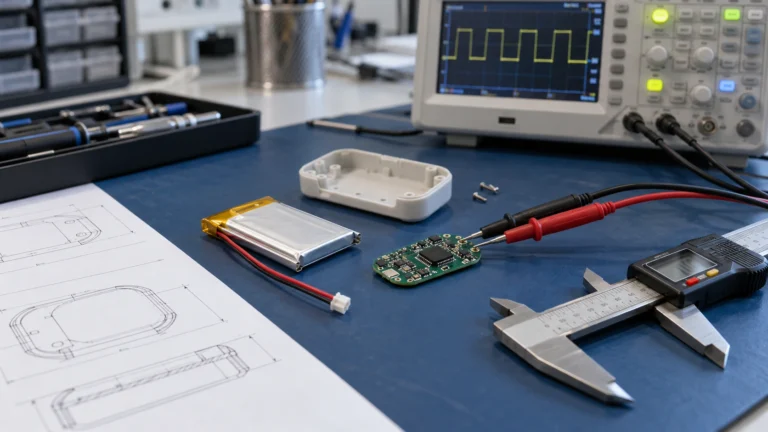
Custom LiPo Battery Prototyping: From Device Requirements to Mass Production
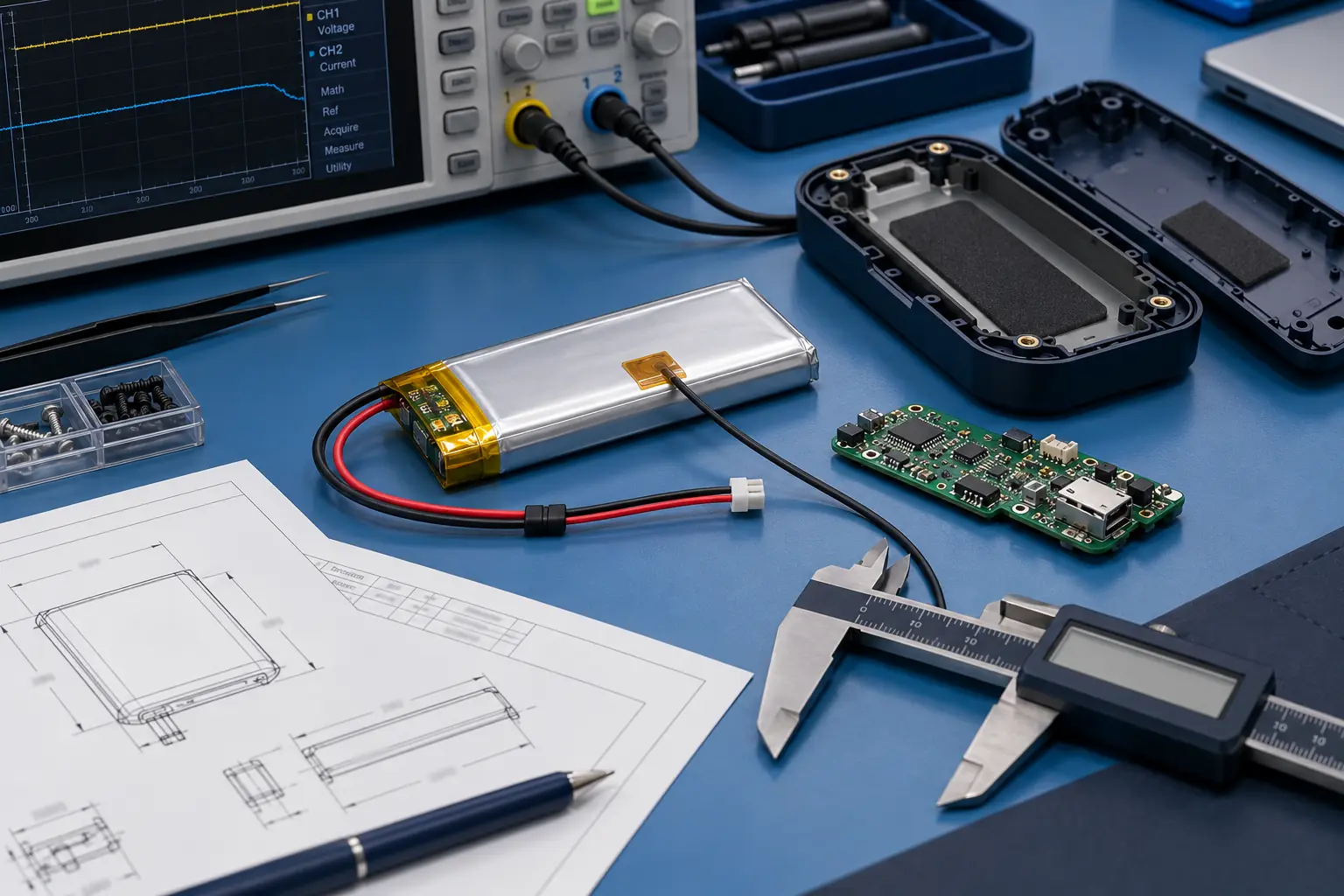

Technical reviewer: Dr. Maximilian Weber
Chief Scientist at THOR Power. Reviews prototype validation boundaries, electrical limits, battery safety and production relevance.

Author: Victor Xiong
President, OEM Division & Custom Battery Specialist. Leads custom battery requirement definition, prototype coordination and production release.
An OEM engineering guide to requirement definition, engineering samples, production-intent validation, change control and release
A custom LiPo battery prototype is useful only when it reduces uncertainty. The buyer is not trying to prove that one hand-built sample can power the device once. The real goal is to convert a device requirement into a battery configuration that can be measured, repeated, documented and released to production without silently changing the mechanical fit, electrical path, protection behavior or compliance basis.
Quick Answer
A controlled development path is: requirement package -> candidate cell -> engineering samples -> real-device validation -> production-intent samples -> compliance review -> controlled mass-production release. Freeze the finished-pack drawing, BOM, test method and acceptance limits before release. Treat any later change to the cell, PCM, wire, connector, charge voltage or assembly process as an engineering change that may require revalidation.
Terminology used in this guide: “Production-intent sample” means a sample built with the cell construction, PCM, harness, materials and assembly process intended for production. It is a project-control term used here for clarity; it is not a universal IEC certification category.
Contents
- 1. What a Battery Prototype Must Prove
- 2. Define the Device Requirement Package
- 3. Choose a Standard Cell, Custom Pack or Custom Cell
- 4. Plan Engineering Samples Around the Test Matrix
- 5. Validate the Battery in the Real Device
- 6. Build and Freeze the Production-Intent Configuration
- 7. Control Changes and Revalidation
- 8. Plan Compliance at the Correct Stage
- 9. THOR Power Project Case: Spanish OEM Program
- 10. Production Release Checklist
- 11. Engineering RFQ Checklist
- 12. Frequently Asked Questions
- 13. Technical References
1. What a Battery Prototype Must Prove
A prototype has value only if each sample is tied to a decision. The most common buyer mistake is to ask, “Can you make a sample?” before defining what the sample must prove. That creates a physical object without a release logic.
| Buyer question | Prototype must establish | Evidence before approval |
|---|---|---|
| Will it fit? | Maximum finished-pack envelope, local PCM/connector protrusions, cable exit and assembly path. | Controlled drawing, measured samples and fit in representative enclosures. |
| Will it run the device? | Usable energy, continuous load, critical pulse, device cutoff and low-SOC margin. | Battery-terminal and device-level measurements using the real load profile. |
| Will charging be correct? | Cell voltage class, charge current, charger accuracy, PCM/NTC behavior and gauge assumptions. | Charge profile and protection behavior on the intended hardware. |
| Can it be produced repeatedly? | Released cell, PCM, wire, connector, insulation, label, process and acceptance limits. | BOM, drawing, test method, approved reference / retain samples and change-control rules. |
Use nominal capacity and cell code only for discovery. The release must be based on the finished assembly and device conditions. For the mechanical boundary, use the LiPo Battery Dimensions Guide and the Finished Battery Size Guide.
2. Define the Device Requirement Package
A request such as “3.7V, 1000mAh, as small as possible” is enough to begin a conversation but not enough to build a controlled sample. Before tooling or sample assembly, define the hard limits, the flexible targets and the unknowns that the prototype is expected to resolve.
| Requirement group | Minimum buyer input | Why it changes the battery |
|---|---|---|
| Mechanical | Minimum usable cavity or maximum finished T × W × L, keep-out zones, cable exit, assembly direction. | Determines cell geometry, PCM position, wire route and real fit margin. |
| Energy | Runtime target, duty cycle, device cutoff and standby/storage expectation. | Separates nominal mAh from usable energy in the real device. |
| Power | Continuous current, peak/pulse current, duration, repetition, lowest SOC and temperature. | Controls cell impedance, protection path, wire, connector and brownout margin. |
| Charging | Maximum cell voltage, charge current, charger IC/accuracy, NTC and gauge behavior. | Prevents 4.20 V / 4.35 V platform mismatch and protection conflicts. |
| Interface | PCM/BMS functions, connector/mating part, pinout, polarity, wire gauge and length. | Defines the complete current path and final pack geometry. |
| Environment/life | Operating, charging and storage temperatures; cycle/storage target; vibration/service needs. | Changes validation conditions and end-of-life margin. |
| Program | Prototype quantity, forecast, target markets, documentation and certification route. | Determines test allocation, compliance timing and release evidence. |
If the mating connector is not yet frozen, define it before the production-intent stage using the LiPo Battery Connector Types Guide. If protection thresholds or timing may limit the load, use the PCM/BMS Selection Guide. For voltage-platform decisions, review 4.2V vs 4.35V Lithium Battery Charger Compatibility before samples are frozen.
Buyer red line: Do not freeze the enclosure around a nominal cell model and do not approve polarity from wire color alone. Release the finished-pack geometry and electrical interface from controlled drawings and measurements.
3. Choose a Standard Cell, Custom Pack or Custom Cell
“Custom battery” does not automatically mean a new electrochemical cell. The lowest-risk solution is often an existing cell geometry with a project-specific PCM, NTC, connector, wire length, polarity, label or mechanical arrangement. A custom cell should be considered only when the project cannot meet its hard requirements with a credible existing platform.
| Project situation | Preferred engineering path | Reason |
|---|---|---|
| Existing cell fits with margin and meets current/life needs. | Standard cell + project-specific pack configuration. | Fastest path with the least electrochemical uncertainty. |
| Cell fits, but connector/PCM/wire/finished size must change. | Custom pack around an existing cell. | Solves interface and packaging without unnecessary cell development. |
| Hard thickness/width/length or usable-energy target cannot be met by existing families. | Custom cell development plus production-intent pack validation. | Justified only when the device requirement creates real value. |
| Capacity, thickness, current and life targets conflict. | Renegotiate the requirement before tooling. | Avoids paying to prototype an infeasible specification. |
THOR Power’s commercial customization scope is summarized on the Custom LiPo Battery page. For the high-level buyer workflow, see How Custom Battery Projects Work.
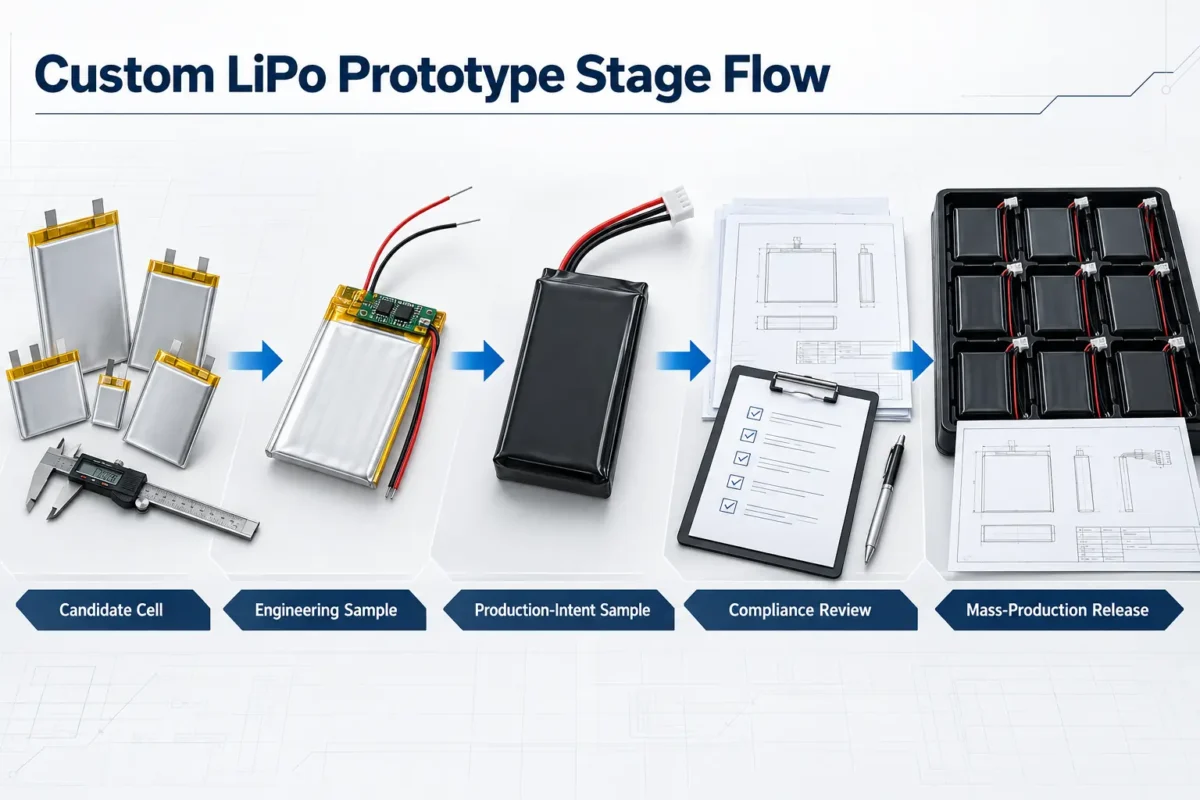
4. Plan Engineering Samples Around the Test Matrix
Sample quantity should come from the questions that must be answered. A fixed universal MOQ is not a validation method. Some samples are consumed by fit checks, destructive tests, environmental tests, customer evaluation or compliance work and therefore cannot all be returned to the same use.
| Sample stage | Purpose | Typical control status |
|---|---|---|
| Candidate cell / feasibility unit | Screen geometry, chemistry platform and first-pass capacity/current fit. | May not contain the final harness or protection configuration. |
| Engineering sample | Answer defined mechanical, electrical and device-integration questions. | Temporary or still-to-be-confirmed parts may be allowed if clearly documented. |
| Production-intent sample | Validate the configuration intended for volume production. | Cell construction, PCM, harness, materials, assembly route and drawing revision should match intended production. |
| Release / retain sample | Reference production acceptance and future change review. | Tied to released BOM, drawing, test method and acceptance limits. |
A practical allocation is: fit samples + electrical/device samples + environmental/destructive samples + customer units + retained references. Engineering samples are often more expensive per unit than production because small-batch material handling, custom harness work, setup and inspection are concentrated into very few pieces. The useful buyer question is not “Why is the sample expensive?” but “Which uncertainty will this sample remove?”
5. Validate the Battery in the Real Device
Bench measurements are necessary but they do not reproduce every system interaction. The device adds regulator behavior, firmware timing, input capacitance, PCB resistance, charging logic, enclosure pressure, heat sources and service conditions. A battery that passes on heavy laboratory leads can still fail after the production harness and mating connector are introduced.
| Validation area | What to measure or inspect | False pass to avoid |
|---|---|---|
| Mechanical fit | Maximum finished size, local high points, connector pocket, wire bend and assembly path. | Checking only nominal cell dimensions. |
| Runtime / usable energy | Device duty cycle, cutoff voltage, low-SOC behavior, temperature and aging point. | Assuming rated mAh equals usable runtime. |
| Continuous / pulse load | Pack output and PCB-input voltage, current, PCM behavior, connector drop and temperature. | Testing only room-temperature mid-SOC current. |
| Charging | Maximum voltage, charge current, charger accuracy, NTC and protection thresholds. | Assuming every 1S LiPo uses the same charge ceiling. |
| Environment / life | Relevant temperature, cycle/storage condition, vibration or service use where applicable. | Approving only a new-cell bench sample. |
| Production repeatability | Multiple production-intent samples across expected variation. | Treating one best sample as the distribution. |
For detailed test planning, use the Battery Pack Prototype Testing and Validation Guide. For devices with large startup or radio/motor bursts, use the High-Discharge LiPo Battery Guide to define continuous, peak and pulse limits at explicit measurement points.
Release gate: Final device approval should use the production-intent battery and a representative production-intent device. Any temporary lead, substitute connector or provisional PCM used earlier must be removed from the final evidence set unless it is formally released.
6. Build and Freeze the Production-Intent Configuration
The transition from a successful engineering sample to production is where many projects lose control. A prototype can pass even though the supplier still intends to change the cell grade, FET, PCM layout, wire length, terminal, tape, label or assembly route. If those items can affect fit, current path, charging, thermal behavior or compliance, the prototype is not yet a production reference.
Freeze, at minimum:
- Cell manufacturer/model or controlled cell construction and capacity grade.
- PCM/protection circuit revision, protector IC/FET set and NTC where applicable.
- Wire gauge, length, color, connector housing, terminals, pinout, polarity and exit direction.
- Insulation, tape, label, adhesive/foam and finished-pack drawing.
- Capacity/load/charge test methods, measurement boundaries and acceptance limits.
- Approved suppliers or controlled alternatives for critical components.
- Approved reference / retain sample identifiers, BOM revision and drawing revision.
The production reference is the controlled document set plus approved reference samples and acceptance evidence. A physical reference sample alone cannot tell a future inspector which FET, crimp terminal, wire length or test condition was originally approved.
7. Control Changes and Revalidation
Change control keeps a validated battery from silently becoming a different product. Not every change requires the same amount of retesting, but any change that can alter the released evidence must be reviewed before shipment.
| Change trigger | Minimum engineering response | Likely evidence to repeat |
|---|---|---|
| Cell model, construction, capacity grade or voltage class | Re-open electrical, mechanical and life review. | Capacity, load, charge, fit, life and compliance assessment as applicable. |
| PCM/protector/FET revision | Review thresholds, delays, resistance and thermal behavior. | Protection and load tests at project conditions. |
| Wire/connector/terminal change | Review pinout, resistance, crimp, fit and sourcing status. | Polarity, continuity, voltage-drop, heat and mechanical fit. |
| Finished-pack geometry/material change | Review enclosure fit, pressure points and assembly path. | Dimensional inspection and representative device fit. |
| Process or supplier change for critical item | Assess whether prior process capability/evidence remains valid. | Incoming/process checks plus targeted revalidation. |
| Compliance-relevant change | Review applicable standard/type definition and test-report impact. | Engineering/compliance decision before shipment. |
8. Plan Compliance at the Correct Stage
Compliance planning should start early, but expensive final testing should not be launched against a configuration that is still likely to change. Freeze the items that define the tested battery before starting the final certification or transport test route whenever the applicable program allows it.
IEC 61960-3:2017 provides performance tests, designations, markings, dimensions and other requirements for secondary lithium cells and batteries for portable applications; Annex A addresses dimensions of laminate-film cells. It is useful for performance/measurement discipline, not as a substitute for product-specific safety or transport requirements.
IEC 62133-2:2017 + AMD1:2021, including COR1:2021 where applicable, covers safety requirements and tests for portable sealed secondary lithium cells and batteries under intended use and reasonably foreseeable misuse. The exact certification route, CB scheme use, national deviations and end-product requirements depend on the target market and device category; avoid the vague claim that a battery simply “has IEC certification.”
UN Manual of Tests and Criteria, Revision 8 (2023) and Amendment 1 (2025) contains the current UN transport-test framework and changes affecting subsection 38.3. A configuration change must be reviewed against the applicable type definition and transport documentation rather than assuming an earlier report automatically covers a changed pack.
9. THOR Power Project Case: Spanish OEM Program
Case scope: The following anonymized account is based on a completed THOR Power customer project in Spain. Customer identity, product details and commercial pricing are omitted. The purpose is to show how sample allocation, validation and certification planning controlled the transition from engineering samples to the production of 800 battery-pack assemblies.
A Spanish OEM required a custom battery program that ultimately entered production for 800 battery-pack assemblies. The technical risk was not the ability to assemble hundreds of units; it was deciding which configuration deserved to be multiplied. The project therefore separated supplier validation, customer device validation and later compliance work before bulk release.
| Project gate | Actual project plan | Why the gate mattered |
|---|---|---|
| Factory engineering build | 3 packs reserved for THOR internal testing; about 10 days were allocated to this stage. | Allowed mechanical/electrical issues to be found before sending customer units. |
| Customer validation build | 10 additional packs built for real-device evaluation in Spain. | Customer approval had to come from the device, not only factory bench data. |
| International validation logistics | Customer samples planned by air; project communication allowed roughly 15-20 days for transit/handling. | Logistics became part of the development schedule, not an afterthought. |
| Production release | After customer device validation and approval of the 10-sample configuration, THOR Power released and produced 800 battery-pack assemblies. | Prevented an unproven prototype configuration from being multiplied. |
| Compliance allocation | A separate certification quantity was expected; approximately 60-80 packs could be consumed depending on the final laboratory plan. | The nominal production quantity therefore had to be planned separately from units allocated to validation, certification and retained evidence. |
| Custom protection hardware | The project required a dedicated PCM development/tooling step. | Protection configuration had to be controlled before production and certification. |
| Program timing | The customer was advised that final bulk arrival would require at least about 60 days from the current project point. | The long pole was validation + logistics + compliance sequencing, not simply assembly speed. |
The lesson is operational: an 800-pack production target did not mean building all 800 packs before the configuration was proven. Some early units were deliberately allocated to internal validation, customer device validation, certification planning and retained evidence. Only after the required gates were passed was the approved configuration released for production of the 800 battery-pack assemblies.
Evidence boundary: The gates, quantities and timing described here belong to this Spanish project. No unrecorded performance figures, customer identity or confidential product details have been added, and the project-specific certification allocation and delivery timing should not be treated as universal THOR Power commitments.

10. Production Release Checklist
Before mass production, the buyer and supplier should be able to identify exactly what was approved and how a future lot will be judged. The following package is a practical minimum; project risk may require more.
| Release item | Minimum content |
|---|---|
| Finished-pack drawing | Maximum dimensions, local high points, wire/connector geometry, polarity and revision. |
| BOM / critical-part list | Cell, PCM/FET, NTC, wire, connector, insulation/label and controlled sources. |
| Electrical specification | Voltage class, capacity test, charge conditions, continuous/pulse load and cutoff/temperature limits. |
| Device-validation record | Representative-device fit, runtime/load behavior, charging behavior and pass/fail criteria. |
| Production test plan | Incoming/process/final checks, measurement method, sample level and acceptance limits. |
| Approved reference / retain samples | Identifiers linked to the released drawing/BOM and stored under agreed conditions. |
| Compliance / transport file | Applicable reports, declarations, test summaries and configuration scope. |
| Change-control rules | Which changes require notice, engineering review, retest or new compliance assessment. |
11. Engineering RFQ Checklist
A useful RFQ allows the battery engineer to evaluate the device as a system rather than guess at a catalog replacement. Send:
- Application/device and target market.
- Minimum usable cavity or maximum finished-pack T × W × L, including keep-out zones and assembly direction.
- Required runtime, duty cycle and device cutoff voltage.
- Continuous current, peak/pulse current, pulse duration/repetition and lowest SOC/temperature of interest.
- Charge voltage, charge current and charger architecture.
- PCM/BMS/NTC requirements and any shutdown/recovery behavior that matters to the device.
- Exact mating connector or photos/drawing, pinout, polarity, wire gauge/length and exit direction.
- Operating, charging and storage temperatures plus life target.
- Prototype quantity, annual forecast, certification/documentation needs and desired project schedule.
If several fields are unknown, mark them as unknown rather than filling them with guesses. The purpose of the first engineering review is to close those gaps. Use the custom battery inquiry form to submit the project package.
Planning a Custom LiPo Battery Prototype?
Send the finished-pack envelope, load profile, charging requirements, connector and PCM details, prototype quantity, target markets and validation plan. THOR Power can review the engineering path from sample definition to controlled production release.
12. Frequently Asked Questions
How many custom LiPo samples should I order?
There is no universal number. Build the quantity from the test matrix: fit, electrical/device validation, destructive/environmental work, customer units and retained references. Ten samples may be reasonable for one program and inadequate or excessive for another.
Why can prototype pricing be much higher than mass-production pricing?
Engineering samples concentrate setup, material handling, custom harness work, inspection, tooling and low-volume process time into a small quantity. The buyer should judge prototype cost against the uncertainty it removes before volume production.
Does a successful engineering sample mean the pack is ready for mass production?
Not necessarily. Production should wait until the intended cell construction, PCM, harness, materials, assembly process, drawing, BOM, test method and acceptance limits are controlled and validated.
What does production-intent sample mean?
In this guide it means a sample built with the configuration intended for production. It is a THOR project-control term used to distinguish a near-final controlled sample from an early engineering sample; it is not a universal IEC certification stage.
When should IEC 62133-2 or UN 38.3 work start?
Plan the route early, but avoid committing the final test program to a configuration that is still likely to change. The correct timing depends on the target market, device category, transport route and the scope of the released battery configuration.
Can a supplier change an equivalent connector, PCM or cell after approval?
Only through the agreed change-control process. “Equivalent” purchasing descriptions do not prove equivalent electrical, mechanical, thermal or compliance behavior. Critical substitutions should be reviewed and revalidated to the extent justified by risk.
13. Technical References
- [1] IEC 61960-3:2017. Secondary lithium cells and batteries for portable applications – Part 3. Performance tests, designations, markings, dimensions and other requirements; Annex A covers dimensions of cells with a laminate film case. Official source
- [2] IEC 62133-2:2017 + AMD1:2021 (including COR1:2021 where applicable). Safety requirements and tests for portable sealed secondary lithium cells and batteries under intended use and reasonably foreseeable misuse. Official source
- [3] UN Manual of Tests and Criteria, Revision 8 (2023) and Amendment 1 (2025). Current UNECE publication set for the Manual of Tests and Criteria; Amendment 1 includes changes to subsection 38.3 addressing lithium cells and batteries. Official source
Evidence boundary: The standards above define general performance, safety and transport frameworks. They do not create a universal prototype quantity, schedule, certification route or acceptance limit for every OEM project. Final requirements must be set for the exact battery configuration, device, market and validation plan.