
Home / Products / 600mAh LiPo Batteries
3.7V 600mAh LiPo Battery
Compare compact 600mAh LiPo options that add runtime over 500mAh without moving to a much larger battery envelope.
Compare 10 verified 3.7V 600mAh lithium polymer battery models across thin-long, short-wide and narrow formats. Use the model list to screen bare-cell geometry, then confirm the finished pack with PCM, insulation, wires and connector.
Technical Overview
A 3.7V 600mAh LiPo battery is often considered when a 500mAh cell no longer provides enough runtime but moving to a larger 800mAh battery would force unnecessary enclosure growth. It sits at the lower end of THOR Power’s 501–1,999mAh medium-capacity LiPo range. The same 600mAh capacity is produced in different pouch geometries, so thickness, width and length must be checked against the actual battery cavity rather than the capacity number alone. Compact wireless devices, small sensors, handheld accessories and portable monitoring electronics can all use this capacity, but final selection should be based on finished-pack dimensions, continuous and peak load, and the required operating time. THOR Power lists 10 verified 600mAh pouch models — use the model list below to screen geometry, then confirm the finished pack, measured duty cycle, charging method and connector routing.
Find a 600mAh LiPo Battery for Your Available Space
Enter the maximum battery space available in your device. We’ll identify potential matches based on estimated finished dimensions. Final fit must be confirmed after reviewing PCM, insulation, wiring, connector position and mechanical clearance.
10 listed 600mAh models
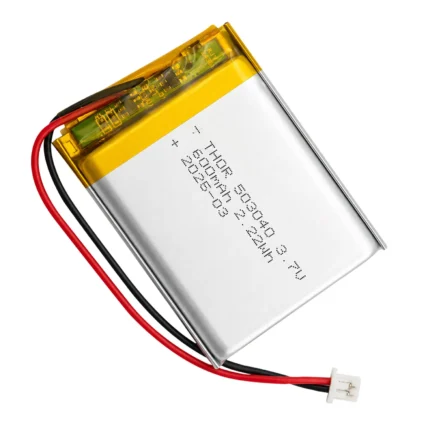


Finished dimensions depend on PCM, insulation, connector and wire-harness configuration and are confirmed on the engineering drawing for the selected model.
Add Runtime Margin Without Moving to an 800mAh Envelope
A 600mAh LiPo battery sits between the common 500mAh and 800mAh classes. At the same nominal voltage, it stores about 20% more nominal capacity than a 500mAh cell. Actual device runtime depends on load profile, conversion efficiency, cutoff voltage, temperature and cell aging, so the capacity difference should be treated as an engineering input rather than a guaranteed runtime increase.
The practical advantage of the 600mAh class is geometry choice: the same rated capacity is available in multiple shapes, allowing engineers to use the enclosure axis that has the most room.
When 500mAh Is Not Enough but 800mAh May Be Too Large
Stay at ~500mAh when
The available cavity is extremely restricted, the runtime requirement is modest and every millimeter of the enclosure matters. Compare 500mAh options if space is the hard limit.
Move to 600mAh when
500mAh runtime is no longer sufficient, a modest geometry increase is acceptable, and the device should stay compact. This is the case the 600mAh class is built for.
Step up to 800mAh when
Longer runtime becomes more important, the enclosure can accept additional volume, and the system load or duty cycle justifies the larger capacity. Compare 800mAh options when more energy is the priority.
Higher capacity is not automatically better. The right choice depends on the finished-pack envelope, the load profile and the required operating time — not on the capacity number alone.
Thin and long
THOR-303065 uses a 3 x 30 x 65mm bare-cell format where thickness is tightly constrained but length is available.
Short and compact
THOR-503040 uses a 5 x 30 x 40mm format for devices that can accept more thickness but less length.
All dimensions above describe the verified bare-cell model geometry. Finished pack dimensions can increase after the protection circuit, tabs, insulation, wires and connector are added.
Validate 600mAh Continuous and Peak Load Requirements
A 600mAh label does not define maximum continuous or peak current. In a compact wireless controller, a small sensor node or a portable accessory, events such as radio transmission bursts, a display or backlight turning on, a buzzer or audio event, sensor startup or a brief motor pulse can draw current well above the average. Continuous and peak capability depends on the selected cell model, its C-rate, internal resistance, PCM configuration, wire gauge, connector and finished-pack design — not every 600mAh model supports the same current. Use the battery runtime and capacity guide for energy planning, then verify the full operating cycle and peak events in a prototype.
For a project-specific review, compare these requirements with a custom LiPo battery configuration.
Bare Cell Size vs Finished Battery Size
The model code and specification dimensions describe the pouch cell itself. Your enclosure must accommodate the complete battery assembly, including protection electronics and cable routing.
In a space-constrained portable device, finished thickness, wire exit and connector position can matter as much as the bare-cell capacity number when confirming that the pack fits the cavity.
Bare Cell Size
Nominal pouch thickness, width and length used to compare cell geometries.
PCM, Insulation, Wires, Connector
Project-specific parts add local thickness, length and bending space.
Estimated Finished Size
The assembly envelope that must be checked against the device cavity.
Allow clearance for assembly tolerance, pouch expansion, connector insertion, wire bend radius and service access. Do not design the battery cavity to the bare-cell dimensions alone.
How to Choose a 600mAh LiPo Battery
A suitable model must satisfy mechanical, electrical and assembly requirements together.
Measure the Space
Record maximum thickness, width and length at the actual battery location.
Allow Clearance
Reserve room for insulation, tolerance, swelling and assembly access.
Confirm the Load
Share average current, peak current, pulse duration and cutoff voltage.
Define the Assembly
Specify PCM, connector, polarity, wire gauge, wire length and exit direction.
Test the Prototype
Verify fit, runtime, charging and thermal behavior in the final device.
A potential match from the filter is a starting point. Engineering confirmation and a physical prototype are required before production release.
Custom 600mAh LiPo Battery Configuration
THOR Power can review a 600mAh battery configuration around the host device rather than treating the cell as an isolated component. Project options can include PCM parameters, connector family, polarity, wire gauge, wire length, wire exit direction, insulation, labels and packaging, subject to engineering confirmation.
For the fastest review, provide a cavity drawing or three-axis space limit, the expected load profile, charging method, connector requirement and target production quantity.
Get an Engineering Quote
Share your enclosure limits and electrical requirements. Our team will review the listed 600mAh models and identify practical candidates for prototype evaluation.
Need a 600mAh LiPo Battery for Your Project?
Tell us your available battery space, application, working current, peak current, connector requirement and quantity. Our engineering team will review the suitable 600mAh model and finished battery configuration.
- Bare Cell Size
- —
- Approx. Finished Size
- —
Your information is used only to review and respond to your battery project request. Privacy Policy.
600mAh LiPo Battery FAQ
What sizes are represented among the listed 600mAh models?
The 10 verified bare-cell models span approximately 3.0 to 8.0mm in thickness, 18 to 30mm in width and 35 to 65mm in length. Finished assembly dimensions depend on the selected PCM, insulation, wires and connector.
How does a 600mAh battery compare with a 500mAh battery?
At the same nominal voltage, 600mAh represents 20% more nominal capacity than 500mAh. The actual runtime difference depends on device load, conversion losses, cutoff voltage, temperature and battery condition.
Should I choose 600mAh or 800mAh?
Choose based on the complete mechanical and electrical requirement. An 800mAh model can provide more nominal energy, while a 600mAh geometry may integrate more easily in a smaller cavity. Compare finished dimensions and validate runtime in the device.
Why do 600mAh LiPo batteries have different shapes?
Pouch-cell geometry can distribute similar active material across different thickness, width and length combinations. This gives product designers alternatives for thin-long, short-wide or narrow battery spaces.
Are the listed dimensions the final battery dimensions?
No. Listed model dimensions describe the bare cell. PCM placement, tab folding, insulation, wiring and connector position can increase the finished envelope.
How much current can a 600mAh LiPo battery deliver?
Current capability depends on the selected cell design, discharge-rate requirement, PCM and thermal conditions. Provide continuous current, peak current and pulse duration for engineering review.
Can a 600mAh LiPo battery power a wireless sensor or compact connected device?
Potentially yes, but check the average load, the transmission or sensing peaks and the actual cell and PCM current capability. Confirm the finished envelope, runtime, charging method and temperature with the real electronics before committing to a model.
Related Pages
Why compare nearby capacities: A 500mAh model may provide more packaging margin in a tightly constrained enclosure. An 800mAh model may extend runtime when added finished-pack volume and charge time are acceptable.