LiPo Battery vs. Li-ion Battery: Understanding the Real Differences


Technically Reviewed By
Chief Scientist
Dr. Maximilian Weber is THOR Power’s Chief Scientist and a senior expert in lithium battery technology. His technical review focuses on battery safety, performance optimization, energy density and custom battery solution development.
Last technical review: September 2026

Written By
President of OEM Division & Custom Battery Specialist
Victor Xiong holds a Master’s degree from The Chinese University of Hong Kong, Shenzhen. He leads THOR Power’s OEM Division and focuses on custom battery solutions for global device brands, product developers and industrial customers.
| Written By | Technically Reviewed By |
|---|---|
| Victor Xiong President of OEM Division & Custom Battery Specialist. Victor Xiong leads THOR Power’s OEM Division and focuses on custom battery development for global device brands, product developers and industrial customers. His work centers on translating product requirements into controlled cell, pack and production decisions. | Dr. Maximilian Weber Chief Scientist. Dr. Weber is a senior expert in lithium battery technology. His review for this article focuses on cell-format terminology, pack geometry, voltage and current boundaries, mechanical and thermal integration, safety scope and production evidence. |
The Real Problem: Same mAh Does Not Mean Same Battery
An OEM team compares a 4600 mAh pouch cell with a 4500 mAh 21700 cell. Purchasing sees almost the same capacity. Industrial design sees a 4.8 mm-thick flat battery versus a 21.55 mm-diameter cylinder. The power engineer sees different voltage profiles, current paths and charger requirements. The quality team sees different handling, inspection and change-control risks.
All four views are valid. The mistake is treating “LiPo” and “Li-ion” as two complete battery specifications. In most commercial product discussions, LiPo means a flexible pouch-format lithium-ion cell, while Li-ion is often used as shorthand for cylindrical or hard-prismatic lithium-ion cells. The real decision is which exact cell and complete pack architecture can meet the product requirement and remain repeatable in production.
For a thin custom pack, start with custom LiPo battery models. For cylindrical architectures, compare controlled 18650 and 21700 battery packs rather than treating the diameter code as a performance specification.
If the battery fits in CAD but not after PCM, tabs, insulation and cable routing are added, or if a same-mAh substitution changes runtime, charging or connector temperature, the issue is not the format name. It is the complete battery system.
LiPo is usually a pouch-format lithium-ion cell, not an opposite chemistry. For OEM projects, compare pouch versus cylindrical or prismatic architecture by fit, voltage, usable energy, current path, charger, protection, thermal behavior and production repeatability.
📥 Free OEM Resource
LiPo vs Li-ion Battery Format Selection Checklist
Prepare cavity dimensions, Z-height limit, load waveform, charger and connector needs, temperature range and target markets before your inquiry.
1. LiPo and Li-ion Are Not Opposite Chemistries
Lithium-ion is the broader rechargeable-battery family. Panasonic Energy, for example, lists cylindrical, prismatic and pouch cells under its lithium-ion product category. The package changes the mechanical architecture; it does not by itself define the cathode chemistry, electrolyte system, maximum charge voltage, pulse current, cycle life or safety performance.
“Lithium polymer” is widely used in the market as a synonym for pouch cells, but the word polymer does not provide enough information to approve a charger, protection board or product enclosure. Two pouch cells can use different voltage windows, current limits and aging behavior. Two 21700 cells can also differ dramatically in power, energy, temperature performance and authorized supply route.
Approve manufacturer, exact model, voltage window, cell format and complete pack architecture. Never approve a battery from the words LiPo, Li-ion, 18650 or 21700 alone.
2. Official Capacity-Class Comparison
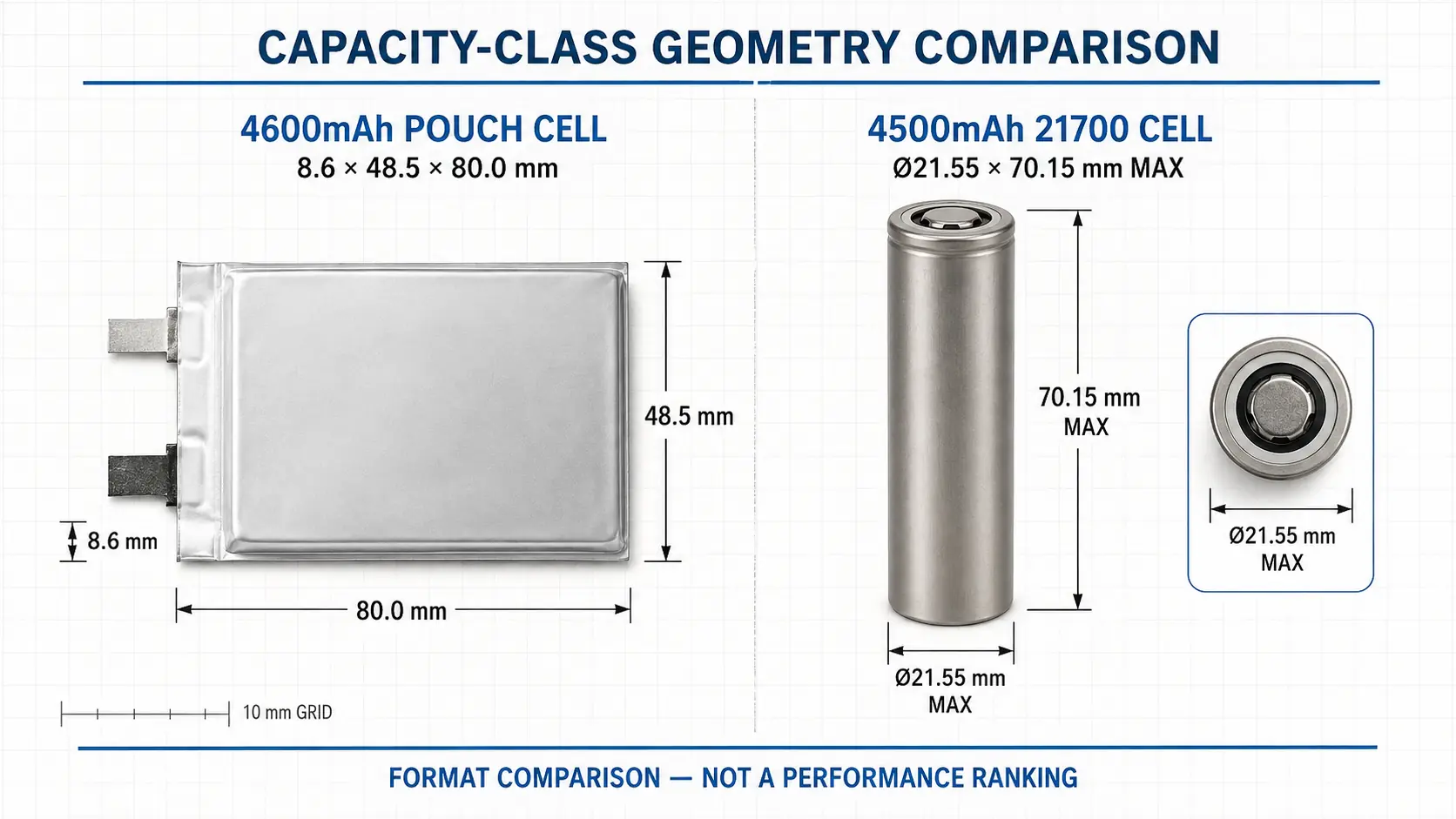
The Panasonic UPF488270Z pouch cell and Molicel INR-21700-P45B cylindrical cell are useful teaching examples because their headline capacities are close, yet their physical and electrical architectures are different. This is not a claim that either cell is a substitute for the other. It is a controlled comparison of what public manufacturer data can and cannot tell an OEM team.
| Published item | Panasonic UPF488270Z | Molicel P45B | OEM meaning |
|---|---|---|---|
| Package | Flexible laminate pouch | 21700 steel can | The formats create different enclosure, support and interconnection requirements. |
| Nominal voltage | 3.85 V | 3.6 V | Same capacity class does not mean the same voltage profile or charger assumptions. |
| Typical / minimum capacity | 4600 / 4470 mAh | 4500 / 4300 mAh | Headline mAh is close, but production planning should use exact test conditions and minimum values. |
| Derived nominal energy | About 17.7 Wh | 16.2 Wh | Energy differs because nominal voltage differs. This is a screening calculation, not delivered device energy. |
| Cell dimensions | 4.8 × 81.3 × 69.5 mm | 21.55 mm dia. × 70.15 mm max. | The pouch is thin and broad; the cylinder is narrow and deep. |
| Maximum weight | 62.4 g | 70 g | Bare-cell weight is not final pack weight; support, interconnects, BMS and enclosure allowance can reverse the final result. |
| Published current information | The public model page used here does not publish a discharge-current rating. | 45 A continuous discharge with an 80 °C cut-off condition in the P45B datasheet. | Do not infer current from format. Compare exact, condition-bound manufacturer data and the complete pack path. |
The two cells use different manufacturers, voltage systems and published test conditions. The 3.85 V versus 3.6 V difference is an exact-cell and voltage-system difference, not a universal pouch-versus-cylindrical rule. Use this table for architecture reasoning, not as a performance ranking or drop-in replacement recommendation.
3. The Product Cavity Decides the First Format Screen
The first practical difference is not chemistry. It is the direction in which the product can allocate volume.
| Illustrative cavity | Pouch result | 21700 result | Decision |
|---|---|---|---|
| Flat device cavity: 84 × 72 × 8 mm | Bare pouch can be screened, but complete-pack thickness is still unproven. | 21700 diameter does not fit. | Pouch direction is mechanically plausible. |
| Handle cavity: 30 × 75 × 25 mm | Pouch width does not fit. | One 21700 can be screened with holder, insulation and terminal clearance. | Cylindrical direction is mechanically plausible. |
| Irregular cavity with custom keep-outs | Custom pouch footprint may use otherwise unusable area. | Cylinder arrays may create corner voids but can route around structural features. | Build both complete-pack CAD concepts before freezing the enclosure. |
A flat wearable, GPS tracker or handheld terminal may need a thin pouch because Z-height is the controlling dimension. A power tool handle, scanner grip or tubular assembly may naturally favor cylindrical cells because depth is available and width is constrained. Format screening should begin with the real product envelope, not a general claim that one format is better.
A bare-cell fit is not a battery-pack fit. The winning format must still close the product after all real pack layers, tolerance and life-related dimensional change are included.
4. Pack Envelope Beats Bare-Cell Dimensions
A pouch cell often appears to win a thin-device comparison because the laminate envelope is efficient. That advantage can disappear when the pack requires a separate PCM, folded tabs, terrace and seal keep-outs, cable strain relief, label, foam, edge protection and an approved allowance for thickness change.
A cylindrical cell appears mechanically self-contained, but the complete pack still needs a holder or controlled support, top and side insulation, welded interconnects, fuse strategy, BMS, connector and wire, spacing and a vent-aware enclosure. A multi-cell cylindrical pack may add many welds and branch-current paths even when the individual cells are easy to source.
| Pack-level question | LiPo pouch direction | Cylindrical Li-ion direction |
|---|---|---|
| Primary packaging advantage | Broad, thin footprint with low Z-height. | Rigid standardized can and predictable diameter. |
| Common hidden overhead | PCM, tab bend, seal or terrace keep-out, support and thickness-change allowance. | Holder, welds, busbar or nickel, top insulator, spacing and vent route. |
| Mechanical control | Flat support, edge protection and controlled compression without damaging the pouch. | Retention against vibration and impact without blocking intended vent behavior. |
| Production risk | Supplier-specific footprint, tab orientation and thickness inspection. | Weld consistency, holder tolerance, insulation and cell-model substitution. |

For the connector, wire and NTC decisions that often determine the final pack envelope, use the Connector, Wire Gauge and NTC Selection Guide.
5. Voltage, Charging and Runtime Are Exact-Cell Decisions
The official example already shows why a same-mAh comparison is incomplete: the pouch is specified at 3.85 V nominal while the cylindrical cell is specified at 3.6 V nominal. The derived nominal energies are therefore about 17.7 Wh and 16.2 Wh even though the capacities are nearly equal.
Nominal voltage is not the charger setting. Before replacing one format with the other, the team must confirm the exact maximum charge voltage, CC-CV profile, charge current, termination current, recharge threshold, temperature window, precharge behavior and fuel-gauge model from the exact manufacturer documentation.
A product designed around one 1S battery is not automatically compatible with another 1S battery. A different voltage curve can change full-charge voltage, usable runtime, displayed state of charge, converter efficiency, protection thresholds and the point at which the device shuts down. When usable Wh and load profile matter more than nominal mAh, use the Battery Runtime Calculation Guide.
6. Cell Current Is Not Pack Current
The P45B datasheet publishes high discharge-current capability under defined conditions. That does not make every 21700 pack a 45 A pack. Finished-pack current is limited by the weakest element in the path: cell, weld, tab or busbar, BMS MOSFETs, fuse, connector, wire, PCB copper, thermal path and device contact.
The pouch public page used in this comparison does not publish a discharge-current rating. That absence does not prove that pouch cells are low-power; it only means the public data used here cannot support a current claim. High-power pouch cells exist, just as low-power cylindrical cells exist. The exact model decides.
The resistance values below are illustrative complete-path values. They do not represent either the Panasonic pouch cell or the Molicel P45B, and they should not be interpreted as a pouch-versus-cylindrical ranking.
| Format-neutral illustrative path | Voltage drop | I²R heat | Engineering meaning |
|---|---|---|---|
| 15 A through 18 mΩ | 0.27 V | 4.05 W | Can reduce device margin and concentrate heat in tabs, FETs, welds or connector. |
| 15 A through 10 mΩ | 0.15 V | 2.25 W | Lower loss, but still requires temperature and low-SOC validation. |
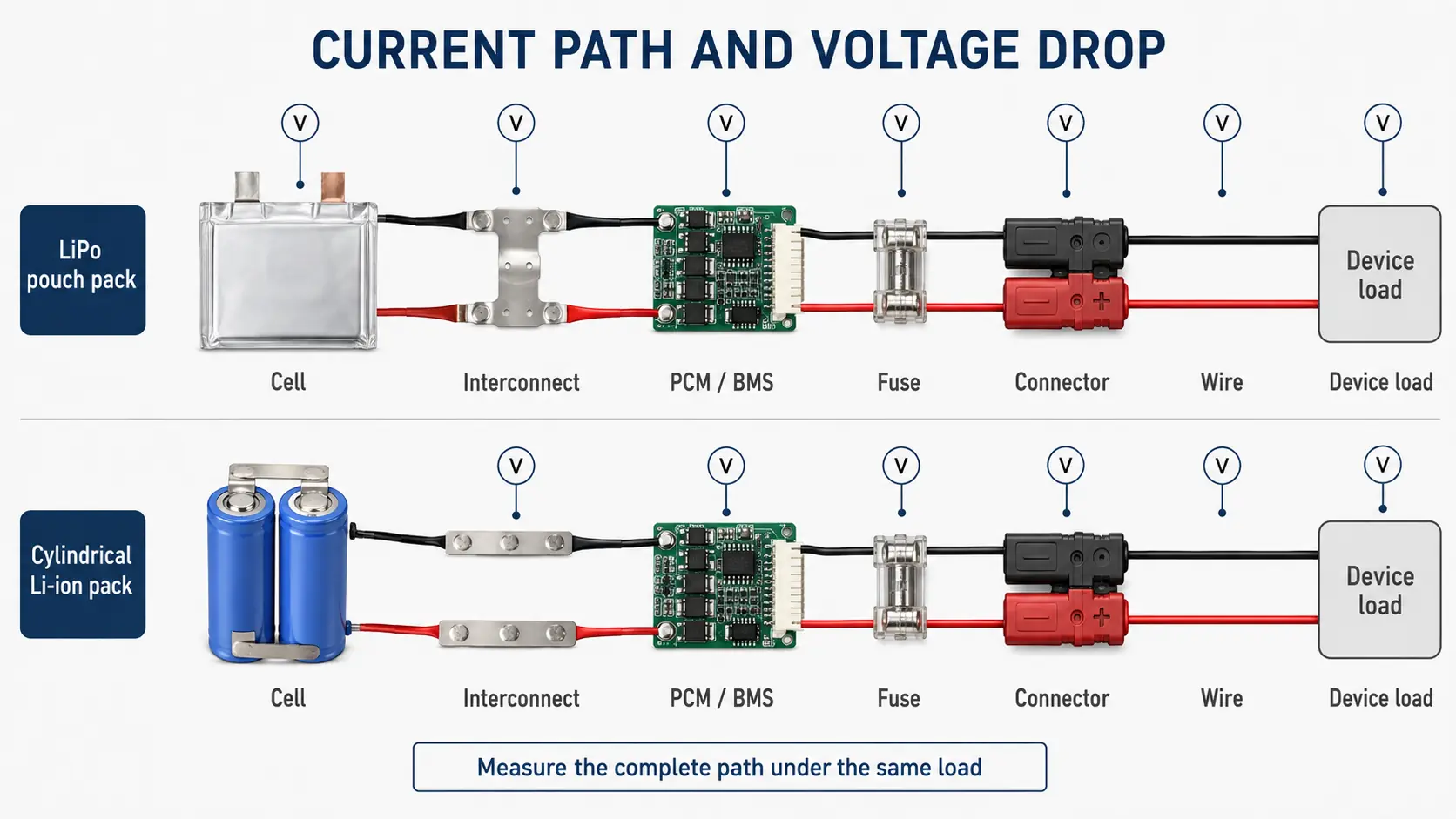
Do not copy a cell datasheet current into a finished-pack quotation. Approve loaded voltage, temperature and protection behavior in the complete production-intent path.
7. Mechanical, Thermal and Safety Boundaries
The formats manage mechanical and thermal stress differently. A pouch has a flexible laminate envelope and broad faces that can couple to a flat heat spreader, but it needs edge protection, stable support and room for approved thickness change. A cylindrical cell has a rigid can and a defined vent structure, but the pack must retain the cell, insulate the can and provide a credible path for heat and vent products.
Cell-to-pack integration literature likewise treats mechanical restraint, electrical interconnects and thermal paths as coupled design variables. The package format changes how those variables are managed; it does not remove the need to validate them together.
Neither format is automatically safer. Safety depends on cell design and quality, state of charge, charger, protection, mechanical loading, temperature, current path, enclosure response and manufacturing control. IEC 62133-2 addresses safety tests within its portable-lithium scope, but it does not prove that a specific finished device will meet its runtime, surface-temperature, drop, venting or propagation requirement.
| Engineering boundary | LiPo pouch | Cylindrical Li-ion |
|---|---|---|
| Normal dimensional change | Pouch thickness can change with state, age and condition; project limits and support must be defined. | Rigid can geometry is more stable, but holders and welds still move under vibration and impact. |
| Heat transfer | Broad face can support conduction if contact pressure and insulation are controlled. | Cell-to-cell spacing, holder contact and weld or busbar hotspots shape the thermal path. |
| Abnormal pressure release | Laminate seal and pouch construction respond differently from hard-case vents. | Dedicated vent features require an enclosure that does not obstruct the intended release path. |
| Mechanical damage risk | Puncture, edge load, fold and uncontrolled compression require attention. | Can denting, insulation damage, weld stress and blocked vent path require attention. |
Use the Battery Pack Thermal Management Guide when format choice changes the heat path, enclosure contact, repeated-duty temperature rise or vent/thickness allowance.
Do not use pouch swelling, cylindrical venting or a metal can as a universal safety ranking. Validate the exact cell and complete product under intended use, foreseeable misuse and applicable compliance scope.
8. Manufacturing and Supply Can Reverse the Preference
A pouch architecture may reduce cell count and interconnect count, but a custom footprint can become tied to one supplier, tab layout or tooling path. Thickness, seal condition, tab position, insulation and handling become critical-to-quality characteristics.
A cylindrical architecture benefits from standardized diameters and mature welding equipment, but 21700 is only a size class. An alternate cell with similar capacity can change impedance, charge profile, temperature rise, life evidence and authorized supply route. Every substitution still requires controlled review.
The lowest cell quotation is therefore not the lowest battery cost. Compare total tooling, holder and bus structure, process yield, inspection time, rework, pilot variation, documentation, logistics and revalidation exposure. For scale-up planning, connect the selected architecture to the THOR Power Production Process before treating the design as ready for repeat production.
9. Three Engineering Cases
Project situation: A slim handheld device selected a pouch cell from its body dimensions.
Hidden risk: The CAD model omitted the PCM, folded tabs, seal keep-out, label, support foam, cable exit and thickness-change allowance.
Engineering response: The battery envelope was rebuilt as a controlled stack-up drawing. A closure mock-up showed that the tab fold, PCM and cable-exit region exceeded the available Z-height, so the enclosure ribs and cable route were changed before tooling.
Buyer lesson: A pouch wins only when the complete production battery fits, not when the bare cell fits.
Project situation: A team planned to replace a cylindrical cell with a similar-capacity pouch while keeping the 1S charger and fuel-gauge settings.
Hidden risk: The voltage profile and approved charge conditions were different even though both products were called 1S lithium batteries.
Engineering response: A synchronized full charge/discharge trace compared charger BAT-pin voltage, true cell voltage, battery current, device cutoff and displayed SOC. The charger, protection thresholds and fuel-gauge model were then requalified as one system.
Buyer lesson: Series count and mAh do not prove electrical compatibility.
Project situation: A high-power cylindrical cell was selected for a motorized product from its cell datasheet.
Hidden risk: The BMS, connector and wire path had not been approved at the same current and duty cycle.
Engineering response: Voltage was measured on both sides of the mated connector while connector temperature was recorded through the real duty cycle. The synchronized drop-and-temperature trace confirmed the interface as the limiting point, and the current path was redesigned.
Buyer lesson: Cell power does not bypass a weak pack interface.
10. Five Tests That Close the LiPo vs Li-ion Comparison
| Validation area | Method | Approval evidence |
|---|---|---|
| Complete-pack fit | Build the real pack stack-up with protection, conductors, insulation, routing, support, tolerance and thickness or vent allowance. | Closed-product inspection and dimensional evidence. |
| Usable-energy and pulse test | Apply the real device waveform at full and low SOC, relevant temperatures and final cutoff. | Delivered Wh, minimum loaded voltage and reset/protection margin. |
| Charging and gauge validation | Use the production charger, NTC, power path and firmware from controlled starting SOC through termination. | Correct current, voltage, temperature permissions, termination and SOC display. |
| Thermal and mechanical test | Test repeated duty, final enclosure, drop, vibration, compression conditions and current-path hotspots. | No uncontrolled damage, overheating or loss of electrical margin. |
| Pilot and change-control review | Build with normal materials, tools and operators; control exact cell, BMS, connector, wire and process changes. | Pilot variation remains inside the validated envelope. |
IEC 61960-3 provides standardized performance criteria for portable secondary lithium cells and batteries, IEC 62133-2 addresses safety within its scope, and UN 38.3 addresses transport design-type testing. None of them replaces final-device fit, runtime, charging, thermal and production validation.

11. What the Buyer Should Send and the Supplier Should Return
The buyer should send the battery cavity with keep-outs, voltage window, real load waveform, runtime target, charger and charge-while-use behavior, ambient range, drop or vibration requirement, target markets, annual volume and any existing cell or connector constraints.
The supplier should return the exact cell model and supply route, complete pack drawing, voltage and current boundaries, charger and protection assumptions, mechanical support concept, thermal path, sample plan, validation evidence, production controls and revalidation triggers for any cell, BMS, connector, wire, firmware or enclosure change.
For project-specific format selection, use THOR Power Custom Solutions to compare pouch and cylindrical directions against the real product requirement.
12. Final Format Approval Rule: Release the Complete Battery, Not the Label
| Release area | Required evidence | Approval rule |
|---|---|---|
| Exact cell | Manufacturer, model, voltage window, capacity or current evidence and authorized supply route are frozen. | No equivalent LiPo or equivalent 21700 substitution without review. |
| Mechanical fit | Production pack closes the product with support, tolerance, cable route and life-related dimensional allowance. | No cell, tab, can, seal, wire or enclosure interference. |
| Electrical behavior | Usable energy, pulse voltage, charger, protection and gauge pass in the final device. | No early cutoff, wrong termination or unstable SOC display. |
| Thermal and safety | Cells, BMS, interconnects, connector and enclosure remain inside approved limits. | Format-specific support and vent or thickness behavior are controlled. |
| Production margin | Pilot units remain inside dimensional, resistance and functional limits. | Normal process variation does not depend on hand adjustment. |
| Change control | Cell, pack material, firmware, connector, wire and enclosure changes have defined revalidation. | Shipped configuration remains tied to evidence and documents. |
How THOR Power Supports LiPo and Li-ion Battery Selection
THOR Power supports custom LiPo pouch batteries, 18650/21700 battery packs, Li-ion and LiFePO4 packs, and special battery projects. The engineering review can compare exact cells, complete pack geometry, current path, PCM/BMS, connector and wire, charger, NTC, thermal behavior, sample evidence and pilot-production control.
For thin devices, review LiPo battery models as a starting point. For cylindrical architectures, compare 18650 and 21700 models against the actual product drawing, load profile, charger and market evidence. Verified production evidence is available through the THOR Power certificates and production process.
Planning a Custom LiPo or Li-ion Battery Pack?
Share the battery cavity, voltage window, load waveform, charger, connector, temperature range and target market. THOR Power can compare pouch and cylindrical architectures, develop production-intent samples, coordinate pack-level validation and prepare the selected design for stable manufacturing.
Key Takeaways
- LiPo is usually a pouch-format lithium-ion cell, not the opposite of lithium-ion chemistry.
- Similar mAh does not mean similar voltage, energy, charging, power or product fit.
- Pouch cells use thin, broad cavities efficiently; cylindrical cells suit deeper cavities and standardized arrays.
- Neither format is automatically safer, higher-current, longer-life, cheaper or more energy-dense at complete-pack level.
- Approve current at the weakest point in the complete path, not from the cell label.
- Release the exact cell and production pack with final-device and pilot evidence, then control substitutions as engineering changes.
Conclusion
The real LiPo-vs-Li-ion difference is not a contest between two chemistry names. It is a comparison between package architectures, exact cell models and complete battery systems.
For a thin handheld device, a pouch may be the only geometry that can use the cavity. For a handle, tube or high-power multi-cell pack, a cylindrical architecture may be easier to support and manufacture. In both cases, the winning design is the one that fits after pack overhead, delivers usable energy under the real load, charges correctly, manages heat and mechanical stress, and remains repeatable in production.
FAQ: LiPo Battery vs. Li-ion Battery
Is LiPo different from Li-ion?
LiPo is usually a market term for a lithium-ion cell in a flexible laminate pouch. Li-ion is the broader family and includes pouch, cylindrical and hard-prismatic formats.
Which is safer, LiPo or Li-ion?
Neither label is automatically safer. Safety depends on the exact cell, charger, protection, current path, mechanical support, enclosure, manufacturing controls and application validation.
Does LiPo have higher energy density than cylindrical Li-ion?
Sometimes a pouch uses a thin rectangular cavity more efficiently, but complete-pack energy density depends on chemistry, voltage, tabs or welds, BMS, support, cooling and unused enclosure volume.
Why can two batteries with similar mAh have different energy?
Watt-hours depend on both capacity and voltage. A 4600 mAh cell at 3.85 V has a different nominal energy from a 4500 mAh cell at 3.6 V, before load and cutoff effects are considered.
Can a LiPo pouch replace a 21700 cell?
Only after redesign and validation. The change can affect dimensions, voltage profile, charger, protection, fuel gauge, current path, thermal behavior, mechanical support, transport evidence and firmware.
Which format is better for a thin device?
A pouch is usually the first format to screen when Z-height is limited. The complete pack must still fit after the PCM, tabs, insulation, cable routing, support and thickness-change allowance are included.
Which format is better for high-current equipment?
Use the exact high-power cell and complete pack path. Both pouch and cylindrical cells can support high current, but tabs, welds, BMS, fuse, connector, wire and cooling must be validated.
Can LiPo and cylindrical Li-ion batteries use the same charger?
Only when the exact cells have compatible approved charge voltage, current, termination, temperature and recovery requirements. Design from the exact manufacturer data, not the package name.
Do pouch cells always swell?
Pouch thickness can change with normal state, aging or abnormal gas generation. The product needs approved support, dimensional allowance and rejection criteria. Normal dimensional change and hazardous swelling are not the same condition.
Is UN 38.3 enough to approve the battery for my product?
No. UN 38.3 addresses transport design-type testing. It does not prove device runtime, charging compatibility, installed temperature, mechanical integration, firmware behavior or production repeatability.
Technical References
- Panasonic Energy. Lithium-ion Batteries — official lithium-ion product category showing cylindrical, prismatic and pouch product families.
- Panasonic Energy. UPF488270Z Pouch Cell — official public pouch-cell dimensions, voltage, capacity and weight data used for the comparison example.
- Molicel. INR-21700-P45B Product Data Sheet — official cell characteristics used for the 21700 comparison example.
- NREL. Integration Issues of Cells into Battery Packs for Plug-In and Hybrid Electric Vehicles.
- International Electrotechnical Commission. IEC 61960-3:2017 — performance, markings, dimensions and requirements for portable secondary lithium cells and batteries within its scope.
- International Electrotechnical Commission. IEC 62133-2:2017+AMD1:2021 — safety requirements and tests for portable sealed secondary lithium cells and batteries within its scope.
- UNECE. UN Manual of Tests and Criteria, Revision 8 and Amendment 1 — including lithium-cell and battery transport testing under subsection 38.3.
Evidence standard: official manufacturer data and standards are used only within their published scope. Illustrative fit, energy and current-path examples are screening tools, not universal performance rankings or substitution approvals. Final OEM selection should use the exact cell datasheet, complete pack drawing, production-intent samples, final-device validation and controlled change review.