
3.7V 300mAh LiPo Batteries — Compare Sizes for Your Device
Fit 300mAh into an ultra-compact wearable while balancing the complete protected-pack envelope, thin geometry and a BLE-and-sensor load.
Miniature sensors, wearable modules and compact assistive devices often have a battery cavity defined by the PCB and housing before capacity is finalized. Compare the listed 300mAh pouch-cell models, screen potential matches by estimated finished dimensions, and confirm the complete protection, wiring and connector envelope before selecting a prototype battery.
Bare & Estimated Finished Sizes
Custom PCM & Connector Options
Engineering Fit Review
Technical Overview
A 300mAh LiPo battery suits ultra-compact wearable and assistive devices where the battery cavity is defined by the PCB and housing before capacity. At 300mAh, geometry can matter as much as nominal capacity: the same rating can be built in very different thickness, width and length combinations. In devices such as smart glasses or a compact assistive scanner, the load is mostly ultra-low standby with short camera, scanning or BLE peaks, so the finished-pack envelope and thin geometry drive the choice. Select by the finished-pack envelope and actual load profile, not by capacity alone.
Find a 300mAh LiPo Battery for Your Available Space
Enter the maximum battery space available in your device to screen the listed 300mAh models. Results are potential matches based on estimated finished dimensions; final fit requires review of PCM, insulation, wiring, connector position, manufacturing tolerance and mechanical clearance.
7 listed 300mAh models
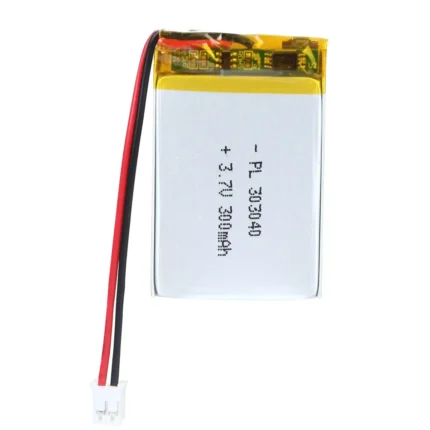

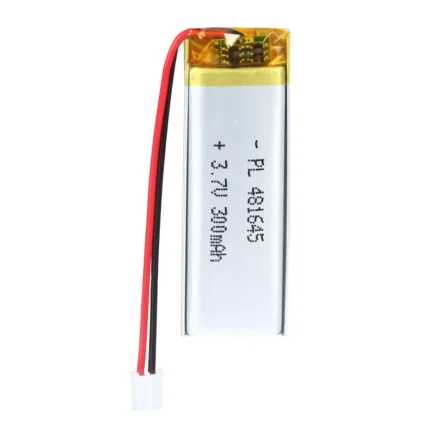
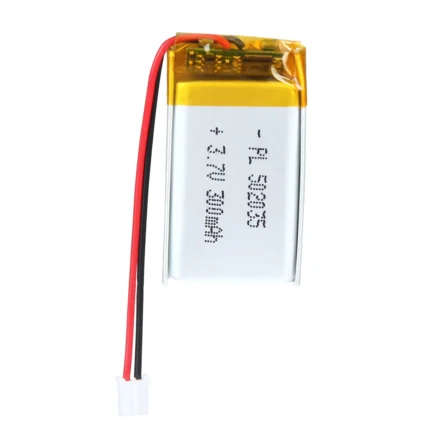
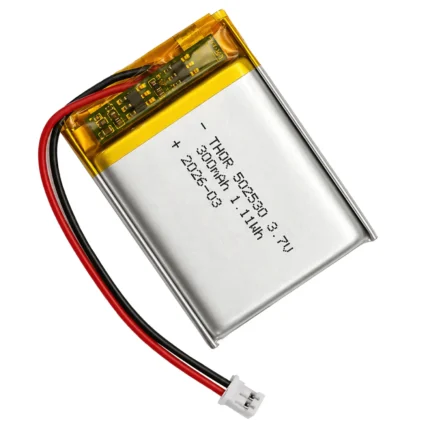


Finished dimensions depend on PCM, insulation, connector and wire-harness configuration and are confirmed on the engineering drawing for the selected model.
Fit 300mAh into an Ultra-Compact Wearable or Assistive Device
A 300mAh rating does not define one footprint. The listed THOR-303040 uses a nominal 3 × 30 × 40mm bare-cell envelope, while the listed THOR-481645 uses a narrower 4.8 × 16 × 45mm format. These examples show how the same capacity can use different areas of a miniature enclosure.
For a 300mAh design, the preferred model is the geometry that protects the device's tightest axis while leaving space for the full assembly.
Same 300mAh capacity, very different geometry. The listed models below all store 300mAh, yet each one asks for completely different space inside a device:
THOR-303040
3 × 30 × 40 mm — the thinnest listed 300mAh cell. Thin and flat; suits a temple arm or slim wearable module.
THOR-481645
4.8 × 16 × 45 mm — a narrow, elongated strip. Suits a glasses temple or thin assistive-scanner handle.
THOR-602030
6 × 20 × 30 mm — thicker with the smallest footprint. Trades thickness for a tiny module or BLE beacon.
All three store 300mAh, yet each needs different space. If thickness is the limit, start from the thin, flat models; if the device is a narrow arm or a tiny module, a different geometry can shrink the critical axis. The geometry, not the capacity, decides the fit.
If none of the listed 300mAh shapes is suitable, engineering can review a custom geometry or a nearby capacity. Compare 350mAh and 500mAh only when the enclosure and runtime target allow a larger pack.
Validate 300mAh Current Capability for Ultra-Compact Portable Loads
The 300mAh rating describes charge capacity, not maximum continuous or peak current. In an ultra-compact wearable or assistive device such as smart glasses, a BLE beacon or an assistive barcode scanner, most operating time is ultra-low standby, with short peaks from a camera, a scan or a BLE transmit event. Whether the cell sustains those peaks depends on the specific cell model, C-rate, internal resistance, PCM and temperature. Use the battery runtime and capacity guide for energy planning, then validate loaded voltage, pulse duration and low-state behavior with the actual electronics. A custom LiPo battery configuration should be reviewed when the standard assembly does not satisfy these constraints.
Bare Cell Size vs Finished Battery Size
The nominal dimensions of a 300mAh model describe the bare pouch cell. A finished battery may be larger after the protection circuit, insulation, leads and connector are positioned.
In an ultra-compact device, even a small change in PCM location or wire exit can decide whether the finished pack clears the frame or housing.
Bare Cell Size
Raw pouch-cell dimensions
(T × W × L)
→
+ PCM, Insulation, Wires, Connector
Protection circuitry, insulation wrap, lead wires, connector & wire exit
→
Estimated Finished Size
Approximate assembled dimensions for initial screening
Use the estimated finished size for early screening, then approve the device cavity against the configuration-specific finished drawing and agreed tolerances.
How to Choose a 300mAh LiPo Battery
Measure the Space
Record the maximum battery cavity: thickness × width × length.
Allow Clearance
Allow for manufacturing tolerance, insulation, assembly and long-term cell expansion.
Confirm the Load
Provide continuous and peak current requirements. Capacity alone does not define current capability.
Define the Assembly
Confirm PCM, connector, polarity, wire length, wire exit direction and labeling.
Verify With Samples
Confirm the final drawing, finished dimensions and sample fit before volume production.
Custom 300mAh LiPo Battery Configuration
THOR Power can review a 300mAh project for pouch geometry, PCM, connector and polarity, wire gauge, lead length and exit direction, labeling and packaging. Finished dimensions and electrical limits are confirmed for the selected configuration.
Need a 300mAh LiPo Battery for Your Project?
Tell us your available battery space, application, working current, peak current, connector requirement and quantity. Our engineering team will review the suitable 300mAh model and finished battery configuration.
- Bare Cell Size
- —
- Approx. Finished Size
- —
Your information is used only to review and respond to your battery project request. Privacy Policy.
300mAh LiPo Battery FAQ
What size is a 300mAh LiPo battery?
There is no single standard size for a 300mAh LiPo battery. The listed models use different thickness, width and length combinations, so compare the exact model dimensions with the device cavity.
Is bare-cell size the same as finished battery size?
No. Bare-cell dimensions exclude some or all protection, insulation, leads and connector space. The final envelope depends on the selected assembly and must be confirmed on the finished drawing.
What current can a 300mAh battery deliver?
Do not infer allowable current from the 300mAh rating alone. Confirm continuous load, peak current, pulse duration and cutoff requirements against the exact cell and PCM specification.
Can a 300mAh LiPo battery be made thinner?
A different 300mAh geometry may reduce one constrained dimension while increasing another. Custom size and capacity requests must be reviewed together for engineering and manufacturing feasibility.
Should I choose 350mAh or 500mAh instead of 300mAh?
A 350mAh cell adds a little runtime with barely more volume; a 500mAh cell adds more but needs a larger cavity. Compare finished-pack dimensions side by side, because in an ultra-compact device even 1–2mm can decide the fit.
Is a 300mAh LiPo suitable for smart glasses or AR eyewear?
It can be considered when the finished-pack envelope fits the temple or frame and the selected cell supports the ultra-low standby plus camera, display or short wireless peaks. Confirm PCM behavior, connector routing, weight, charging and temperature with the actual eyewear electronics.
What should I check for a BLE beacon or assistive scanner?
For a BLE beacon or compact assistive barcode scanner, verify that the cell and PCM handle the short transmit or scan peaks without excessive voltage sag, and confirm self-discharge over long standby, charging strategy and temperature range with the actual electronics.
Related Pages
Why compare nearby capacities: A 350mAh pack adds a little runtime with barely more volume in a wearable or sensor. A 500mAh pack adds more energy when the enclosure can accept a larger finished-pack volume and the load requirements remain compatible.