
Home / Products / 1600mAh LiPo Batteries
3.7V 1600mAh LiPo Batteries: Compare Diverse Sizes
Fit 1600mAh into long-narrow, flat-wide or short-thick enclosures.
Compare 10 verified 3.7V 1600mAh lithium polymer battery models across an unusually broad geometry range. The listed cells share the same nominal capacity while distributing volume very differently across thickness, width and length.
Technical Overview
A 1600mAh LiPo battery is available in unusually diverse pouch geometries, making shape selection central to the design decision. The same capacity may be long and narrow, thin and wide or short and thick, serving compact portable devices with very different enclosure constraints. Use the model table below to compare shapes, then confirm the finished pack dimensions, device load profile, charge current, wire route and mechanical support for the selected geometry.
Find a 1600mAh LiPo Shape for Your Enclosure
Enter the maximum battery space available in your device. We’ll identify potential matches based on estimated finished dimensions. Final fit must be confirmed after reviewing PCM, insulation, wiring, connector position and mechanical clearance.
10 listed 1600mAh models
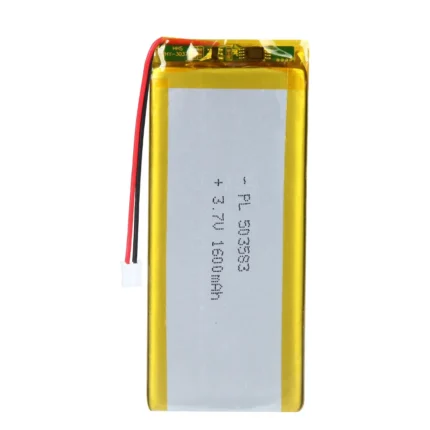

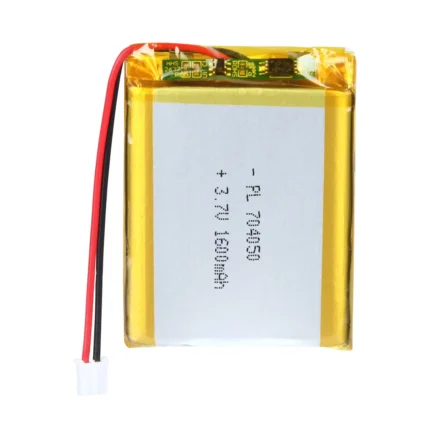

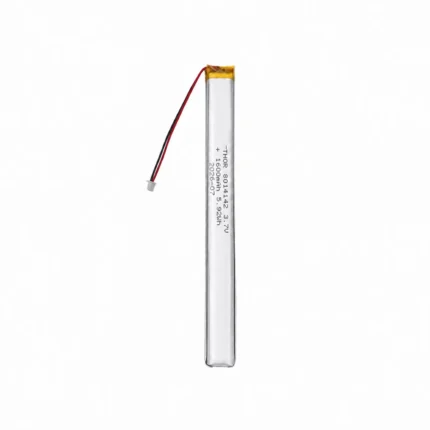

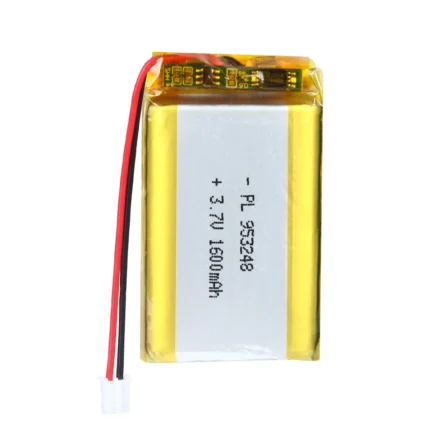
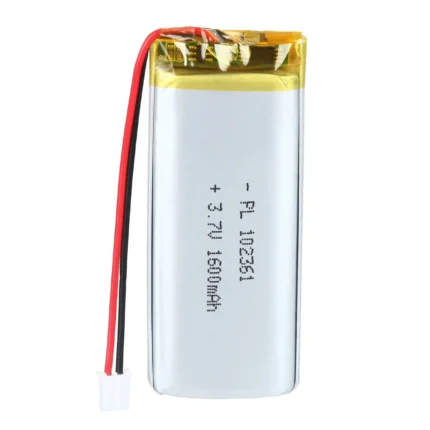
Finished dimensions depend on PCM, insulation, connector and wire-harness configuration and are confirmed on the engineering drawing for the selected model.
Use Geometry to Fit the Same 1600mAh Capacity
The 1600mAh class is useful when the product enclosure has enough total volume but restricts one or two axes. The 10 listed models range from 14 to 50mm in width and from 42 to 142mm in length. That diversity lets engineers compare long-narrow, flat-wide and short-thick approaches before committing to a battery cavity.
The engineering question is not only whether 1600mAh provides enough energy. It is which 1600mAh geometry leaves adequate room for protection electronics, wiring, connector access and mechanical clearance.
Long and narrow
THOR-8014142 uses an 8 x 14 x 142mm bare-cell format for products with a long channel and very limited width.
Thin and wide
THOR-405073 uses a 4 x 50 x 73mm format where a broad footprint is acceptable but thickness must stay low.
Short and thicker
THOR-903742 uses a 9 x 37 x 42mm format where length is constrained and additional thickness is available.
Long, narrow cells need appropriate support and wire routing. Flat, wide cells need controlled surface clearance. Every geometry must be evaluated as a finished assembly inside the host device.
Load Profile Matters as Much as 1600mAh Capacity
A 1600mAh rating describes stored capacity, but it does not define how much continuous or peak current a battery can safely deliver. Real devices may combine standby load, wireless transmission, displays, sensors, motors, LEDs or short startup pulses.
The selected cell, internal resistance, discharge capability, PCM limits, wire gauge, connector and thermal conditions all affect the finished pack under load.
For this reason, continuous current, startup or pulse current, pulse duration and repetition frequency should be reviewed together with capacity and enclosure fit. Use the battery runtime and capacity guide for energy planning, or start a custom LiPo battery configuration for a project-specific review.
Bare Cell Size vs Finished Battery Size
The model dimensions identify the pouch cell itself. A production battery pack also includes the selected protection circuit, tab arrangement, insulation, wires and connector, which can enlarge the required envelope in specific areas. Understanding how these components affect the final envelope is essential — see the finished battery pack dimensions↗ guide for a detailed comparison.
Bare Cell Size
Verified pouch thickness, width and length used for model comparison.
PCM, Insulation, Wires, Connector
Assembly components add local dimensions and routing constraints.
Estimated Finished Size
The complete envelope to compare with the usable device cavity.
A model that fits by bare-cell dimensions can still fail during assembly if the connector has no insertion space, the wire bend is too tight or the PCM overlaps a restricted feature. Validate the finished configuration with drawings and prototypes.
How to Choose a 1600mAh LiPo Battery
Use the enclosure geometry and load profile together to narrow the 10 listed options.
Map the Cavity
Measure all three axes and identify ribs, bosses, openings and restricted zones.
Select the Shape
Compare long-narrow, flat-wide and compact formats against the usable volume.
Check the Load
Define average current, peak current, pulse duration and expected duty cycle.
Plan the Assembly
Confirm PCM location, connector access, polarity, wire gauge and routing.
Prototype in Device
Test fit, charging, runtime and temperature in the final mechanical environment.
The filter returns potential matches based on estimated finished dimensions. Final selection requires engineering confirmation of the exact assembly.
Compare 1600mAh With 1500mAh and 1800mAh
At the same nominal voltage, 1600mAh provides about 6.7% more nominal capacity than 1500mAh and about 11.1% less than 1800mAh. These percentages do not translate directly into guaranteed runtime because device efficiency, cutoff voltage, temperature, cell impedance and aging also affect usable energy.
If the 1600mAh geometry conflicts with the enclosure, an adjacent capacity model may provide a more practical mechanical solution. Compare the finished assembly rather than selecting capacity first and forcing the enclosure around it.
Custom 1600mAh LiPo Battery Configuration
THOR Power can configure connector type, polarity, wire gauge, wire length, wire exit direction, PCM parameters, insulation, labels and packaging according to project requirements, subject to engineering confirmation.
For long-narrow cells, share support points and wire exit constraints. For flat-wide cells, provide surface-clearance limits and nearby heat sources. A cavity drawing and load profile help our engineers review both fit and electrical suitability.
Get an Engineering Quote
Send the usable cavity dimensions, load profile and connector requirement. We will compare the listed 1600mAh geometries and recommend candidates for prototype evaluation.
Need a 1600mAh LiPo Battery for Your Project?
Tell us your available battery space, application, working current, peak current, connector requirement and quantity. Our engineering team will review the suitable 1600mAh model and finished battery configuration.
- Bare Cell Size
- —
- Approx. Finished Size
- —
Your information is used only to review and respond to your battery project request. Privacy Policy.
1600mAh LiPo Battery FAQ
What size range is available for 1600mAh LiPo batteries?
1600mAh LiPo cells are available in very different thickness, width and length combinations, so there is no single standard 1600mAh size. On this page, the listed models are intended to help compare long and narrow, thin and wide, and shorter but thicker geometries. The best choice depends on the actual device cavity and the finished-pack clearance required after PCM, insulation, connector and wire routing are considered.
Why can 1600mAh LiPo batteries have very different shapes?
Capacity describes how much charge the cell stores, not the shape of the pouch. A 1600mAh cell can distribute its internal active material across different thickness, width and length combinations. This allows the same nominal capacity to fit products with very different enclosure constraints. Cell geometry should therefore be selected together with mechanical space, load requirements and finished-pack assembly rather than by capacity alone.
Are the listed dimensions bare-cell or finished-pack dimensions?
The model dimensions identify the pouch cell itself unless a finished pack dimension is explicitly stated. A complete battery pack may also include PCM/BMS, insulation, tabs, wires, NTC and a connector, all of which can change the final envelope. Enclosure design should therefore be based on the expected finished battery configuration↗ rather than the bare-cell drawing alone.
How does 1600mAh compare with 1500mAh and 1800mAh LiPo batteries?
1600mAh sits between nearby 1500mAh and 1800mAh options, but the most important difference may be geometry rather than nominal capacity alone. A 1500mAh model can sometimes fit a restricted cavity better, while an 1800mAh model may provide additional runtime if the enclosure allows the required thickness, width or length. Compare capacity, finished dimensions and device fit together before selecting the final model.
How much continuous or peak current can a 1600mAh LiPo battery deliver?
1600mAh capacity alone does not determine the allowable current. The result depends on the specific cell design, discharge rating, internal resistance, voltage sag, PCM protection limits, wire gauge, connector, temperature and the duration of any startup or pulse load. Continuous current and peak or pulse current should therefore be checked against the selected model and the complete finished battery pack. See the LiPo C-rate and discharge current guide↗ for detailed engineering context.
What charging current should I use for a 1600mAh LiPo battery?
The charging current should be based on the selected cell's specification rather than calculated from 1600mAh capacity alone. Different cell designs may have different recommended and maximum charge rates, and the final setting must also match the charger, protection circuit and thermal conditions. Confirm the charge voltage and current from the actual model specification before releasing the device charging design.
Can the connector, wire length, PCM or NTC be customized on a 1600mAh battery pack?
Yes. The finished 1600mAh pack can be configured around the device interface, including connector family, wire length, polarity, PCM/protection requirements and NTC temperature sensing where needed. These additions can affect the finished battery dimensions and should be confirmed before enclosure and harness details are frozen. Review connector, wire and protection requirements↗ for available options, then validate with a sample in the actual device before mass production.
Related Pages
Why compare nearby capacities: A 1500mAh pack may simplify mechanical integration when one axis is tight. An 1800mAh or 2000mAh pack can add runtime when the device enclosure has enough finished-pack volume and thermal margin.