LiPo Battery vs. Li-ion Battery: Understanding the Real Differences

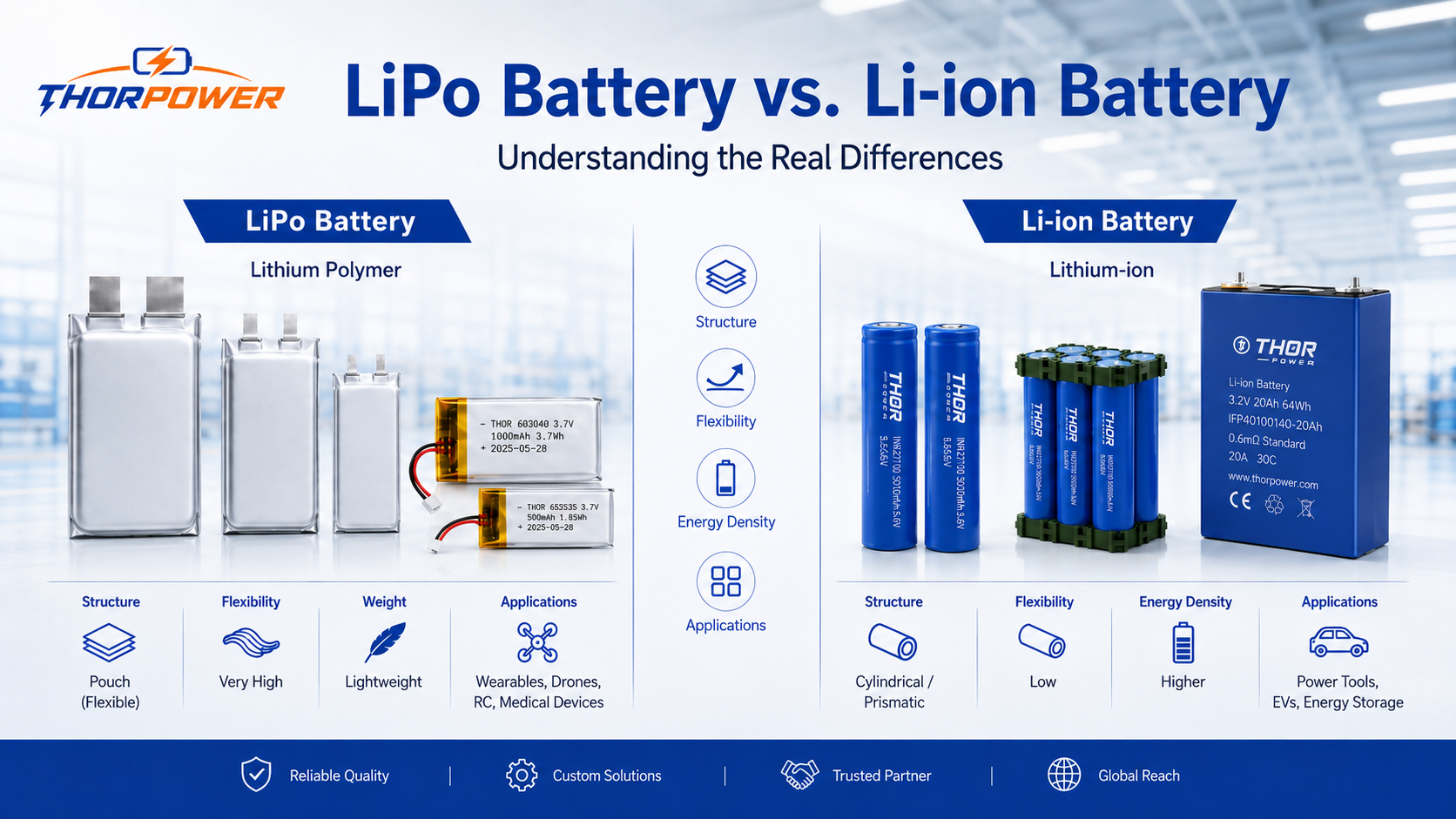
LiPo battery vs Li-ion battery is a common question for product developers, engineers, and purchasing teams when choosing a power solution for compact electronic devices. Although both belong to the lithium battery family, their structure, shape flexibility, safety design, energy density, and suitable applications can be different.
- Lithium Polymer Battery (LiPo)
- Lithium-ion Battery (Li-ion)
Although both belong to the rechargeable lithium battery family, they differ significantly in structure, performance characteristics, safety behavior, application scenarios, and manufacturing flexibility.
This article provides a professional comparison between LiPo and Li-ion batteries from the perspectives of engineering performance, product design, energy efficiency, customization capability, and commercial applications.
Clearing Up a Common Misconception
“LiPo” and “Li-ion” are not two opposite chemistries. Both are lithium-ion batteries. In everyday industry use, “Li-ion” usually refers to hard-case cells (cylindrical such as 18650 / 21700 packs, or prismatic) with a liquid electrolyte, while “LiPo” refers to a soft pouch cell using a polymer or gel electrolyte. Under UN transport rules, a lithium-polymer cell that uses lithium-ion chemistry is regulated as a lithium-ion cell. What actually determines performance is the cell model, cathode material (NMC, LCO, LFP), format and BMS — not the broad “LiPo vs Li-ion” label alone.
1. The Fundamental Difference: Electrolyte Structure
The most important distinction between LiPo and Li-ion batteries is not voltage or capacity, but the electrolyte structure.
Li-ion Battery Structure
Traditional Li-ion batteries generally use:
- Liquid electrolyte
- Rigid metal casing
Common formats include:
- 18650 cylindrical cells
- Cylindrical battery packs
- Prismatic battery cells
These batteries are known for their structural stability and high energy density.
LiPo Battery Structure
LiPo batteries typically use:
- Polymer or gel-like electrolyte
- Flexible aluminum pouch construction
This design enables:
- Ultra-thin battery profiles
- Lightweight construction
- Customized battery shapes and dimensions
As a result, LiPo batteries are widely used in compact and portable electronic devices where space optimization is critical.
2. Design Flexibility: LiPo Batteries Have a Major Advantage
One of the greatest strengths of LiPo technology is manufacturing flexibility.
LiPo batteries can be produced in:
- Ultra-thin configurations
- Curved or irregular shapes
- Lightweight pouch-cell formats
- Small customized dimensions
This makes LiPo batteries highly suitable for:
- Smart wearable devices
- GPS trackers
- Bluetooth speakers
- Consumer drones
- RC products
- Portable electronic equipment
Li-ion Batteries Favor Standardization
Compared with LiPo batteries, Li-ion batteries are better suited for:
- Standardized production
- Large-capacity applications
- Industrial-scale energy systems
Typical applications include:
- Laptop computers
- Power tools
- Electric bicycles
- Energy storage systems
- Electric vehicles
Their standardized form factors simplify large-scale manufacturing and battery pack integration.
3. Energy Density: Li-ion Batteries Typically Perform Better
Short answer: For the same size and weight, cylindrical Li-ion cells usually store more energy than pouch LiPo cells, so Li-ion generally offers higher energy density. LiPo trades some of that density for a thinner, lighter, shape-flexible pouch format. Exact figures depend on the specific cell model and cathode material rather than the LiPo-versus-Li-ion label.
Li-ion batteries generally offer:
- Higher energy density
- Longer operating time per unit volume
- Better long-term storage efficiency
This is one of the primary reasons why cylindrical Li-ion cells dominate:
- Electric vehicles
- Large battery packs
- Industrial power systems
LiPo Batteries Prioritize Form Factor Over Maximum Density
LiPo batteries often sacrifice some energy density in exchange for:
- Lower overall weight
- Better shape flexibility
- Easier integration into compact products
For many portable electronics and airborne applications, this tradeoff is highly beneficial.
4. High-Discharge Performance: LiPo Batteries Usually Lead
LiPo batteries are widely used in:
- FPV drones
- RC vehicles
- Racing drones
- High-performance hobby electronics
Because they can support:
- Rapid discharge capability
- High burst current output
- Fast throttle response
High C-rating LiPo batteries are especially important in performance-driven applications where instant power delivery is critical.
Li-ion Batteries Are Better for Stable Continuous Output
Li-ion batteries are often preferred for applications requiring:
- Long endurance
- Stable discharge behavior
- Higher energy efficiency
Especially in devices designed for:
- Long operating cycles
- Moderate discharge rates
- Continuous daily use
5. Weight Plays a Critical Role in Portable Applications
LiPo battery packs are generally lighter than equivalent Li-ion battery solutions.
This advantage is extremely important for:
- Drones
- Wearable electronics
- Portable filming equipment
- RC aircraft
In airborne devices, every gram directly affects:
- Flight duration
- Motor load
- Energy efficiency
- Handling performance
As a result, lightweight LiPo batteries remain the preferred option for many aerial applications.
6. Safety Considerations: Both Require Proper Protection
Neither LiPo nor Li-ion batteries should be considered inherently safe without proper protection systems.
Both technologies must be designed and tested to recognized safety standards such as IEC 62133-2 for portable lithium cells. Both technologies require:
- Battery protection circuits
- Reliable charging systems
- Thermal management
- Proper usage conditions
LiPo Battery Safety Characteristics
LiPo batteries are generally more sensitive to:
- Overcharging
- Physical damage
- Swelling
- Puncture
- Excessive heat
Improper handling may increase the risk of battery failure.
Li-ion Battery Safety Characteristics
Li-ion cylindrical cells typically provide:
- Stronger physical protection
- More durable external structure
- Better resistance to mechanical stress
This makes them more suitable for heavy-duty industrial applications. Regardless of format, cells and packs must also pass UN 38.3 transport testing before international shipping — a transport-safety requirement, not a full product-safety certification.
7. Manufacturing Flexibility: LiPo Batteries Are Easier to Customize
For OEM and custom electronic projects, LiPo batteries provide a major advantage in customization.
Manufacturers can customize:
- Battery capacity
- Thickness
- Width and length
- Cable length
- Connector type
- PCM/BMS configuration
This is why many OEM electronic devices use custom LiPo battery packs rather than standardized cylindrical cells.
| Parameter | LiPo (pouch) | Li-ion (cylindrical) |
|---|---|---|
| Nominal voltage | 3.7 V (typical) | 3.6–3.7 V (typical) |
| Full-charge voltage | Usually 4.2 V per cell | Usually 4.2 V per cell |
| Cell casing | Soft aluminum-laminate pouch | Rigid metal can |
| Electrolyte | Polymer / gel | Liquid |
| Energy density | Lower (form-factor optimized) | Higher |
| Peak / burst discharge | High (high-C-rate versions available) | Moderate to high, model dependent |
| Typical cycle life | Often several hundred cycles, cell dependent | Often several hundred to 1,000+ cycles, cell dependent |
| Shape flexibility | High — thin / custom shapes | Low — fixed standard sizes |
| Weight | Lighter for equivalent capacity | Heavier |
| Best-fit use | Wearables, drones, RC, slim devices | Laptops, power tools, e-bikes, storage |
8. Which Battery Type Is Better?
Short answer: Neither is universally better. Choose a LiPo pouch cell when light weight, a thin or custom shape, or high burst discharge matter most — typical for wearables, drones and RC. Choose a cylindrical Li-ion cell when maximum runtime, energy density, standardized formats or lower cost per watt-hour matter most — typical for laptops, power tools and energy storage. The best pick follows the application, not the label.
Neither battery technology is universally superior. The more important question is: which battery technology is better suited for the specific application?
Choose LiPo Batteries If You Need:
- Lightweight construction
- Thin battery profiles
- High discharge performance
- Compact electronic designs
- Customized battery dimensions
- Drone or RC applications
Choose Li-ion Batteries If You Need:
- Maximum energy density
- Longer operating duration
- Standardized battery formats
- Large-capacity systems
- Lower cost per watt-hour
Still Weighing LiPo vs Li-ion for Your Project?
Skip the guesswork. Tell us your device, target runtime, discharge rate and available space, and our engineers will match the right cell chemistry and pack design – with samples and full OEM/ODM support.
Talk to a Battery Engineer9. The Future of Lithium Battery Technology
The lithium battery industry continues evolving toward:
- Higher energy density
- Faster charging technology
- Smarter battery management systems
- Improved safety chemistry
- Application-specific energy solutions
LiPo batteries will continue expanding in consumer electronics, drones, smart wearable devices and portable electronics. Meanwhile, Li-ion batteries will remain dominant in electric vehicles, industrial energy systems and large-scale energy storage.
Both technologies are expected to coexist for many years because they solve different engineering requirements.
Final Thoughts
LiPo and Li-ion batteries are not direct competitors in every application. Instead, they address different design priorities and engineering challenges.
LiPo batteries emphasize lightweight construction, design flexibility, high-discharge performance and compact integration. Li-ion batteries emphasize high energy density, long endurance, structural durability and scalable standardization.
Understanding these differences enables engineers, buyers, and product developers to select the most suitable power solution based on actual application requirements rather than simply choosing the battery with the largest capacity.
Frequently Asked Questions
Is a LiPo battery safer than a Li-ion battery?
Neither chemistry is automatically safer. LiPo and Li-ion cells use similar lithium chemistry and store similar energy, so both require proper protection. A LiPo pouch cell has a soft aluminum-laminate case that can swell and release pressure, while a cylindrical Li-ion cell has a rigid metal can with a vent. In real products, safety depends far more on cell quality, correct charging, PCM or BMS protection, enclosure design and mass-production consistency than on the pouch-versus-cylindrical format itself.
Which is better for drones and RC models, LiPo or Li-ion?
For drones, racing RC models and other high-drain applications, LiPo batteries are usually the better choice because they deliver high discharge current and high burst power in a light, flat pouch form. Li-ion cells are generally better for applications that prioritize maximum runtime and energy density over peak current, such as long-endurance devices and power banks. The right choice depends on the load profile, weight limit and available space rather than a single winner.
Does a LiPo battery have higher energy density than a Li-ion battery?
Not usually. Cylindrical Li-ion cells typically reach higher energy density and pack more capacity into the same weight, which is why they are common in laptops, power tools and long-runtime devices. LiPo pouch cells trade a small amount of energy density for design flexibility, light weight and high discharge performance. For a given size and weight, a well-matched Li-ion cell often stores more total energy.
Can I replace a Li-ion battery with a LiPo battery in my product?
Only after proper engineering review. Even at the same nominal voltage, the two formats differ in discharge behavior, swelling characteristics, mechanical fit and protection requirements. Swapping chemistry without matching the charging profile, BMS settings, mechanical space and safety design can cause swelling, reduced cycle life or safety risks. Thor Power evaluates the device space, load profile, charging method and safety needs before recommending a suitable cell.
How do I choose between a LiPo and a Li-ion battery for a custom project?
Start from the application rather than the mAh number. Define the available space, discharge current, peak power, weight limit, charging method, operating temperature and cycle-life target. Choose LiPo when light weight, thin form factor or high discharge current matter most, and choose Li-ion when maximum runtime and energy density are the priority. Thor Power reviews these parameters and recommends the right chemistry, cell format and BMS protection with samples and mass-production support.

Dr. Maximilian Weber is THOR Power's Chief Scientist and a senior expert in lithium battery technology. His technical review focuses on battery safety, performance optimization, energy density and custom battery solution development.
Last technical review: July 2026

Victor Xiong holds a Master's degree from The Chinese University of Hong Kong, Shenzhen. He leads THOR Power's OEM Division and focuses on custom battery solutions for global device brands, product developers and industrial customers.